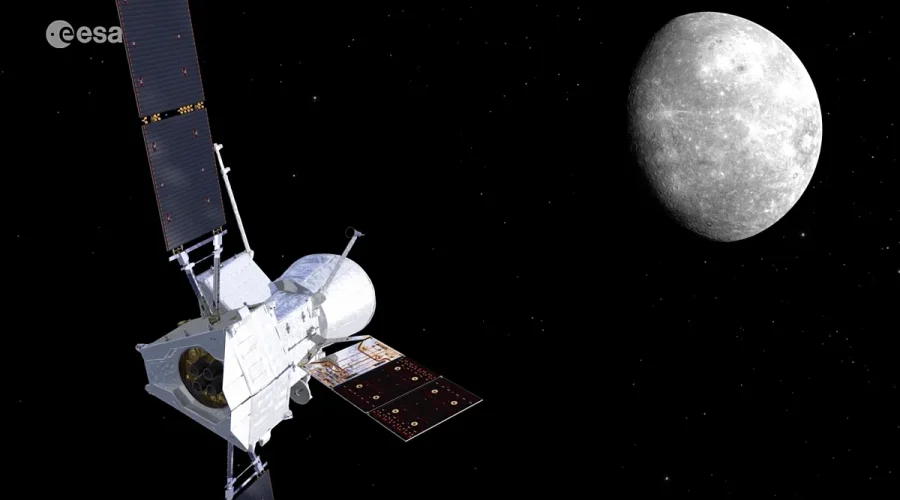
Mercury’s Orbit Within Reach: Europe’s Longest Spaceflight Enters Its Final Phase
Usagevpn.com – After nearly a decade of coasting through the inner solar system, performing nine gravitational flybys of Earth, Venus, and Mercury itself, ESA’s BepiColombo spacecraft is about to execute the single most consequential manoeuvre of its entire voyage. On 3 September at 2:00 pm CEST, the combined vehicle will shed its propulsion backbone and release two science orbiters that have been riding piggyback since launch. What follows over the subsequent weeks and months will determine whether Europe’s first dedicated Mercury mission succeeds in placing instruments into orbit around the smallest planet in our solar system — or whether years of careful planning unravel in a cascade of failures.
Why Mercury Demands Such an Extreme Approach
Mercury is not merely a small, scorched world. It is a dense sphere of metals and silicates wrapped in its own magnetic field, sitting so close to the Sun that solar gravity and radiation reach intensities roughly ten times those experienced at Earth’s distance. A spacecraft falling sunward does not decelerate; it accelerates, dragged inward by the Sun’s pull. Capturing orbit around a planet that itself races around the Sun at high velocity therefore requires matching that velocity almost precisely — a far more energy-intensive manoeuvre than reaching even the outer giants.
That physics constraint is why BepiColombo took a circuitous, eight-year path involving repeated gravitational assists rather than a direct burn. Along the way, an ion engine quietly bled off orbital energy, trading thrust for patience. The result is a spacecraft arriving at Mercury with just enough residual velocity to be captured, but only after a final sequence of chemical thruster firings scheduled for late November and early December.
The Separation Event
On the morning of 3 September, the large Mercury Transfer Module (MTM) — the mothership that carried the two probes through every flyby and every ion-engine burn — will drift away in one direction while the science payload departs in another. The MTM carries no attitude-control system and no remaining fuel. Once released, it becomes a tumbling, inert object whose trajectory will carry it past Mercury and onward into interplanetary space, where it will spend the remainder of its existence as an uncontrolled fragment.
“It’s a fully passive module, so you cannot control it, you cannot manoeuvre it,” explains Frank Budnik, ESA’s Flight Dynamics Manager.
For the two orbiters, separation marks the moment instruments and cameras that have been sealed inside the MTM’s protective structure are suddenly exposed to the full brutality of the Mercury environment. Engineers at ESA’s European Space Operations Centre in Darmstadt, Germany, describe the operational posture as comparable to “operating with a very hot pizza oven running right on your back,” in the words of Flight Director Ignacio Tanco, who likens the overall situation to “working on a knife edge.”
Two Probes, Two Scientific Mandates
The payload comprises ESA’s Mercury Planetary Orbiter (MPO), tasked with mapping the planet’s surface geology and probing its interior structure, and the Mercury Magnetospheric Orbiter (Mio), built by Japan’s space agency JAXA, which will characterise the space environment surrounding the planet. For the weeks immediately following separation, the two orbiters remain physically coupled as a single composite vehicle, flying free of the propulsion module for the first time. Only after the November–December capture burns place the combined spacecraft into a stable Mercury orbit will MPO and Mio split apart, each settling into its own distinct orbital path.
Engineering at the Edge of Tolerance
The thermal and radiative environment at Mercury spans a range from roughly −180 °C on the night side to approximately 450 °C on the dayside. Solar radiation pressure and particle flux reach levels an order of magnitude above what spacecraft encounter at Earth. Among the most delicate subsystems are the solar arrays, which must be held at a precisely calculated tilt angle. A deviation of a fraction of a degree away from the Sun risks a power shortfall; a slight over-rotation toward the star risks thermal destruction of the cells.
“There’s a lot of stuff that is going to be new on Thursday that the teams must prepare for,” Tanco noted, comparing the separation moment to launching an entirely new spacecraft — one that already orbits a different planet and communicates with an 11-minute radio delay in each direction.
Preparing for the Unexpected
Mission Manager Santa Martinez has been frank about the probability that the post-separation sequence will deviate from the nominal timeline. Seconds, minutes, hours, and days after the split will each present novel failure modes that no amount of simulation can fully anticipate.
“We know that it’s likely that not everything is going to go according to the nominal plan,” Martinez said. “But we are ready, we are flexible, and we need to be prepared for the unexpected.”
What is at stake extends well beyond a single mission. Mercury’s interior structure, its magnetic field geometry, and the composition of its exosphere remain among the least understood aspects of any terrestrial planet. Successful orbit insertion would open a multi-year window of close-range observation, yielding data on core formation, tidal evolution, and the interaction between a planetary magnetosphere and the solar wind at perihelion distances. For planetary scientists, the next few months represent the difference between a decade of unanswered questions and the first sustained, in-situ look at the innermost world.
Related Reading
Frequently Asked Questions
What is ESA s BepiColombo mission nears major?
ESA s BepiColombo mission nears major is the main topic of this guide. The article explains the context, practical details, and next steps readers should understand.
Why does ESA s BepiColombo mission nears major matter?
ESA s BepiColombo mission nears major matters because readers are looking for a useful answer, not just a short summary. Good content should match search intent and help them decide what to do next.