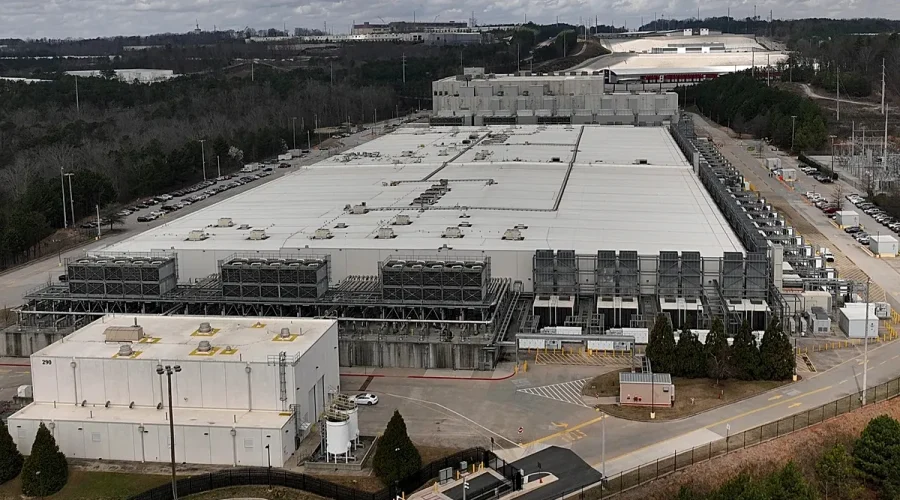
The Water Bill Behind the AI Boom: Can Silicon Valley’s Biggest Players Finally Solve It?
Usagevpn.com – Across American communities, residents are growing increasingly vocal about what they see as an unsustainable appetite for water and electricity driven by the sprawling warehouses that house the servers powering the internet and, more recently, artificial intelligence workloads. The companies pouring billions of dollars into these facilities insist the water dimension of the problem is solvable — and some are already deploying engineering approaches that promise dramatic reductions. Whether those promises translate into measurable relief for local aquifers remains the central question of a debate that has moved from technical white papers into town-hall meetings.
Scale of the Problem
The numbers underscore why the issue has escaped the confines of engineering journals. Global data centres drew 222 billion litres (59 billion gallons) of water specifically for cooling purposes in 2025, a figure compiled by consultancy Rystad Energy. Left unchecked, that draw could nearly triple, reaching approximately 644 billion litres by 2030. Rystad projects that targeted interventions could cap the growth at under 100 percent, but the gap between current trajectories and that ceiling is where the industry’s credibility will be tested.
For readers unfamiliar with the mechanics: every server rack generates substantial heat. Keeping processor temperatures within safe operating ranges traditionally meant pumping large volumes of water through external cooling loops. The more compute density a facility packs into a given square metre — and AI training clusters are pushing that density to unprecedented levels — the greater the thermal load that must be managed.
The Water-Energy Trade-Off
Any solution that slashes water consumption does not arrive for free. The physics of heat removal imposes a direct coupling between the two resources.
“There’s a pretty direct trade-off between how much water is used and how much energy is used” to control temperatures, Andy Masley, an independent researcher covering AI and data centres, said.
In practical terms, reducing the volume of circulating coolant typically demands more electricity, because the liquid still trapped inside sealed piping must be brought back down to operating temperature — often by forcing air across heat exchangers. The engineering challenge, then, is not simply to use less water but to do so without inflating the electrical bill or carbon footprint.
Nvidia’s Closed-Loop Gambit
In a report released in June, chipmaker Nvidia outlined its newest platform for designing and managing AI data centres, branded DSX. The company claims the architecture could virtually eliminate water consumption at certain facilities. The assertion is ambitious, and the industry faces mounting pressure to back it up with operational data rather than white-paper projections.
The underlying technique is closed-loop liquid cooling: coolant flows directly through the server chassis and as close to the silicon as physically possible, where chip temperatures can exceed 80 °C (176 °F). What distinguishes Nvidia’s implementation from most existing closed-loop deployments is the inlet temperature. Where the majority of systems certified by the Uptime Institute operated at roughly 32 °C in 2024, Nvidia allows the liquid to enter the servers at 45 °C. Starting with warmer fluid means the facility does not need to pump in mechanically chilled air on a year-round basis.
“Simple fans circulating the air” are often enough, though sometimes a mix of methods is needed, Josh Parker, Nvidia’s head of sustainability, said.
In regions with extreme ambient heat or during episodic heatwaves, however, supplemental chilled air or evaporative cooling may still be required. The technology thus narrows the water footprint rather than abolishing it universally.
What the Hyperscalers Are Doing
Microsoft, Amazon Web Services, and Meta have each confirmed to AFP that they operate closed-loop cooling systems and that these arrangements produce no net water loss. Yet the aggregate picture is more complicated than the per-litre efficiency metric suggests. Between 2022 and 2025, both Microsoft and AWS expanded their data-centre footprints substantially, and total water volumes rose accordingly. Their efficiency gains — 25 percent at Microsoft and 37 percent at AWS, as disclosed in the latest sustainability reports — were real but insufficient to offset the sheer scale of new construction.
The Reporting Gap and the Indirect Footprint
Comparing one operator’s water stewardship against another’s is complicated by the absence of any industry-wide standard governing how environmental, social, and governance performance is measured and disclosed. Elon Musk’s SpaceX, which became a major data-centre operator following its acquisition of his AI venture xAI, has never published an ESG report. In June, ratings agency MSCI assigned SpaceX its lowest available ESG score, a signal that the governance vacuum is not merely academic.
Economic incentives also cut against rapid water reduction. Because water is generally far cheaper than electricity in most U.S. markets, cost pressure alone does not push operators to minimise the former.
“There are incentives,” Shaolei Ren, an engineering professor at the University of California, Riverside, said, adding that these are driven more by public relations as opposition to data centres grows across the United States.
Another structural obstacle is the capital cost of retrofitting older facilities with newer, lower-water technology. Minh K. Le, who leads research on data centres and hydrogen at Rystad Energy, notes that legacy sites tend to be smaller and less compute-dense than the enormous campuses now under construction, so their absolute cooling demand is lower to begin with. The upgrade question therefore matters most for mid-life facilities that have already been scaled up.
Finally, the water drawn directly by a data centre represents only a fraction of its total hydrological footprint. Electricity generation — the dominant power source for most U.S. grids — consumes water for thermal cycles, and the manufacturing of chips and server components carries its own water intensity. In the United States, that indirect water use can run at roughly twice the volume consumed by the data centres themselves, meaning that even a perfect closed-loop solution at the facility level leaves a substantial upstream footprint untouched.
The engineering tools exist. The question now is whether regulatory pressure, community opposition, and investor scrutiny will converge quickly enough to make deploying them a commercial imperative rather than a voluntary gesture.
Related Reading
Frequently Asked Questions
What is Can tech giants curb AI data?
Can tech giants curb AI data is the main topic of this guide. The article explains the context, practical details, and next steps readers should understand.
Why does Can tech giants curb AI data matter?
Can tech giants curb AI data matters because readers are looking for a useful answer, not just a short summary. Good content should match search intent and help them decide what to do next.