Xiaomi Signs Eight German Dealers as It Prepares to Put Electric Cars on European Roads
Usagevpn.com – On 3 September, inside the halls of Berlin’s IFA trade show, Xiaomi completed a signing ceremony that signals a decisive step toward European automotive retail. Eight German dealership groups — Emil Frey Germany, the Ernst Dello Group, Autohaus Dinnebier, Hahn Automobile, the LUEG Mobility Group, Fett & Wirtz, SPT Avior, and Penske-Jacobs — received letters of intent from the Chinese technology giant. The agreements lay the groundwork for Xiaomi’s stated plan to begin selling electric vehicles across Europe in 2027, a move that would place the company squarely into competition with established automakers and newer EV entrants alike.
Germany is positioned as the beachhead. Xiaomi has indicated it intends to replicate similar distribution partnerships in additional European markets once the German rollout is underway. The company’s Chief Marketing Officer, Xu Fei, framed the ambition plainly during the accompanying press conference:
“Europe is a key market for our global strategy.”
From Pocket-Sized to Four-Wheeled
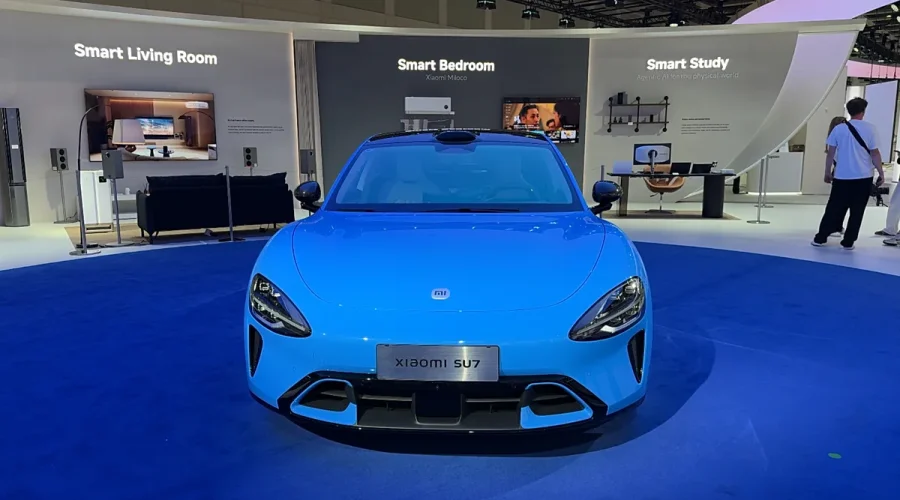
For most of its history, Xiaomi has been identified with affordable smartphones and a sprawling catalogue of consumer electronics. That identity is now being deliberately broadened. At IFA 2026, the company’s Berlin exhibition space led visitors not to a phone display but to a full-scale electric vehicle bearing the Xiaomi emblem — a visual statement that the brand’s centre of gravity is shifting toward mobility and connected living. Chinese consumers have already been purchasing Xiaomi-branded cars for several years, so the European announcement represents an extension of an existing product line rather than a wholly new venture.
The strategic logic behind the expansion is not merely to add another hardware SKU. Xiaomi’s stated philosophy, branded “Human x Car x Home,” treats the vehicle as one node within a continuous digital environment that also encompasses smartphones, smart-home appliances, and wearables. The company’s HyperOS operating system is designed to act as the connective tissue across all of these endpoints, while artificial-intelligence layers are intended to coordinate behaviour between them without requiring the user to issue individual commands to each device.
The Car as a Remote Control for the Household
During the IFA demonstration, Xiaomi showed what that coordination looks like in practice. Seated inside a prototype vehicle, attendees operated connected curtains at a simulated residence and toggled air-conditioning units on and off — all from the driver’s seat. The implication is straightforward: the car becomes an additional control surface for the smart home. A commuter leaving the office could pre-condition the interior of their apartment before pulling into the driveway, or adjust lighting and climate settings while still in transit.
Xiaomi’s longer-term roadmap pushes beyond manual toggling. The company envisions AI systems that interpret contextual signals — time of day, proximity, calendar data, occupancy patterns — and autonomously orchestrate devices spanning the vehicle, the phone, and the household. In that scenario, the user need not issue discrete commands at all; the ecosystem anticipates needs and adjusts accordingly.
Vision Gran Turismo: A Design Exercise, Not a Product
Alongside the concrete retail agreements, Xiaomi also unveiled a more speculative artefact: the Xiaomi Vision Gran Turismo. Developed in collaboration with the Gran Turismo racing-game franchise, this electric hypercar concept explores aerodynamic form, digital interaction interfaces, and design language that would be impractical in a volume-production vehicle. The company was explicit that the Vision Gran Turismo remains a concept study — a laboratory for ideas — rather than a preview of a model slated for near-term road use.
€24 Billion R&D Commitment Through 2030
The European entry is underwritten by a substantial capital programme. Xiaomi disclosed that between 2026 and 2030 it intends to invest more than €24 billion globally in research and development. Priority areas named by the company include artificial intelligence, operating-system development, semiconductor design, intelligent-vehicle engineering, robotics, and smart manufacturing. The scale of that figure places Xiaomi’s R&D outlay in the same order of magnitude as several legacy European automakers’ annual budgets, underscoring how seriously the company treats its transition from a consumer-electronics firm to a full-stack technology platform.
For European consumers, the practical consequence of these announcements will not be felt until at least 2027, when the first vehicles are expected to reach showrooms. By then, the eight German dealer groups that signed letters of intent this September will need to have completed training, infrastructure upgrades, and after-sales networks capable of supporting an EV fleet. Whether Xiaomi can replicate the speed and scale of its Chinese rollout within European regulatory and consumer-protection frameworks remains the central question the next eighteen months will begin to answer.
Related Reading
Frequently Asked Questions
What is IFA 2026?
IFA 2026 is the main topic of this guide. The article explains the context, practical details, and next steps readers should understand.
Why does IFA 2026 matter?
IFA 2026 matters because readers are looking for a useful answer, not just a short summary. Good content should match search intent and help them decide what to do next.