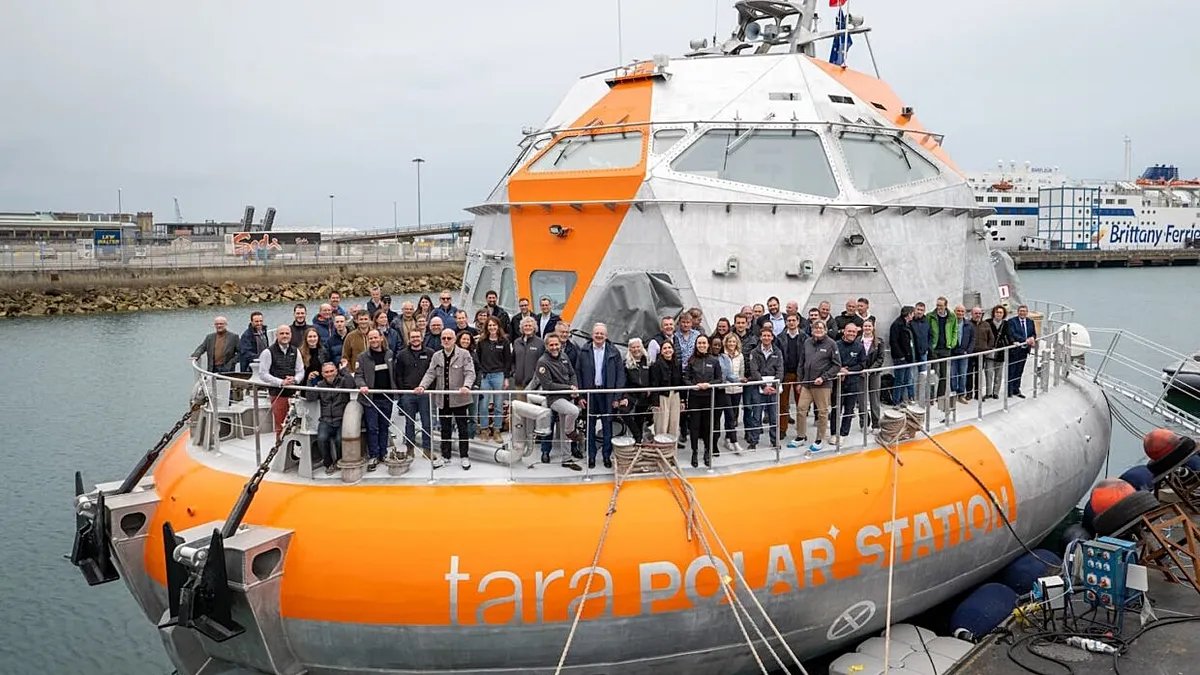
Tara Polar Station Embarks on Historic Arctic Journey
usagevpn.com – The Tara Polar Station, an innovative floating research facility engineered to navigate alongside Arctic sea ice, commenced its maiden voyage from the French port of Lorient on Sunday afternoon. A substantial crowd of several hundred spectators assembled along the waterfront to witness this momentous departure, with Minister for the Sea Catherine Chabaud among the dignitaries present to celebrate the occasion.
A Mission to Understand a Changing Arctic
Operating aboard this distinctive floating platform shaped like a saucer, the expedition crew has set ambitious goals centered on comprehending Arctic Ocean biodiversity and assessing how global warming impacts this critical region. The Arctic is currently experiencing temperature increases at a rate three to four times greater than the remainder of Earth, while simultaneously witnessing rapid retreat of its sea ice cover. This accelerated transformation makes the timing of the Tara Polar Station’s mission particularly significant for scientific understanding.
Twelve nations have committed resources to this ambitious undertaking, including Germany, Canada, the United States, Spain, Switzerland, and Japan. Each country contributes expertise and funding to support the comprehensive research program that will unfold over the coming years.
Engineering for Extreme Conditions
The Tara Polar Station features a distinctive design resembling an igloo positioned atop an enormous buoy. This architectural choice was not merely aesthetic; the structure has been specifically engineered to endure the tremendous pressure exerted by sea ice while maintaining operational capability in temperatures reaching as low as minus fifty-two degrees Celsius. Such robust construction ensures that scientists can conduct their work continuously throughout the harsh Arctic winter months.
Beginning in mid-August, the station will navigate alongside the Russian coastline, accompanied by an icebreaker providing escort and support. By early September, the vessel will become embedded within the pack ice, allowing it to be carried passively by the drifting ice sheet for a period ranging from three hundred fifty to five hundred days. During this journey, the station will travel at an average velocity of approximately ten kilometers per day, ultimately heading toward the Fram Strait situated between Greenland and Svalbard. Scientists project that the station will reach this destination by the conclusion of 2027.
Crew Life in the Polar Environment
Living conditions aboard the station vary seasonally. During the extended winter period, twelve individuals will reside on board, comprising six dedicated scientists alongside support personnel. The summer months see this number increase to eighteen crew members. Selection for this demanding mission involved rigorous medical examinations and psychological evaluations to ensure participants could withstand the isolation and physical challenges ahead. Additionally, all crew members participated in team-building seminars designed to strengthen interpersonal relationships before embarking on this prolonged expedition in extreme environments.
The overwintering team faces considerable challenges, including five consecutive months of polar night, average temperatures hovering around minus twenty-five degrees Celsius, and the ever-present possibility of polar bear encounters. To mitigate safety risks during excursions onto the ice surface, every crew member has received comprehensive training in firearm operation. Complementing these measures, a Lapponian herder dog will accompany the mission, utilizing its keen senses to alert the crew to approaching wildlife.
Scientific Research and Climate Insights
At the heart of the station lies a specialized well equipped with cutting-edge scientific instruments. Through this system, researchers will collect more than ten thousand samples spanning multiple environments: the water column extending to depths of two thousand meters, the atmosphere above, and the cavities existing within the sea ice itself. These samples will provide unprecedented insights into Arctic biodiversity, much of which remains poorly understood before the region undergoes profound ecological transformation.
Beyond biodiversity studies, several research programs aim to enhance climate modeling capabilities. One particularly promising avenue involves examining how bacteria influence cloud reflectivity, potentially offering new perspectives on atmospheric feedback mechanisms. The total investment for this inaugural mission amounts to six million euros, representing a substantial commitment to advancing our understanding of polar ecosystems.
This expedition inaugurates a broader initiative encompassing ten separate expeditions scheduled between 2026 and 2045, with each mission occurring at two-year intervals. Such a long-term commitment underscores the importance of sustained observation in tracking Arctic changes and validating scientific predictions about future environmental trajectories.