Hope, freedom and shared responsibility take centre stage in Oviedo
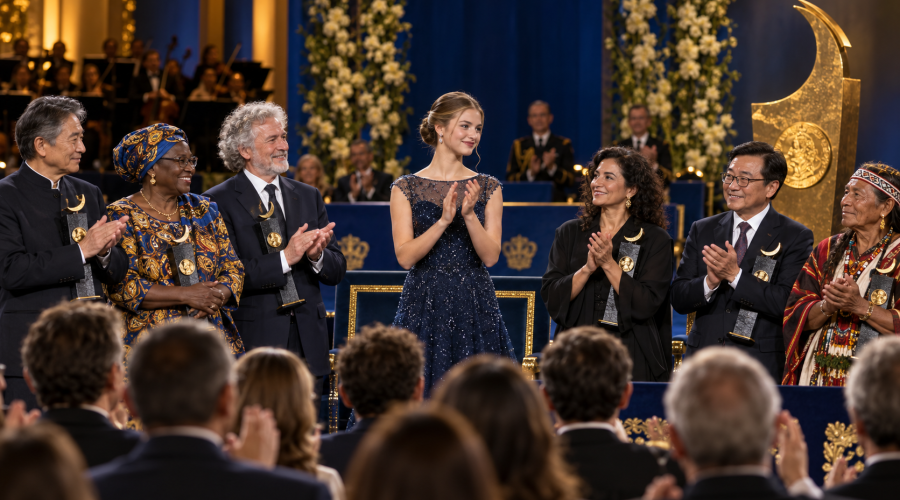
Usagevpn.com – The 46th Princess of Asturias Awards in Oviedo unfolded as a defence of human connection, democratic responsibility and creative perseverance at a time marked by uncertainty. At the Campoamor Theatre on Friday, Princess Leonor, King Felipe VI and this year’s laureates returned repeatedly to a common theme: individual achievement has meaning, but it does not exist apart from society.
Poet and musician Patti Smith gave the evening one of its most resonant moments with a performance of “Wing,” the spoken-word work closely tied to the beginning of her artistic career. The song, offered as a tribute to Spain, reflects on freedom while rejecting the idea that people can truly thrive in isolation.
“And they saw nothing / No future at all / Yet I was free”.
Smith received an especially enthusiastic response inside the theatre, echoing the public warmth she had encountered in Oviedo in the preceding days. Her performance set a tone that continued through the speeches: optimism was presented not as denial of difficult circumstances, but as an active choice to cooperate, create and endure.
A ceremony shaped by many voices
Opening the event, the president of the Princess of Asturias Foundation recalled a description offered by Meryl Streep, a memorable laureate from recent years. Streep had characterised the awards as an occasion carrying the voices of figures who shaped both the twentieth century and the present era.
“The echo of the voices of many of our heroes of the 20th century and of this young century of ours”.
The idea suited an evening in which science, literature, history, film and music were all treated as parts of a wider civic conversation. The awards have long brought together leading figures from different disciplines, and this year’s ceremony emphasised how those fields can inform public life beyond their own audiences.
Christina Koch, recipient of the Princess of Asturias Award for Concord, used her address to challenge conventional assumptions about engineers. Her carefully shaped remarks mixed personal reflection with an appeal for unity, including a memory of her first visit to Spain.
“The first time I came to Spain, I wept openly in the middle of the street”.
For Koch, the capacity to cooperate remains one of humanity’s defining strengths. She described people as members of a species able to come together, bound in part by a search for affection. Her message connected scientific endeavour with a broader human need for trust and collaboration.
Europe, freedom and democratic commitment
Historian Timothy Garton Ash also gave the audience a political reminder of the value of connection. Raised in a family led by a committed Brexit supporter, the British historian drew spontaneous applause when he referred twice to Britain as an inseparable part of Europe.
His remarks extended beyond Britain’s relationship with the continent. In a firm argument for liberties protected through universities, journalism and the rule of law, Garton Ash specifically referred to the International Criminal Court. The court has faced severe criticism from the Trump administration, while the United States has imposed sanctions on its judges.
King Felipe VI later addressed the approaching Spanish general elections, framing democracy as an ongoing responsibility rather than a brief moment at the ballot box. He said citizens would soon again carry the significant task of determining Spain’s political direction, while urging public representatives and voters alike to protect democratic institutions.
“Democracy requires daily commitment, civic and demanding, and care for its forms and institutions, so that we can continue to guarantee our coexistence, to foster that search for the common good which, as far as possible, meets and balances the legitimate interests of all citizens”.
The King’s appeal linked the ceremony’s broader discussion of solidarity to the practical demands of political life. Democracy, in this view, depends not only on elections but also on consistent civic participation, respect for institutions and the willingness to weigh competing interests.
Human experience in the age of AI
Artificial intelligence was another recurring subject. Princess Leonor addressed Julian Barnes, the Literature laureate, by highlighting the emotional force of work made by a human artist.
“No AI will ever be able to replicate the emotion stirred by your work”.
Barnes began his own remarks with Velázquez, suggesting that the Spanish painter’s achievement offers a humbling lesson to later writers and artists.
“When you look at Velázquez you realise that everything has already been said; most writers and artists have at some point in their lives had insights as instructive as his.”
The observation recalled a familiar artistic concern: whether originality is still possible after centuries of exceptional work. Rosalía expressed a similar idea more succinctly several years ago when she said, “It’s all been invented.” Yet the evening’s speeches suggested that the value of art lies not merely in novelty, but in the particular human experience, discipline and feeling brought to it.
King Felipe VI developed that point in his own comments on AI. He acknowledged the appeal of technologies that appear immediate and highly efficient, but argued that the laureates’ work demonstrated a different kind of reliability: achievement built through effort, endurance and sustained practice.
“We live in a world in which Artificial Intelligence sometimes seems to us, because it is so efficient and immediate, more reliable than human intelligence. Our laureates dismantle that impression: their achievements, lived and worked for down to the marrow, show that only through effort and perseverance can talent turn its potential into tangible, lasting realities”.
Trying to live as the wind rises
Near the close of the ceremony, Princess Leonor turned to Studio Ghibli, the Communication and Humanities laureate. Kenichi Yoda, the studio’s president, represented the organisation. The Princess cited a line associated with one of the studio’s films, in which its protagonist, drawing on Paul Valéry, offers a simple call to action.
“The wind rises, we must try to live!”
That phrase captured the emotional centre of the evening. The laureates did not minimise the pressures facing the world, whether political, technological or social. Instead, their speeches argued for meeting them through imagination, mutual care, personal freedom and a renewed commitment to the common good.
Related Reading
Frequently Asked Questions
What is Princess and prizewinners champion hope against?
Princess and prizewinners champion hope against is the main topic of this guide. The article explains the context, practical details, and next steps readers should understand.
Why does Princess and prizewinners champion hope against matter?
Princess and prizewinners champion hope against matters because readers are looking for a useful answer, not just a short summary. Good content should match search intent and help them decide what to do next.