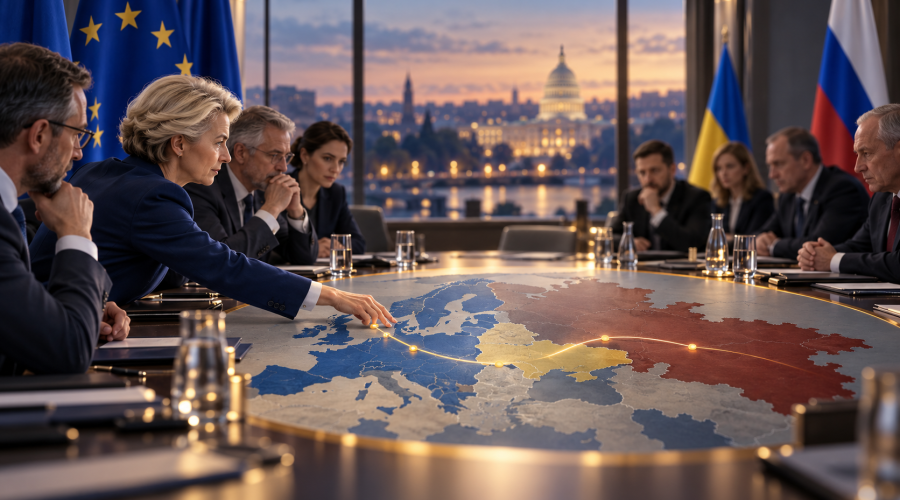
EU seeks a seat at the table as Ukraine-Russia talks may restart
Usagevpn.com – Brussels is pressing to take a more active part in efforts to end Russia’s war against Ukraine as preparations continue for a possible new round of negotiations in November. European officials see the renewed diplomatic activity as a chance to ensure the European Union is involved in decisions that will shape Ukraine’s security, recovery and future relationship with Russia.
The United States is working towards resuming technical-level discussions involving Washington, Kyiv and Moscow after the US midterm elections. Ukraine has signalled that it is open to any negotiating framework and available at any time. Russia has said it is “ready in principle” to return to talks.
Negotiations lost momentum in February, when the United States launched its war on Iran and redirected substantial diplomatic attention towards the Middle East. For EU leaders, a restart could provide an opening to turn a three-party process into a broader multilateral discussion that includes European institutions.
Brussels wants joint EU representation
The European Commission has indicated that the EU expects to participate at senior-official level if discussions proceed. Arianna Podestà, the Commission’s deputy chief spokesperson, said the bloc’s role would reflect its long-standing position that Ukraine must negotiate from a position of strength and that any settlement should be fair and durable.
“Now, there is an expectation that there will be a multilateral-level discussion with representatives at senior official level, and the EU will be present at these talks,” European Commission deputy chief spokesperson Arianna Podestà said on Friday.
Podestà said the Commission and the European Council should represent the EU together. The Commission serves as the bloc’s executive arm, while the Council represents member states. It remains uncertain whether that arrangement would result in direct meetings between EU and Russian officials.
“At this stage, I wouldn’t have further details to provide. The expectation is that there would be a joint Commission-Council representation that would attend the meetings,” she said. “Beyond that, I don’t have other elements to share.”
That uncertainty matters because European involvement has been uneven in previous discussions. At earlier meetings in Miami and Oslo involving Ukraine, Europe and the United States, Bjoern Seibert, the influential chief of staff to Commission President Ursula von der Leyen, attended. Pedro Lourtie, who serves as chief of staff to European Council President António Costa, was not invited.
Moscow still describes next meeting as trilateral
The Kremlin has not immediately rejected a European presence, unlike in some earlier stages of the diplomatic process. Yet Moscow says that the next session being prepared for the first half of November in Abu Dhabi remains a trilateral gathering.
“Nothing can be ruled out a priori,” Kremlin spokesperson Dmitry Peskov said. “But these talks we are discussing, which are scheduled for the first half of November in Abu Dhabi, will take place in a trilateral format.”
The difference between a trilateral and multilateral setting is more than procedural. A broader format could give European governments a more direct opportunity to argue for their priorities, particularly on Ukraine’s future security guarantees, continued pressure on Russia and reconstruction after the war. It could also make it harder for the outcome to be driven solely by exchanges between Washington and Moscow.
Germany, France and the United Kingdom — often referred to as the E3 — sent national security advisers to the Miami discussions, alongside NATO representatives. Italy replaced France at the Oslo meeting. Those talks addressed security guarantees for Ukraine, sanctions on Russia and post-war rebuilding.
Following the Oslo gathering, US special envoy Steve Witkoff travelled to Saint Petersburg for a meeting with Russian President Vladimir Putin that lasted almost three hours. The Kremlin subsequently said Witkoff’s ideas offered “little of real value” for ending the conflict, while also indicating that technical discussions could resume.
European concern over Washington’s approach
EU diplomats and officials remain doubtful that Moscow has moved away from its maximalist demands or is ready for substantive compromise. Nevertheless, they argue that the scale of the issues at stake leaves Europe with little room to remain outside the process.
Concern has intensified in European capitals after US President Donald Trump struck a diesel supply agreement with Putin and moved to loosen sanctions that had been in place against Russia for years. Those steps have added to fears that Washington’s position has shifted markedly in Moscow’s favour. European leaders see a place in the negotiations as an essential counterbalance and a means of protecting Ukraine’s interests.
President Volodymyr Zelenskyy, who has faced repeated criticism from Trump, has encouraged European leaders to create their own channel for talks with Moscow. Earlier in the year, António Costa quietly established a line of communication with Russia. It produced no meaningful result and was later suspended.
EU leaders revisited the possibility of naming a special envoy at their summit last week, but they did not agree on a candidate. Finnish President Alexander Stubb has again entered the discussion after helping host the Oslo talks. Russia later indicated it could accept Stubb as an intermediary if he did not “parrot” the European position.
That condition is likely to be difficult for Stubb, who has been a firm supporter of Ukraine. It also underlines the central challenge facing the EU: European participation may be increasingly necessary, but gaining real influence over the direction of negotiations remains far from guaranteed.
Related Reading
Frequently Asked Questions
What is EU vies to expand role in Ukraine?
EU vies to expand role in Ukraine is the main topic of this guide. The article explains the context, practical details, and next steps readers should understand.
Why does EU vies to expand role in Ukraine matter?
EU vies to expand role in Ukraine matters because readers are looking for a useful answer, not just a short summary. Good content should match search intent and help them decide what to do next.