Brussels Defends €90B Ukraine Loan Amid Growing Doubts
Usagevpn.com – Brussels says 90 billion loan for Ukraine is sufficient for the present phase of the conflict, even as scepticism builds in member-state capitals and within Kyiv’s own government. The European Commission, speaking through its chief spokesperson on Tuesday, reaffirmed that the two-tranche structure — €45 billion allocated to each of the next two fiscal years — stands unchanged. No formal amendment, extension, or acceleration has been tabled, and the executive body will not reopen the question absent a written request from Kyiv.
Disbursement to date has been modest against the full envelope. Approximately €3.2 billion in budgetary support and €8.35 billion in military assistance have reached Ukrainian accounts. Commission spokesperson Paula Pinho was direct when asked whether the timeline might stretch beyond the two-year window:
“In terms of longevity, that is what is foreseen: that this €90 billion loan should be disbursed over the two years.”
Pinho underscored that each tranche release is conditioned on reform milestones adopted in Kyiv, tying the pace of cash flow to Ukraine’s domestic policy trajectory. The Commission’s current priority, in her words, is executing “a very ambitious disbursement plan” within the existing legal architecture.
A War Economy Rewriting the Arithmetic
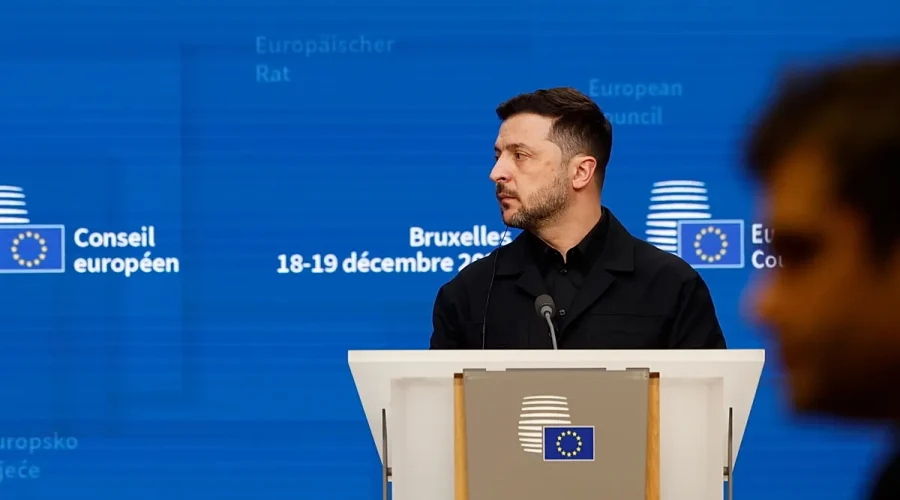
Moscow’s evolving tactics are compressing the window in which the facility can cover operational costs. Near-continuous drone sorties aimed at civilian economic output, paired with intensified ballistic-missile barrages against energy and transport infrastructure ahead of winter, inflate Kyiv’s procurement bill week by week. President Volodymyr Zelenskyy has made the shortfall explicit, asking allied governments to close a €23 billion gap in Ukraine’s Ministry of Defence budget so the country can sustain what he called “competitive” capability in deep-strike operations.
“We need more money, much more.”
As a stopgap, Zelenskyy floated pulling forward a slice of next year’s €45 billion tranche into the current fiscal year. The trade-off is self-evident: doing so would thin resources precisely when the loan’s second half was meant to land. Brussels confirmed it has not yet received a formal written request on this point, so no procedural clock is running.
Political Will in Ireland; No Decision Yet
The question surfaced at an informal foreign-ministerial gathering in Ireland on Tuesday, where Ukraine topped the agenda. Irish Foreign Minister Helen McEntee reported a broad political alignment among attendees to “bring forward funding” within the existing structure, while stressing that further deliberation in Brussels remained necessary before any concrete step. The appetite exists; the legal and budgetary mechanics do not yet.
The Frozen-Assets Gambit Resurfaces
A more radical option is gaining traction among Sweden, the Netherlands, Spain, and Poland, which have revived the proposal to draw on the €210 billion in Russian Central Bank assets frozen under sanctions since February 2022. Their argument is blunt: however the loan is structured, it will not be sufficient for the duration of the conflict. Swedish Foreign Minister Maria Malmer Stenergard laid out the logic plainly:
“What we see is we’re not providing enough support bilaterally and through the EU, and then what is left is the frozen assets. This is what is fair to Ukraine, it’s what is fair to taxpayers.”
The Commission’s posture on frozen assets has been deliberately cautious. Last year the executive threw its full institutional weight behind a mechanism that would have converted the frozen Russian holdings into a revolving credit line for Kyiv. The plan collapsed at a December summit when leaders balked at the legal and political risks and chose instead to underwrite the €90 billion facility through joint EU debt. Belgium, which custodies the frozen accounts, has yet to signal openness to a revised arrangement.
Frequently Asked Questions
How much of the €90 billion loan has been disbursed so far? Roughly €11.55 billion in combined budgetary and military assistance has reached Ukrainian accounts against the full €90 billion envelope.
Can the loan be extended beyond two years? The Commission has stated the two-year, two-tranche structure is what is “foreseen.” No extension mechanism has been activated, and the executive body will not reopen the question without a formal written request from Kyiv.
What happens if Ukraine asks to pull forward next year’s tranche? Brussels confirmed no such written request has been received. Were one submitted, it would enter standard budgetary and legal review before any disbursement schedule could be altered.
What role do frozen Russian assets play? Sweden, the Netherlands, Spain, and Poland have revived a proposal to tap the €210 billion in frozen Russian Central Bank holdings. The Commission remains cautious, having seen a similar mechanism rejected at last December’s summit.