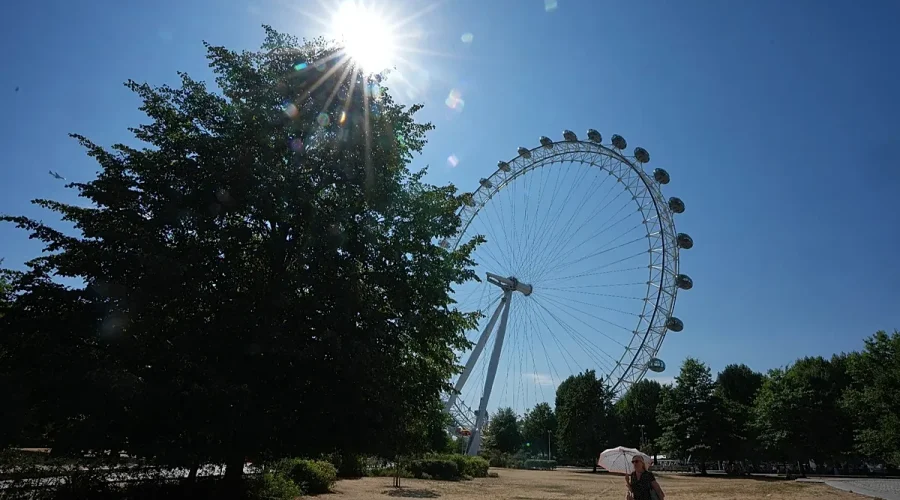
Back-to-Back Record Summers Push UK Heat Extremes Into New Territory
Usagevpn.com – Britain has just endured its second consecutive summer to shatter every prior temperature benchmark, a streak that meteorologists say signals a fundamental shift in the country’s seasonal climate baseline. The Met Office confirmed on Tuesday that the 2026 summer season averaged 16.5°C across the UK, eclipsing the 16.1°C mark set only twelve months earlier and leaving the next tier of historical records — the 15.7°C seasons of 2018, 2006, and 2003 — well behind. The finding places the UK’s warmest-season record, a series stretching back to 1884, firmly in the hands of the most recent two years.
Regional Breakdown and Extreme Conditions
The heat was not confined to a single region. England, Wales, and Northern Ireland each logged their warmest summers in the entire instrumental record. Scotland, while not setting an outright national peak, still posted its joint-sixth warmest summer, underscoring how broadly the anomaly was distributed across the island.
England additionally recorded its warmest June on file and its driest July, with rainfall totalling a mere 6.5 mm for the month — a figure that would have been considered extraordinary even a decade ago. The combination of sustained warmth and acute moisture deficit created conditions ripe for drought stress in agriculture, elevated wildfire risk, and heightened pressure on water utilities.
The single hottest reading of the season came on 13 August, when thermometers at Kew Gardens in southwest London registered 38.1°C. That figure sits among the highest daily maxima ever measured in the capital and illustrates how far individual-day extremes have migrated upward relative to the long-term norm.
Attribution: How Likely Was This Summer?
A dedicated study by Met Office scientists quantified the role of anthropogenic warming in producing a season of this magnitude. The researchers concluded that human-induced climate change made the record-breaking summer roughly 130 times more probable than it would have been in a pre-industrial atmosphere.
“In a climate unaffected by human emissions of greenhouse gases, a summer like this would be exceptionally unlikely, i.e. 1 in over 1,000 years,” said Dr Mark McCarthy, head of climate attribution at the Met Office. “In our current climate, which is changing because of the effect of burning of fossil fuels, we should now expect this to be roughly a 1 in 9 year event.”
That compression of return periods — from a millennium-scale rarity to something expected roughly once every nine years — encapsulates how rapidly the statistical envelope of UK summers is widening. For planners in energy, transport, public health, and water management, the implication is that design assumptions calibrated to twentieth-century extremes are already obsolete.
Official Response and the Frequency Problem
Dr Amy Doherty, who leads the Met Office’s National Climate Information Centre, framed the announcement in terms of accelerating trend rather than isolated anomaly.
“These records are now breaking with increasing frequency, reflecting the influence of human-induced climate change on the temperatures we’re experiencing in the UK,” Doherty stated. “Particularly notable is how much we’ve exceeded the previous summer mean temperature record, set just last year.”
The emphasis on the size of the jump — 0.4°C above the 2025 record — matters because a single-degree increment at the upper tail of the distribution represents a substantial shift in the probability of extreme heat events, not a marginal statistical wobble.
European Context and Downstream Consequences
Britain’s record summer did not occur in isolation. Across much of continental Europe, the same months brought repeated heatwaves, prolonged drought, and a cascade of devastating wildfires that strained emergency services to capacity. Hospital admissions for heat-related illness climbed, crop yields in several Mediterranean and southern European regions fell below seasonal norms, and river levels dropped to levels that disrupted shipping and hydropower generation.
For the UK specifically, the convergence of record warmth and record dryness in a single season raises practical questions about water abstraction limits, rail track buckling thresholds, and the timing of peak electricity demand when air-conditioning loads coincide with reduced thermal output from cooling towers. Infrastructure built to twentieth-century design codes is being tested at its margins more often than engineers originally projected.
The Met Office’s attribution analysis, by assigning a quantified multiplier to the likelihood of such a season, gives policymakers a concrete metric for adaptation planning: if a once-in-a-millennium event is now a once-in-nine-year expectation, then the frequency of compound heat-and-drought stressors will continue to climb through the coming decades unless emissions trajectories change materially. The two consecutive record summers of 2025 and 2026 are, in that framing, less a surprise than a confirmation of a trajectory already embedded in the physics.
Related Reading
Frequently Asked Questions
What is UK records hottest summer on record?
UK records hottest summer on record is the main topic of this guide. The article explains the context, practical details, and next steps readers should understand.
Why does UK records hottest summer on record matter?
UK records hottest summer on record matters because readers are looking for a useful answer, not just a short summary. Good content should match search intent and help them decide what to do next.