EU and NATO Prepare Coordinated Response After Germany Blames Russia for Leipzig Drone Sabotage
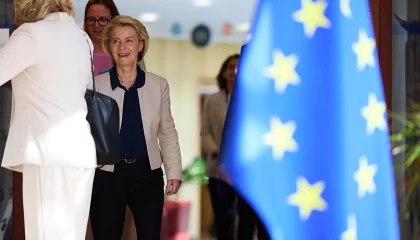
Usagevpn.com – The attribution of a summer drone incident at a major German airport to Moscow has triggered an immediate diplomatic and sanctions response across European institutions. On Monday, Berlin formally concluded that Russia was responsible for the sabotage operation carried out on 4 August near a Ukrainian military cargo aircraft at Leipzig/Halle Airport, prompting European Commission President Ursula von der Leyen to pledge a unified bloc reaction and to schedule an urgent bilateral with NATO’s top commander.
Formal Attribution and Immediate Consequences
German Interior Minister Alexander Dobrindt delivered the finding at a Monday press conference, explaining that the methods employed in the drone operation matched patterns observed in other Russian hybrid operations tied to the war in Ukraine.
“The German government therefore concludes that Russia is responsible for the hybrid attack in Leipzig on 4 August,” Dobrindt stated.
The practical fallout was swift. Germany ordered the closure of the Russian consulate in Bonn and directed that the Russian House in Berlin also be shut down. Foreign Affairs Minister Johann Wadephul framed the incident within what he described as a prolonged campaign of destabilisation, disinformation, threats, sabotage, and aggression aimed at Europe as a whole. The Russian embassy in Germany pushed back with a statement denying Berlin’s conclusions and warning of “consequences” should new sanctions proceed. Moscow’s Foreign Ministry had already issued a late-August communique condemning European accusations, arguing they were premature because an investigation had not yet been completed at the time.
Brussels and Brussels-Adjacent Reactions
Von der Leyen responded within hours, posting a statement on the social media platform X in which she declared “full solidarity” with Germany and signalled that the bloc would not absorb the incident silently.
“We will keep the EU united despite these escalating and serious acts,” she wrote. “The German government has taken strong measures. And the message is clear: hybrid attacks will not go without a clear response.”
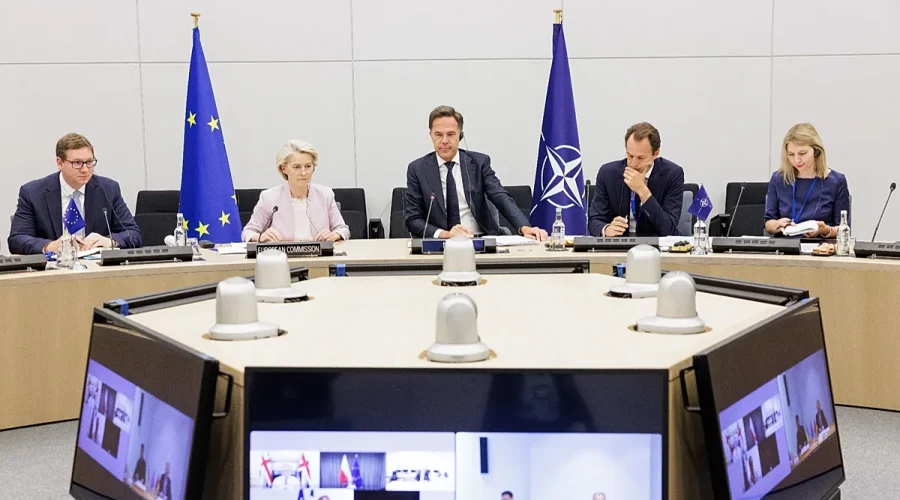
European Commission Chief Spokesperson Paula Pinho confirmed on Tuesday that a “short notice” bilateral between von der Leyen and NATO Secretary-General Mark Rutte had been arranged for Wednesday. Pinho noted the talks would also sit within the broader context of deepening defence cooperation between Europe and the Alliance. A NATO official indicated the session would focus primarily on strengthening coordination against hybrid threats of the kind now being attributed to Moscow.
Additional sanctions packages are reportedly being prepared by foreign ministers ahead of an upcoming meeting, giving the diplomatic track a concrete economic lever alongside the military-coordination discussion.
NATO’s Parallel Position
Rutte mirrored the solidarity language in his own X post, stating that the Alliance stood fully behind Berlin and that “the evidence is clear” regarding Russian responsibility.
“NATO will continue to strengthen our ability to deter and defend all Allies against any threat—including malign actions like those seen in Leipzig and elsewhere across the Alliance,” he said.
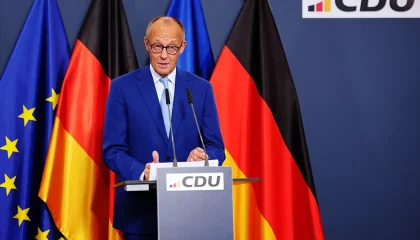
German Chancellor Friedrich Merz had previously vowed a response to the airport incidents, with action to be coordinated between EU and NATO partners. The Wednesday meeting thus represents the first formal institutional step in executing that pledge.
The Wider Hybrid-Warfare Picture
The Leipzig attribution does not exist in isolation. EU foreign policy chief Kaja Kallas, speaking after a defence ministerial meeting in Wicklow, Ireland, characterised a growing pattern of kinetic hybrid incidents as Russia’s attempt to “scare us away” from supporting Ukraine.
“They will not succeed,” Kallas said, adding that the risks from such incidents were rising and that “clearly we are not doing enough to stop this.”
Irish Foreign Minister Helen McEntee, who delivered the press conference alongside Kallas, noted that threats were materialising within the last 24 hours, citing airspace incursions reported by colleagues in Romania, Latvia, and Estonia, as well as Germany. Romania and Estonia both confirmed drone incursions on Tuesday itself. Separately, several improvised explosive devices were discovered near a coal-fired power plant in Germany on the same day, underscoring the breadth of the threat environment.
Estonian Defence Minister Hanno Pevkur, arriving at the Wicklow talks, warned that Europe must prepare for further hybrid-warfare incidents.
“They are testing always this threshold — where is this red line,” Pevkur said, urging Europe to keep a “very clear” head.
Broader European Solidarity
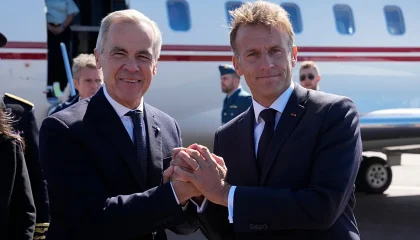
French President Emmanuel Macron posted on X on Tuesday that France stood in “full solidarity” with Germany and supported the adoption of new European sanctions against Russia. Italian Prime Minister Giorgia Meloni likewise voiced solidarity, describing the incidents as attempts to intimidate European publics or drive a wedge between member states.
The convergence of statements from Brussels, NATO headquarters, Berlin, Paris, Rome, Tallinn, and Dublin within a single 48-hour window marks a notable escalation in institutional coordination. What had previously been treated as isolated incidents—airport drone sightings, border airspace crossings, small-scale sabotage—now appears to be framed by European leaders as a single, attributable campaign requiring a unified deterrence and sanctions architecture. The Wednesday von der Leyen–Rutte meeting will be the first test of whether that framing translates into concrete operational and economic measures.
Related Reading
Frequently Asked Questions
What is Von der Leyen pledges response to Russian?
Von der Leyen pledges response to Russian is the main topic of this guide. The article explains the context, practical details, and next steps readers should understand.
Why does Von der Leyen pledges response to Russian matter?
Von der Leyen pledges response to Russian matters because readers are looking for a useful answer, not just a short summary. Good content should match search intent and help them decide what to do next.