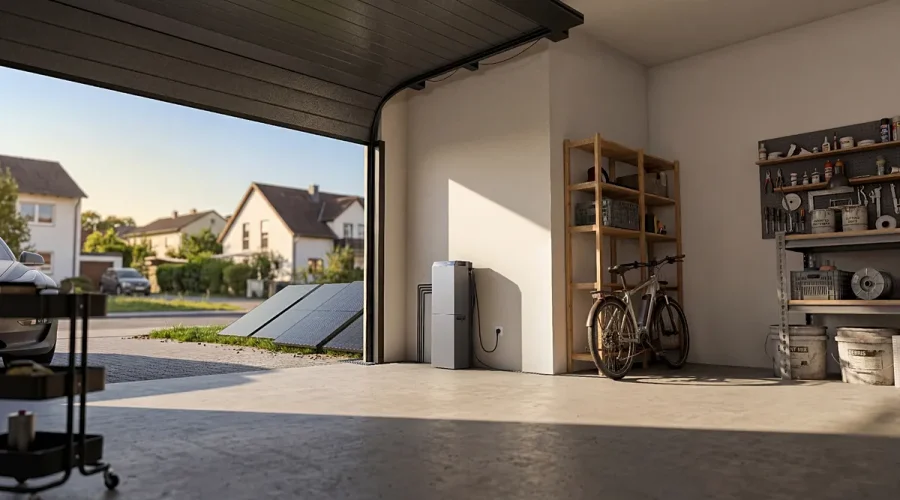
Homegrown Power: How European Households Are Rewiring Their Relationship with the Grid
Usagevpn.com – For most of the past four years, opening an electricity bill has carried a small jolt of dread for millions of families across the continent. Prices that had crept upward for decades accelerated sharply after 2022 and have never fully retreated. Extreme weather events — heatwaves, storms, prolonged cold snaps — have stressed distribution networks that were already aging. The cumulative effect has pushed a question from the margins into mainstream conversation: what if a household stopped being a passive recipient of grid power and started generating, storing, and scheduling its own electricity?
That question is no longer hypothetical. A growing cohort of European homeowners and small businesses now run integrated solar-plus-storage setups that let them produce clean power on their rooftops or balconies, bank it in lithium-ion batteries, and draw from the public grid only when tariffs dip to their lowest points. The result, as reported by early adopters, is a measurable drop in monthly spending, insulation from outages, and a degree of scheduling flexibility that a conventional utility account simply cannot offer.
The Company Behind the Shift
EcoFlow, a manufacturer of residential and commercial solar panels, battery storage units, and software-based energy management platforms, has spent roughly ten years engineering these systems for the European market. Its stated mission is to make self-managed power as straightforward as flipping a light switch. Dr. Bruce Wang, the firm’s chief executive, frames the company’s work in terms of agency rather than mere cost-cutting.
“These are complex challenges, but there is a unifying theme. People feel they are at the mercy of events outside their hands. We are responding the way we always have — by returning control to the individual.”
Wang points to air conditioning as a concrete example. European summers have grown measurably hotter over the past two decades, and households that once never needed mechanical cooling are now seriously evaluating it. The hardware exists and is widely available; the barrier for most families is the running cost. Wang argues that a home producing its own solar power, storing surplus in a battery, and pulling grid electricity only during off-peak tariff windows can slash that cost dramatically — even for apartment dwellers who mount small balcony solar arrays to offset the draw of a compact split-unit AC system.
Economics Are Finally Tilting in the Right Direction
The financial math has improved steadily. Eurostat data show that European household electricity prices remain well above their pre-2022 levels, while the installed cost of photovoltaic modules and residential battery packs has continued its long downward trajectory. The net effect is a shrinking payback period: the number of years required for a home energy system to recoup its upfront investment through bill savings is compressing year over year. For many households, the break-even point now falls inside a single mortgage term.
“At its core, energy independence means living without fear of the next electricity bill.”
The Usability Problem — and How It Is Being Solved
Historically, the technology worked but the user experience did not. Running a whole-home energy system once demanded constant vigilance: monitoring tariff schedules, forecasting the next day’s solar yield, deciding when to charge the battery versus when to import grid power. Most homeowners found that cognitive load exhausting and abandoned the setup within months.
EcoFlow’s answer is its OASIS 3.0 platform, a home energy management system that automates those decisions. It ingests real-time tariff data, local weather forecasts, and battery state-of-charge information, then orchestrates generation, storage, and grid interaction without requiring the homeowner to intervene. Layered on top is EcoBot, a natural-language AI assistant that lets users issue plain-English instructions rather than navigate configuration menus.
“Imagine you’re leaving on holiday for a week. Normally, you’d need to manually adjust your thermostat, turn off electric water heaters or adjust battery discharge limits. With EcoBot, you simply say: ‘I’m away until Friday. Keep my costs down.’ The system automatically configures itself to maximise energy savings for an unoccupied home. One natural statement replaces dozens of manual tweaks.”
Wang is explicit about the design philosophy: technology must serve every household, not only technically inclined enthusiasts.
Three Markets, Three Playbooks
Europe’s energy landscape is far from uniform, and EcoFlow’s product strategy is calibrated accordingly.
Germany: Scale Meets Price Pressure
Germany leads the continent in residential rooftop solar, with more than 1.33 million small-scale systems registered. It simultaneously carries some of Europe’s highest retail electricity prices — approximately 39 cents per kilowatt-hour in the second half of 2025, compared with a continental average near 29 cents. That combination makes battery storage especially attractive: homeowners already generating solar power face a steep incentive to store surplus rather than feed it back at a low feed-in tariff. The result is a rapidly expanding domestic storage market layered atop an already-mature solar base.
United Kingdom: Dynamic Tariffs Reward Smart Scheduling
The UK picture differs. Dynamic energy tariffs — prices that fluctuate hourly or even sub-hourly — are becoming mainstream. A household equipped with solar, a battery, and OASIS 3.0 can consume its own generation first, top up the battery overnight when grid rates dip, and simply avoid purchasing electricity during the expensive evening peak. The software does the arbitrage automatically; the homeowner sees only a lower bill.
Netherlands: Net Metering Ends, Self-Consumption Takes Over
Roughly three million Dutch households — about one in three — already operate solar panels. Adoption was never the bottleneck. What changes on 1 January 2027 is the economic value of what those panels produce. The current net-metering arrangement, which credits homeowners for exported surplus at the full retail rate, will be retired. From that date forward, the financial return of a rooftop array hinges on how much of its output the household actually consumes on-site. Early market signals confirm the shift is already underway: home battery registrations in the Netherlands more than doubled during the first half of 2026 as households rushed to capture self-consumption value before the regulatory change took effect.
“A one-size-fits-all approach does not work across Europe. But the underlying need is the same: people want a simple, safe and affordable way to lower their electricity bill and gain more power over their energy, without having to become technical experts.”
Why This Matters Beyond the Bill
The implications extend past individual household economics. As more homes generate, store, and schedule their own power, the aggregate load profile on distribution networks smooths out — evening peaks flatten, midday solar surges are absorbed locally rather than pushed into the grid. That reduces strain on infrastructure already tested by climate-driven weather extremes and lowers the urgency of costly grid-expansion projects. In a continent where energy security has moved from a back-office concern to a front-page topic, the quiet proliferation of rooftop solar and home batteries represents a distributed resilience strategy that no single utility or government programme can replicate at scale. The technology is mature, the economics are converging, and the usability gap that once kept most households on the sidelines is closing with each software update. What remains is a question of adoption speed — and, increasingly, of regulatory timing.
Related Reading
Frequently Asked Questions
What is The Next Frontier of Europe s Energy?
The Next Frontier of Europe s Energy is the main topic of this guide. The article explains the context, practical details, and next steps readers should understand.
Why does The Next Frontier of Europe s Energy matter?
The Next Frontier of Europe s Energy matters because readers are looking for a useful answer, not just a short summary. Good content should match search intent and help them decide what to do next.