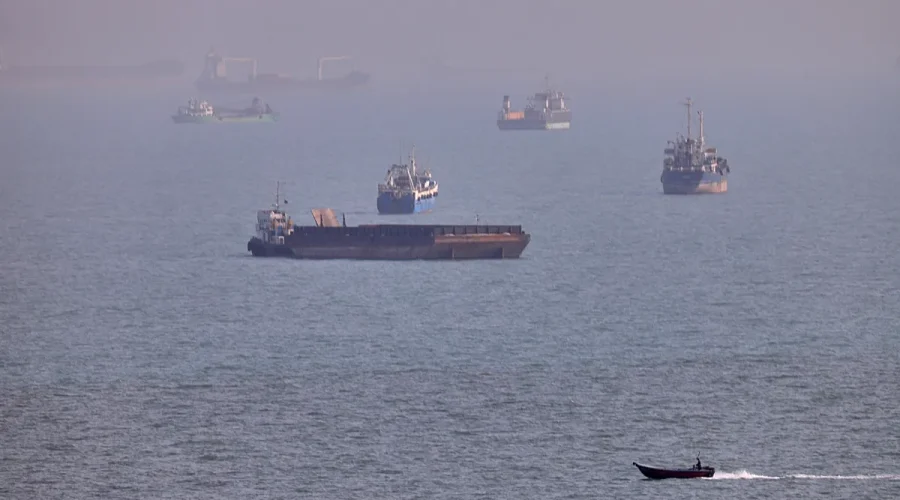
Strait of Hormuz Standoff Deepens as Trump Vows Military Action Against Oman
Usagevpn.com – The expiration of a fragile June memorandum of understanding between Washington and Tehran has thrown the world’s most critical energy corridor back into uncertainty — and President Donald Trump has made clear he will not tolerate what he perceives as interference from a third party. Speaking on Fox News on Monday, the president warned that the United States would strike Oman militarily if the Gulf sultanate obstructs ongoing American-Iranian negotiations over passage through the Strait of Hormuz.
“If Oman gets in the way, we’ll bomb the s— out of them.”
The remark landed against the backdrop of a 60-day negotiation window that had been built into the June accord. That window has now lapsed without a final deal being reached, leaving both capitals without a binding framework for reopening the waterway or lifting the American naval cordon around Iran.
What the June Agreement Required — and What Its Expiration Means
Under the memorandum signed last month, Tehran committed to reopening the strait and reaffirming that it “shall not procure or develop nuclear weapons.” In exchange, Washington pledged to dismantle its naval blockade of Iranian ports and withdraw sanctions imposed on the country. The document was designed as a bridge: it granted both sides sixty days to negotiate a comprehensive final settlement. That period has now run out, and neither side has announced a successor instrument.
The practical consequence is immediate. Commercial tankers and gas carriers that once moved freely through the narrow waterway remain constrained, and the question of who controls transit — Tehran, Washington, or some negotiated arrangement — is once again open.
Oman’s Role and the “Navigation Route Map”
While the American and Iranian positions remain sharply opposed, Tehran has been conducting a parallel track of talks with Muscat aimed at establishing a secure commercial shipping lane through the strait. Iranian Foreign Minister Abbas Araghchi told state media earlier this month that those negotiations had reached their “final stages,” though he cautioned that a bilateral understanding between Iran and Oman would not, by itself, trigger a reopening of the waterway. Additional “conditions,” he stressed, would need to be satisfied.
On Monday, Foreign Ministry spokesperson Esmaeil Baghaei confirmed that the two governments were still working toward a joint agreement. He added that an “understanding” had been reached on what he called the “navigation route map” for the strait — a technical framework for how vessels would be routed through the channel while respecting the territorial waters of both coastal states.
“Insecurity in the Strait of Hormuz was imposed on us, the region, and the entire world. This is a highly complex issue, and for the first time a mechanism is to be established that both safeguards the sovereignty and sovereign rights of the two coastal states (Iran and Oman) and ensures the safe passage of commercial vessels through this waterway.”
Why the Strait Matters
The Strait of Hormuz links the Persian Gulf to the Gulf of Oman and, beyond it, the Arabian Sea. Roughly one-quarter of all seaborne oil traded globally transits this narrow passage each year, making it arguably the single most important chokepoint in international energy logistics. Its effective closure by Tehran following the outbreak of the Iran war in late February sent shockwaves through global markets, shipping insurers, and the economies of every major oil-importing nation.
For Oman, which shares the strait’s southern shore, the stakes are both economic and sovereign. Any arrangement that routes commercial traffic through the waterway must account for Muscat’s territorial claims and port infrastructure. Trump’s threat to bomb the sultanate if it “gets in the way” of American-Iranian talks therefore carries an unusual dimension: it implies the United States views a small Gulf neighbor’s independent diplomatic engagement as a potential obstacle to its own bilateral agenda.
A Tit-for-Tat Rhetorical Escalation
The president’s comments on Monday followed a week of increasingly assertive American posturing. Last week, Trump posted on Truth Social that “The U.S.A. has total control over the Strait of Hormuz. I THINK WE WILL KEEP IT,” a claim that contradicts both the June memorandum’s language and the reality that Tehran had physically closed the waterway after the war began in late February.
On Friday, the president went further, apparently in jest, suggesting he would soon declare the strait “a territory of the United States.” The remark drew a swift and pointed reply from Tehran. Deputy Foreign Minister for Legal and International Affairs Kazem Gharibabadi took to X to respond:
“The Strait of Hormuz has been Iranian, is Iranian, and will remain Iranian. This strait will only be closed and opened under Iran’s command, and as long as you do not accept the reality of defeat and cease your fanciful delusions, Iran will continue to enforce the blockade.”
Where Things Stand
With the June window closed, no formal mechanism remains to compel either side back to the table. Oman continues its own bilateral track with Tehran, while Washington insists it retains ultimate authority over transit. The combination of an expired agreement, a threatened military strike against a third state, and competing sovereignty claims over the world’s busiest oil artery leaves the region in a state of acute diplomatic and economic instability. For the shipping industry, energy traders, and governments dependent on Gulf crude, the next weeks will determine whether the strait reopens under a negotiated regime or remains locked in a standoff with no clear exit.
Related Reading
Frequently Asked Questions
What is Trump threatens to bomb Oman if it?
Trump threatens to bomb Oman if it is the main topic of this guide. The article explains the context, practical details, and next steps readers should understand.
Why does Trump threatens to bomb Oman if it matter?
Trump threatens to bomb Oman if it matters because readers are looking for a useful answer, not just a short summary. Good content should match search intent and help them decide what to do next.