Evacuation begins from Oleshky as a temporary truce holds in southern Ukraine
Usagevpn.com – A humanitarian evacuation has begun in the Russian-occupied city of Oleshky, where residents are being moved away from the front-line area during a temporary ceasefire in Ukraine’s southern Kherson region.
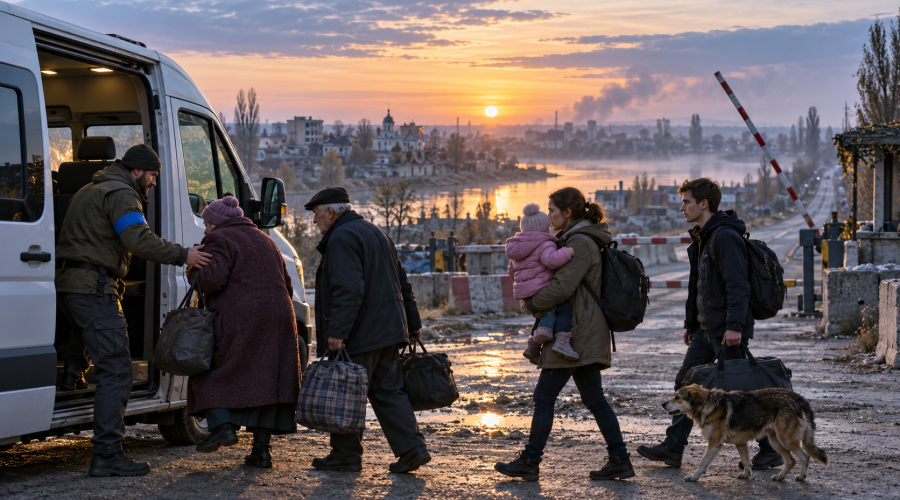
The operation entered a critical phase on Friday, the fourth day of the local truce, as buses and ambulances reached the city with supplies and began collecting people who wanted to leave. Food and medicine were also delivered as part of the mission.
Oleshky lies near the Dnipro River, opposite territory held by Ukraine. Despite that geographical proximity, residents leaving for Ukrainian-controlled areas face a far longer route through Russia and Belarus before they can return to northern Ukraine.
Residents face a long route home
Ukrainian negotiator David Arakhamia said a Ukrainian delegation and evacuees had departed for Anapa. The group is then expected to fly to Belarus before continuing by bus into Ukraine.
“The Ukrainian delegation, along with the evacuated residents of Oleshky, set off for Anapa. From there, they will fly to Belarus and then travel home by bus,” said Ukrainian negotiator David Arakhamia.
The full route has not been made public. The journey highlights the unusual logistical realities created by the war: Ukrainian-held territory is only a few kilometres away across the river, yet the evacuation corridor requires travel over hundreds of kilometres and across international borders.
A convoy of 25 buses, supported by several ambulances, arrived in Oleshky earlier on Friday. Its immediate task was to bring relief supplies into the damaged city and provide transport for civilians seeking to depart.
Kyrylo Budanov, head of Ukraine’s presidential office, said the operation was continuing. He is not a member of the Ukrainian delegation working in Oleshky.
“At this moment, the humanitarian operation is underway in Oleshky,” Kyrylo Budanov wrote in an post online.
A rare joint humanitarian effort
Officials from Ukraine and Russia have cooperated on the evacuation, an uncommon instance of practical coordination during a conflict that has otherwise continued across the country.
Russia’s human rights ombudsman, Yana Lantratova, said the Russian side was also concluding its work in the city. In a Telegram video, she described a convoy carrying people travelling toward Russian territory.
“We are completing our humanitarian mission in Oleshky,” Russia’s human rights ombudsman Yana Lantratova said in a video on Telegram, adding that a “convoy with those who are going to the territory of the Russian Federation is heading to the territory of the Russian Federation”.
Ukraine and Russia issued separate statements using identical wording to say residents would be able to decide whether to leave. The messages also said civilians who remain in Oleshky would receive humanitarian assistance.
“Everyone who wishes to leave Oleshky will have the opportunity to do so safely,” Russia and Ukraine said in separate, identical statements. “Those who choose to stay may remain and will receive all the humanitarian support they need.”
Local authorities and volunteer groups estimate that roughly 2,000 people are still in Oleshky. For those residents, the temporary pause in fighting offers a limited opportunity to make a difficult choice: leave a city affected by the war or remain with access to promised aid.
Ceasefire remains limited in scope
The ceasefire applies locally in the Kherson region and is scheduled to continue until Sunday evening. Its purpose is to make the humanitarian operation possible, but it does not signal a wider halt to the war.
Combat continued elsewhere on Friday. Russia’s Defence Ministry said it had intercepted more than 1,000 Ukrainian drones overnight. Ukraine, meanwhile, said it had faced Russian attacks involving ballistic missiles, other missiles and dozens of drones.
The contrast underlines the narrow nature of the arrangement around Oleshky. A corridor for buses, ambulances and civilians can operate while military activity continues beyond the designated area. The safety of the evacuation therefore depends on the ceasefire holding for its intended duration and on both sides maintaining the agreed conditions.
For people leaving the city, the immediate priority is safe passage rather than the shortest route. The detour through Anapa and Belarus reflects the barriers imposed by the front line and the Dnipro River, which separates Oleshky from nearby Ukrainian-controlled territory.
The evacuation also brings humanitarian needs into focus. The arrival of medicine and food indicates that civilians still inside Oleshky require continuing support, whether they leave during the truce or choose to stay. With thousands of people believed to remain, the operation’s outcome will depend on how many residents can be transported before the local ceasefire expires.
As the truce moves toward its final days, the buses departing Oleshky represent a brief opening for civilians caught in an occupied and war-affected city. The arrangement offers a temporary route out, while the broader conflict remains unresolved and fighting continues in other parts of Ukraine.
Related Reading
Frequently Asked Questions
What is Residents leave Russian occupied Oleshky amid?
Residents leave Russian occupied Oleshky amid is the main topic of this guide. The article explains the context, practical details, and next steps readers should understand.
Why does Residents leave Russian occupied Oleshky amid matter?
Residents leave Russian occupied Oleshky amid matters because readers are looking for a useful answer, not just a short summary. Good content should match search intent and help them decide what to do next.