Oleshky evacuation puts fragile ceasefire under intense scrutiny
Usagevpn.com – A short-lived truce around the Russian-occupied Ukrainian town of Oleshky is set to enable a rare humanitarian operation on Friday, bringing renewed focus to a community where residents face severe shortages and widespread destruction.
The mission is expected to include evacuations and the delivery of assistance, with activities planned through the afternoon. The ceasefire intended to make the operation possible is due to remain in force until Sunday. For an estimated 2,000 people still in Oleshky, however, the narrow window also brings an agonising decision: attempt to leave via Russia or occupied Crimea without certainty of reaching Ukrainian-controlled territory, or stay behind as essential supplies become harder to obtain.
Arseniy Yatseniuk, Ukraine’s former prime minister, described the situation in stark terms during an appearance on Europe Today. He warned that Russia could not be trusted in connection with the temporary arrangement.
“There is no way to trust Russians.”
“What is happening right now in Oleshky is a humanitarian disaster and it’s actually a living hell.”
A town under pressure
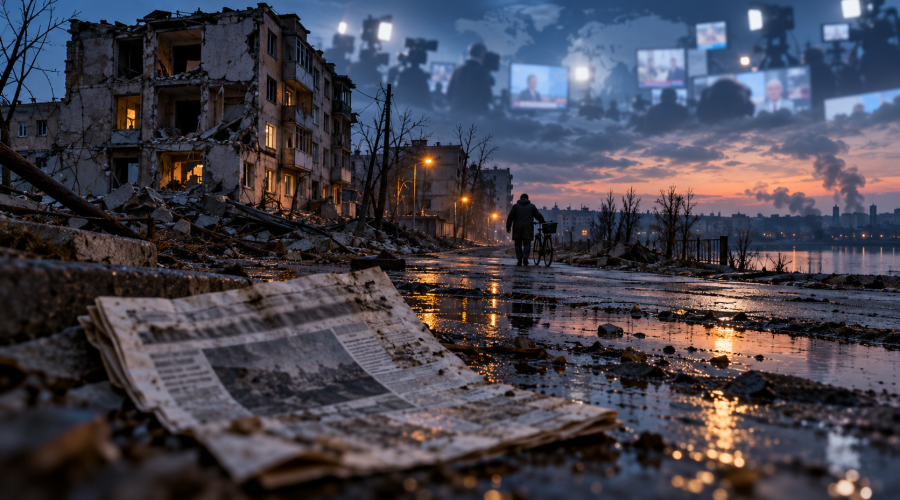
Tetiana Hasanenko, who leads the Oleshky city military administration, has portrayed conditions inside the occupied town as desperate. She said people have had to survive on weeds and described the city as almost entirely ruined.
“People have been forced to eat weeds.”
“The city is practically destroyed.”
Humanitarian access in occupied areas is especially consequential because civilians often have limited ability to move freely, obtain reliable supplies or communicate safely with the outside world. Even a temporary opening can mean the difference between remaining trapped and reaching a route out, but it can also expose people to new uncertainty when the destination and terms of travel are unclear.
The operation was agreed with the involvement of US First Lady Melania Trump. Its success will be judged not only by whether aid reaches residents, but also by whether civilians who choose to depart can do so safely and without being diverted away from Ukrainian-controlled territory.
Yatseniuk has accused Moscow of treating civilians as hostages and using the operation to cast itself as a humanitarian saviour. The days ahead will therefore test both the ceasefire itself and the credibility of promises made to people living in Oleshky.
Gaza, settlements and the prospects for peace
Another conflict dominated discussion on Europe Today as Mustafa Barghouti, general secretary of the Palestinian National Initiative, spoke about Palestinians facing what he described as the pressure of far-right Israeli politics.
“We’re not leaving. We’re going to stay. We will resist.”
His comments followed Israeli legislative elections on Tuesday, in which Arab parties made major gains. They also came after the United Nations Independent International Commission of Inquiry found that Israel had committed genocide in the Gaza Strip.
Barghouti argued that the future of a two-state settlement depends on reversing the expansion and entrenchment of Israeli settlements in the West Bank.
“The only way to save the two-state solution is to remove the illegal Israeli settlements from the West Bank.”
He said international inaction, particularly the absence of sanctions over those actions, had made that prospect harder to achieve. The electoral gains by Arab parties may alter parts of Israel’s political conversation, but they do not by themselves resolve the central questions surrounding Gaza, the West Bank, security and Palestinian statehood.
The two-state framework remains a shorthand for the idea of Israel and a future Palestinian state existing side by side. Its viability is closely tied to territorial realities in the West Bank, where settlement policy remains one of the most contentious obstacles to a negotiated outcome.
EU and Canada seek a deeper partnership in Montréal
European Commission President Ursula von der Leyen, European Council President António Costa and Canadian Prime Minister Mark Carney are meeting in Montréal on Friday for the second day of the EU-Canada summit.
The talks are expected to cover trade, investment, supply-chain resilience, artificial intelligence, quantum technology and continued support for Ukraine. The gathering also reflects a broader political shift: Donald Trump’s “America First” approach and an unsettled US relationship with Kyiv have encouraged closer coordination between Europe and Canada.
A central point of debate is whether Canada could become the European Union’s first “associate member.” Von der Leyen renewed that proposal at an event in Montréal, presenting it as a way to build a closer relationship without beginning the path to EU accession.
“Our idea is simple: it is an association without accession.”
Germany pushed strongly against including the associate-member language in the summit’s joint declaration. Chancellor Friedrich Merz subsequently endorsed the broader idea of an “alliance for the future” in a cryptic social-media post, leaving the precise political meaning open to interpretation.
Carney then appeared to revive the more specific terminology, saying Canada was working toward a new alliance in which it would hold associate-member status.
“We’re in the process of forging a new alliance for the future, with Canada as an associate member.”
The distinction matters. A formalised association could signal a more durable institutional relationship between Canada and the EU, while a looser alliance might offer greater political flexibility but less clarity about commitments. The summit’s closing press conference, scheduled for 5:25pm CET, is expected to offer a clearer indication of which formulation will prevail.
Related Reading
Frequently Asked Questions
What is A living hell?
A living hell is the main topic of this guide. The article explains the context, practical details, and next steps readers should understand.
Why does A living hell matter?
A living hell matters because readers are looking for a useful answer, not just a short summary. Good content should match search intent and help them decide what to do next.