Exposed Riverbeds and Empty Cargo Holds: Germany’s Rhine Struggles Under a Prolonged Drought
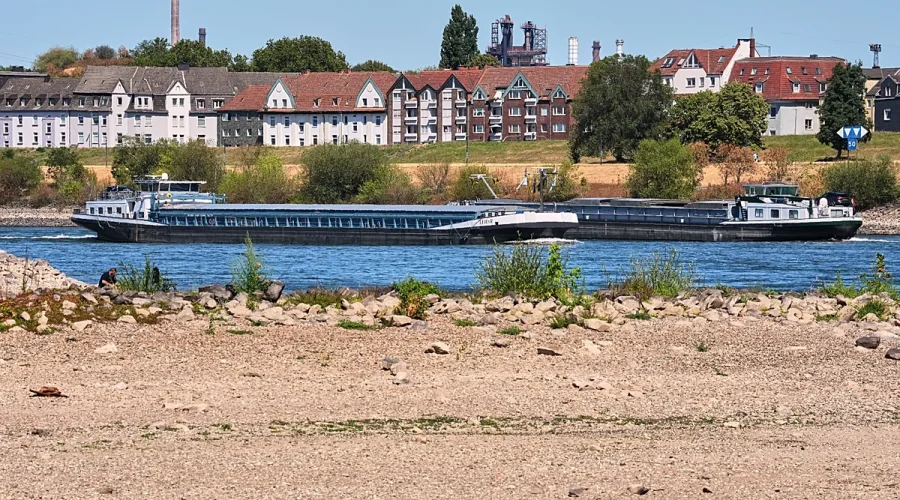
Usagevpn.com – Aerial footage captured above the town of Kaub in Germany’s Hesse region reveals a scene that would have been unthinkable just a few summers ago: stretches of the Rhine’s riverbed lying bare, cracked, and sun-bleached where water once ran deep. The images, recorded in mid-August 2026, document just how severely the river’s flow has contracted under weeks of persistent dry conditions. What remains of the channel in places is a narrow ribbon of water threading between exposed gravel banks, a stark visual reminder that the drought gripping western Europe has reached a critical threshold for one of the continent’s most vital commercial arteries.
A Lifeline Running Dry
The Rhine is not merely a scenic waterway winding through vineyards and medieval towns. At roughly 1,230 kilometres in length, it threads through Switzerland, Liechtenstein, Austria, Germany, France, and the Netherlands before emptying into the North Sea. For decades it has served as the backbone of inland freight transport across western Europe, carrying chemicals, steel products, automotive components, construction materials, and bulk agricultural goods between industrial centres and seaports. Millions of tonnes of cargo move along its length each year, making the river’s navigability a matter of direct economic consequence for ports from Rotterdam to Basel.
When water levels drop below operational thresholds, the consequences cascade quickly. Vessels must reduce their draft — the depth they sit in the water — to avoid grounding on shoals. That means fewer tonnes of cargo per transit, more transits required to move the same volume of freight, and higher per-unit transport costs. In the most severe stretches, certain sections become impassable to fully loaded barges altogether, forcing operators to offload cargo at intermediate points and transfer it by road or rail. For industries clustered along the river’s banks — chemical plants in the Rhine-Main corridor, steelworks in the Ruhr, automotive suppliers in Baden-Württemberg — even a modest reduction in navigable depth translates into supply-chain friction and added expense.
The Weather Behind the Recession
The current low-water episode does not exist in isolation. It arrives amid what meteorologists describe as a record-breaking sequence of extreme weather events sweeping western Europe through the summer of 2026. Persistent dry spells, above-average temperatures, and diminished precipitation over the Alpine headwaters have combined to suppress inflow into the river system. The Rhine’s flow is fed substantially by snowmelt and rainfall in the Swiss and Austrian Alps; when those inputs dwindle, downstream levels respond within weeks. The result is a compounding stress: the river loses its seasonal replenishment while evaporation rates climb in parallel.
Western Europe has experienced similar episodes before — most notably in the summer of 2022, when the Rhine fell to historic lows and barge traffic was curtailed across multiple stretches. Each successive event sharpens the question of how resilient the continent’s inland-waterway infrastructure is to a climate regime in which prolonged dry periods become more frequent and more intense. Port authorities, shipping associations, and national water-management agencies have since invested in deeper dredging, revised minimum-draft regulations, and expanded multimodal transfer facilities, yet the scale of the 2026 recession is testing even those adaptations.
What the Kaub Footage Tells Us
Kaub sits within the Rhine Gorge, a section where the river cuts through narrow sandstone cliffs and where water depth has historically been constrained even in normal years. That geography makes the town a sensitive indicator: when the riverbed shows through here, operators downstream in the wider, deeper reaches of the river can expect reduced margins of safety. The aerial imagery from this period captures the gorge’s banks receding well above the waterline, with sediment flats visible that would ordinarily remain submerged. For local communities, the visual impact is compounded by reduced recreational boating, altered aquatic ecosystems, and increased dust from the exposed substrate.
The river that once carried the weight of an industrial continent is now carrying almost nothing at all — and the exposed ground beneath it is a ledger of what has been lost.
Broader Implications and What Comes Next
For policymakers and logistics planners, the immediate concern is continuity of supply. German industry, which depends heavily on the Rhine for inbound raw materials and outbound finished goods, faces the prospect of elevated freight costs and delivery delays through the autumn shipping season. If dry conditions persist into September and October — when autumn rains typically restore Alpine inflow — the economic toll will deepen. Conversely, a return to normal precipitation would allow gradual recovery of navigable depth over several weeks, though full restoration to summer-peak levels may not occur until spring snowmelt.
The episode also underscores a structural vulnerability: western Europe’s freight system remains disproportionately reliant on a small number of inland waterways whose operational capacity is hostage to climatic variability. Diversification toward rail and road corridors, investment in smaller-draft vessel fleets capable of operating in reduced-depth conditions, and coordinated basin-wide water management are all measures under discussion. Until those transitions mature, the Rhine will continue to serve as both an economic engine and a climate barometer — its water level a weekly indicator of how far the continent’s weather has drifted from the norm.
For now, the riverbed at Kaub stands exposed, silent, and waiting for water that may not return for months. The barges that once crowded the channel sit idle in side basins, their holds empty, their crews on standby. The drought has not ended. The river’s recovery, when it comes, will be measured not in days but in seasons.
Related Reading
Frequently Asked Questions
What is Rhine River remains low amid ongoing?
Rhine River remains low amid ongoing is the main topic of this guide. The article explains the context, practical details, and next steps readers should understand.
Why does Rhine River remains low amid ongoing matter?
Rhine River remains low amid ongoing matters because readers are looking for a useful answer, not just a short summary. Good content should match search intent and help them decide what to do next.