Lightning Claims American Hiker on Mount Etna Amid Ongoing Eruptive Phase
Usagevpn.com – A summer thunderstorm over one of Europe’s most active volcanoes turned a solitary hiking excursion into a fatal encounter with lightning, killing a 29-year-old American visitor on the slopes of Mount Etna in Sicily. The man was struck on Sunday evening while traversing a remote stretch of the volcano’s eastern flank, just as a violent storm cell rolled across the summit region. Despite a rapid aerial rescue, he could not be saved.
The Incident and Rescue
Emergency services received the call shortly before 8 p.m. local time. The victim had been in the Rocca Capra sector of the Valle del Bove, a vast, bowl-shaped depression on Etna’s eastern side sitting at roughly 1,400 metres above sea level. Preliminary information from local authorities indicated the man was hiking alone and may have been inside a zone temporarily closed to the public or otherwise restricted owing to the volcano’s heightened eruptive behaviour in recent weeks.
An Italian firefighter helicopter, a Drago 142, was scrambled to the scene. Crew members attempted on-site resuscitation before winching the man aboard and flying him to Cannizzaro Hospital in Catania. He landed in cardiac arrest. Medical staff continued cardiopulmonary resuscitation for approximately ninety minutes before pronouncing him dead at around 9:30 p.m. His body was moved to the hospital morgue. Police opened an investigation into the circumstances of the death, and as of the latest updates no family members had been located. The victim’s name had not been released publicly.
Etna’s Current Volcanic State
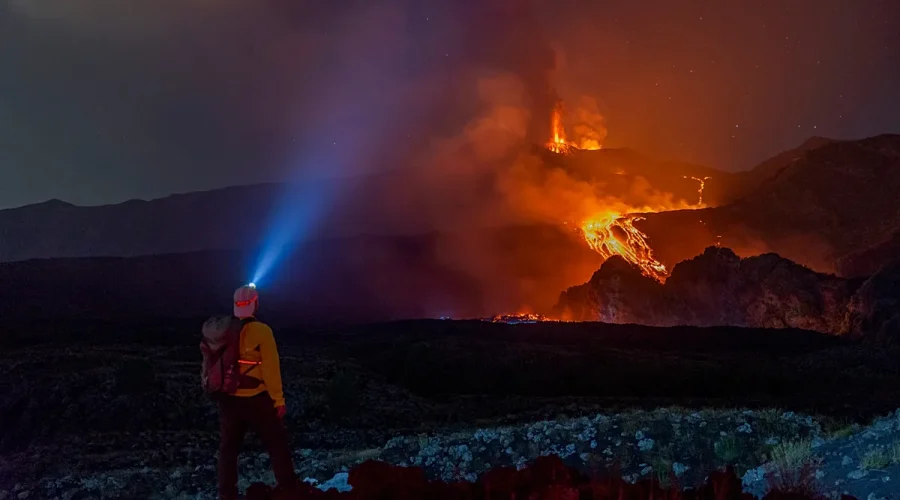
The tragedy unfolded against a backdrop of sustained eruptive activity. The National Institute of Geophysics and Volcanology (INGV), which operates the Etna Observatory, confirmed that a new lava vent had opened in the Valle del Bove following the partial collapse of the eastern flank of the Rittmann summit cone. That fresh vent, situated at approximately 2,350 metres elevation, generated a lava flow stretching roughly 500 metres before stalling and cooling. A second vent at around 1,900 metres remained active, sending molten rock downslope to an altitude near 1,600 metres.
Simultaneously, explosive activity persisted at Voragine, one of Etna’s principal summit craters. The associated eruption plume climbed to roughly 6,000 metres above sea level and drifted toward the south-east. Volcanic tremor readings stayed at elevated, steady levels, confirming the volcano remained in an active eruptive phase. The INGV stated it was monitoring the situation closely and updating its hazard assessments in real time.
Air Traffic Disruption Over Sicily
The ongoing ash emissions have continued to complicate aviation operations around the island. Authorities extended the closure of sector B1 of the Catania airspace and imposed a cap on arrivals at Catania-Fontanarossa airport: no more than ten flights per hour were permitted until noon on Tuesday. Departures, by contrast, faced no formal restriction. Passengers were nonetheless urged to verify flight status directly with their carriers before heading to the terminal. The disruption was not isolated; ash-related cancellations had already accumulated over the preceding days, underscoring how quickly Etna’s activity can cascade into regional transport chaos.
A Parallel Tragedy in the Alps
The Etna death arrived the same week a 42-year-old man perished on Piz Starlex in South Tyrol, apparently struck by lightning during his descent. His body was located late in the evening by a search drone at an altitude of approximately 2,600 metres. Two fatalities within days, both attributed to lightning on high ground, sharpened the focus on a recurring seasonal hazard.
Why August Is the Most Dangerous Month for Mountain Hikers in Italy
Mountain rescue organisations across Italy consistently identify August as the busiest month of the year for alpine and volcanic-terrain interventions. Thunderstorms, which build rapidly over ridgelines and summit zones in midsummer, rank among the most lethal natural hazards for people on foot at elevation. Exposed crests, rocky outcrops, and open slopes offer little shelter and present tall, isolated targets for cloud-to-ground strikes. Rescue teams advise hikers to descend from high ground and seek cover the moment thunder is heard or lightning is visible, ideally before the storm arrives overhead. On an actively erupting volcano, the calculus is compounded: ash-laden air, restricted access zones, and rapidly changing terrain mean that a hiker who strays into a closed sector faces compounded risks from both the volcano itself and the weather above it.
Mount Etna, rising to about 3,357 metres, is the tallest active volcano in Europe and has been in a state of intermittent eruptive activity for much of the past several years. Its proximity to densely populated areas of eastern Sicily, combined with its influence on one of the region’s principal airports, makes every eruptive episode a matter of public-safety urgency. The death of the American hiker will likely prompt renewed scrutiny of signage, access-control enforcement, and public communication around restricted zones on the volcano’s flanks during periods of heightened activity.
Related Reading
Frequently Asked Questions
What is Mount Etna lightning strike kills hiker?
Mount Etna lightning strike kills hiker is the main topic of this guide. The article explains the context, practical details, and next steps readers should understand.
Why does Mount Etna lightning strike kills hiker matter?
Mount Etna lightning strike kills hiker matters because readers are looking for a useful answer, not just a short summary. Good content should match search intent and help them decide what to do next.