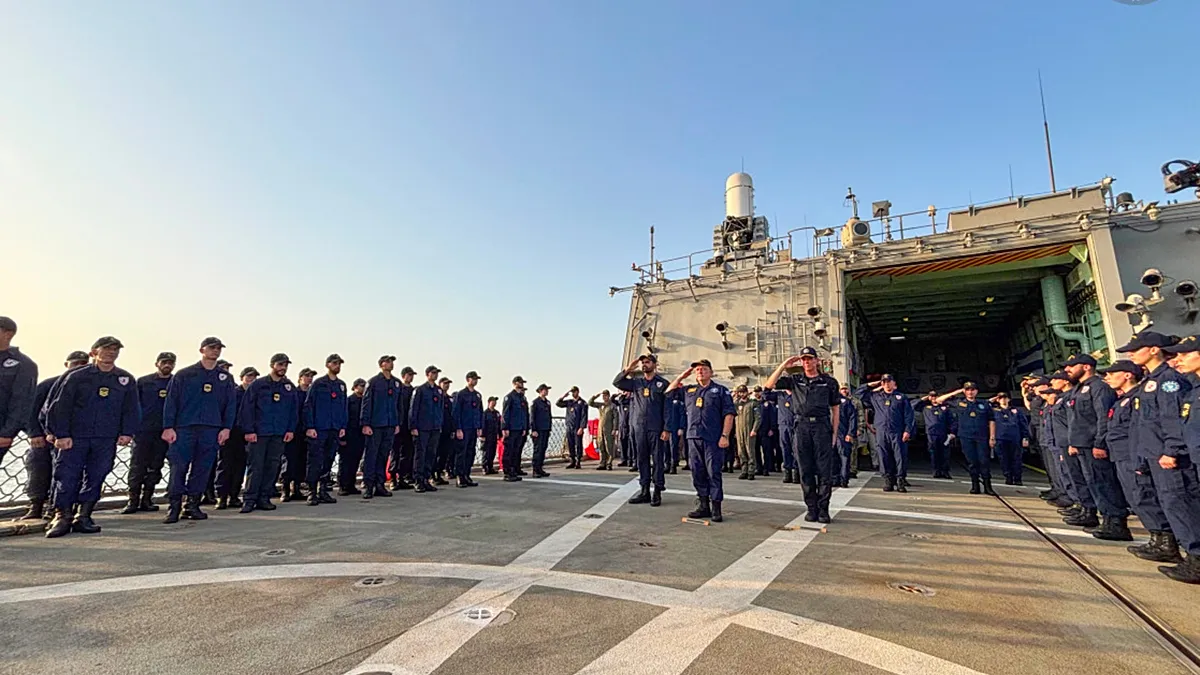
EU bolsters Red Sea mission amid – The European Union is ramping up its security missions in the Red Sea as the Iran-backed Houthis are reported to be preparing at Tehran's behest to close the Bab el-Mandeb strait, the gateway to the key Red Sea global shipping route and oil route in the Horn of Africa. The Bab el-Mandeb — Arabic for "Gate of Tears" — is a narrow strait roughly 30 kilometres wide at its narrowest point, separating Yemen on the Arabian Peninsula from Djibouti and Eritrea on the Horn of Africa. Around 10-15% of global maritime trade passes through it, including a significant share of Europe's oil and gas imports.
A closure would force vessels to take the much longer route around the Cape of Good Hope, adding two to three weeks to journeys between Asia and Europe and sharply increasing shipping costs. EU High Representative for Foreign Affairs and Security Policy Kaja Kallas wrapped up a trip to Djibouti on Thursday, where she visited the EU’s Aspides and Atalanta naval missions, which ensure security in the Red Sea against the Houthis. “Maritime security is under growing pressure," Kallas told the gathered press in Djibouti.
"Iran's repeated attacks on commercial vessels transiting the Strait of Hormuz are unravelling the interim agreement with the United States, while the situation in the Red Sea is once again deteriorating.” The EU foreign policy chief signed a new EU-Djibouti Status of Forces Agreement for Operation Aspides with the Djibouti government, a new joint security agreement to ramp up Europe’s security presence, warning that recent Houthi missile attacks on Saudi Arabia are a sign that instability on land becomes insecurity at sea. “Seeing our sailors at work reminds me and reminds all of us that the freedom of navigation cannot be taken for granted. It must be protected every single day,” Kallas told the Djibouti government officials.
Kallas said Djibouti has been one of the EU's closest maritime security partners in the region. “Together, we are significantly reducing the threat of piracy and contributing to safety and security at sea. That would not have been possible without Djibouti.” She said the deal signed between the EU and Djibouti “ensures maintaining access to and support for our ships and air assets for as long as they are needed.“ “The European Union continues to play an important role in helping to secure key maritime routes in the Red Sea, and it is needed more than ever across the region," Kallas added.
Kallas’ visit coincided with reports of Tehran requesting from its Yemeni proxies, the Ansar Allah — more commonly known as the Houthis — to get ready to shut the Bab el-Mandeb strait if the US attacks Iran’s infrastructure. The Houthis launched their Red Sea campaign in October 2023, declaring solidarity with Hamas during the war in Gaza and targeting vessels they alleged had Israeli connections. The campaign drove a roughly 50% drop in commercial traffic through the Red Sea between late 2023 and early 2024, forcing dozens of major shipping companies to reroute around Africa.
The Houthis paused most attacks after the US-brokered Israel-Hamas ceasefire in October 2025 but have since announced their readiness to resume them if conditions change. In a move that may send further shockwaves through the global economies as the Strait of Hormuz is still closed, Iran has chosen to use its so-called "Axis of Resistance" network to threaten the key maritime route. The network has served as a force multiplier for Iran throughout the current war, allowing Tehran to open multiple fronts simultaneously without directly deploying its own forces.
Any blockade of the Bab el-Mandeb would open an extra front in addition to the Hormuz, to pressure the US and its allies from further military action in Iran. EUNAVFOR Aspides, launched in February 2024 in response to the Houthi campaign against commercial shipping that began in October 2023, is a purely defensive maritime security mission covering the Red Sea, Gulf of Aden, Arabian Sea and Gulf of Oman. It does not conduct strikes on land targets.
Over the last two years, it has safeguarded more than 670 merchant ships and saved 128 seafarers, Kallas said. Operation Atalanta, the EU's older naval mission, launched in December 2008, was originally established to counter Somali piracy and has since been broadened to encompass broader maritime security in the western Indian Ocean. Both missions are coordinated from Djibouti, which hosts military bases for more than half a dozen countries — including the US, France, China, Japan, Italy and Germany — owing to its position at the southern entrance to the Red Sea.
If Bab el-Mandeb were to be choked off, too, the cost would be borne by European homes and businesses. For now, Europe is moving to keep this open. “When shipping is threatened, supply chains disrupted, prices rise, and families and businesses feel the consequences far beyond this region.
That is why today's agreement matters," Kallas said. "It's about more than supporting European operations. It's about keeping one of the world's economic lifelines open together,” she concluded.
Euronews correspondent Toby Gregory reported from the EU military vessels patrolling the Red Sea.