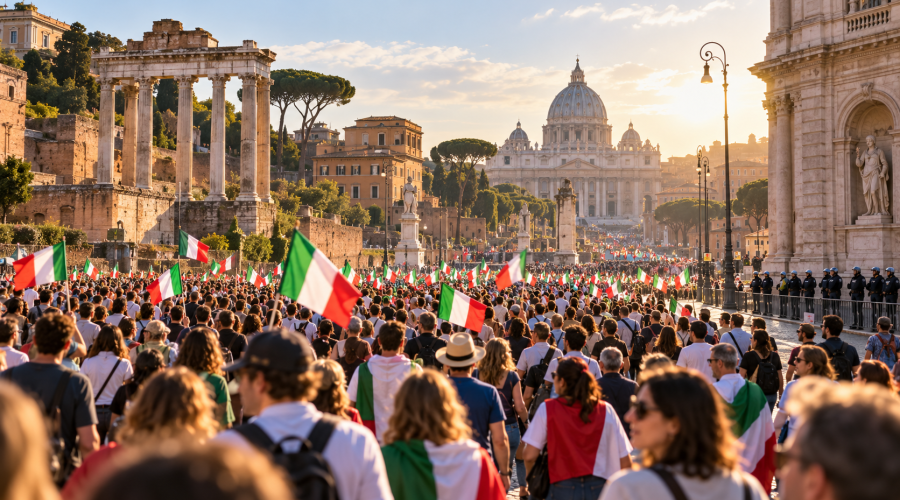
Protests sweep Italian cities amid heightened security presence
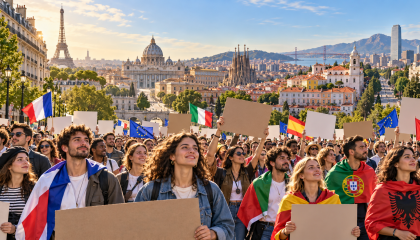
Usagevpn.com – Large demonstrations took place across Italy on Saturday, bringing thousands of people into the streets of major cities to voice concerns about the cost of living, Prime Minister Giorgia Meloni’s government and the wars in the Middle East. Most of the gatherings remained peaceful, though scattered confrontations emerged later in the day in Rome, Florence, Bologna and Turin.
The demonstrations came after violence during protests the previous weekend, prompting authorities to introduce a substantial security operation. Police officers and soldiers were deployed in city centres, while Milan received an additional deployment of 500 soldiers following attacks on shops there the previous Saturday.
Rather than forming one unified procession, participants in Florence, Turin, Milan and Rome initially assembled in smaller groups across different neighbourhoods. These groups later converged as they moved through the cities. Security forces repeatedly prevented protesters from entering central areas, creating tense standoffs at several points along the routes.
Rome march reaches the Colosseum
In Rome, a small number of demonstrators separated from the main march on Via Cavour and made their way towards the Colosseum. The group entered the Flavian Amphitheatre, displaying signs and chanting slogans inside one of the capital’s best-known historic landmarks.
Authorities subsequently led the protesters out of the site, while the larger demonstration continued through Rome’s streets. The episode underscored the challenge of managing a major protest in a city where public spaces, transport routes and internationally significant monuments are closely intertwined.
A second incident in Rome was captured in videos circulated on social media. A young protester stood in front of a police water-cannon vehicle as it moved forward for several metres. He came close to ending up beneath the truck before officers pulled him away by force.
Clashes in Florence and Bologna
In Florence, tensions rose around the Santa Trìnita bridge after protesters attempted to cross it. Officers held their security line as people pressed against the barrier. Police used batons while preventing the crowd from breaking through the cordon.
Bologna saw one of the more forceful responses of the day. A march was stopped from proceeding toward Via Marconi and Via Reno. Bottles and other objects were thrown at security personnel, who replied with tear gas and a water cannon. One person was taken to hospital after being struck by police officers.
Turin also experienced moments of friction as the day moved into the evening, although the available events pointed to isolated incidents rather than sustained disorder across the country. The pattern varied from city to city, with authorities seeking to contain groups and stop them from reaching particular central locations.
Milan remains comparatively calm
Milan was calmer than the cities where more serious confrontations developed. At least three separate marches came together and travelled around the area near the city centre. There were verbal exchanges between demonstrators and some far-right activists, but the situation did not escalate in the same way as elsewhere.
By the end of Saturday, nine people had been arrested and 87 others had been referred to the authorities, figures released by the Department of Public Security showed. Police also brought 371 people to stations for identity and other checks. That total included 110 minors and 69 foreign nationals.
Among those detained in Milan was 30-year-old Youssef Siher, who was placed under investigation on suspicion of aggravated incitement to commit a crime. Investigators allege that he was behind the “17 October Movement,” a group through which thousands of people are said to have exchanged information about participating in the previous weekend’s protests.
The events highlighted the competing pressures facing Italy’s authorities: safeguarding the right to public demonstration while trying to prevent violence, damage and disruption in densely populated urban centres. The heavy security presence was intended to deter a repeat of the previous weekend’s disorder, but the confrontations in several cities showed how quickly a peaceful march can become strained when routes are blocked or groups split away from the main crowd.
Meloni calls for safety alongside protest rights
On Saturday evening, Meloni praised the personnel involved in handling the demonstrations and stressed that public safety and freedom of assembly must coexist. Her message drew a distinction between those joining peaceful protests and people seeking conflict.
The right to demonstrate must always be guaranteed, just as the right of citizens to live in their cities in safety.
Safety must be guaranteed for everyone. For those who want to protest peacefully, for those who work and for those who want to live in their city without fear. Without leaving room for those who seek only confrontation and violence.
The scale of the protests reflected the range of issues motivating those who took part. Economic pressure, dissatisfaction with the government and anger over conflict in the Middle East brought people together under a broad protest movement rather than a single narrowly defined cause. That diversity also made the demonstrations harder to characterize as one unified political event.
Saturday’s marches ended with significant police activity and a limited number of arrests, while most participants were able to demonstrate without major violence. Attention will now remain on whether future gatherings can proceed peacefully under the expanded security measures introduced in Italy’s principal cities.
Related Reading
Frequently Asked Questions
What is Thousands march across Italy as protests?
Thousands march across Italy as protests is the main topic of this guide. The article explains the context, practical details, and next steps readers should understand.
Why does Thousands march across Italy as protests matter?
Thousands march across Italy as protests matters because readers are looking for a useful answer, not just a short summary. Good content should match search intent and help them decide what to do next.