Azerbaijan and Germany Forge New Strategic Partnership in Berlin
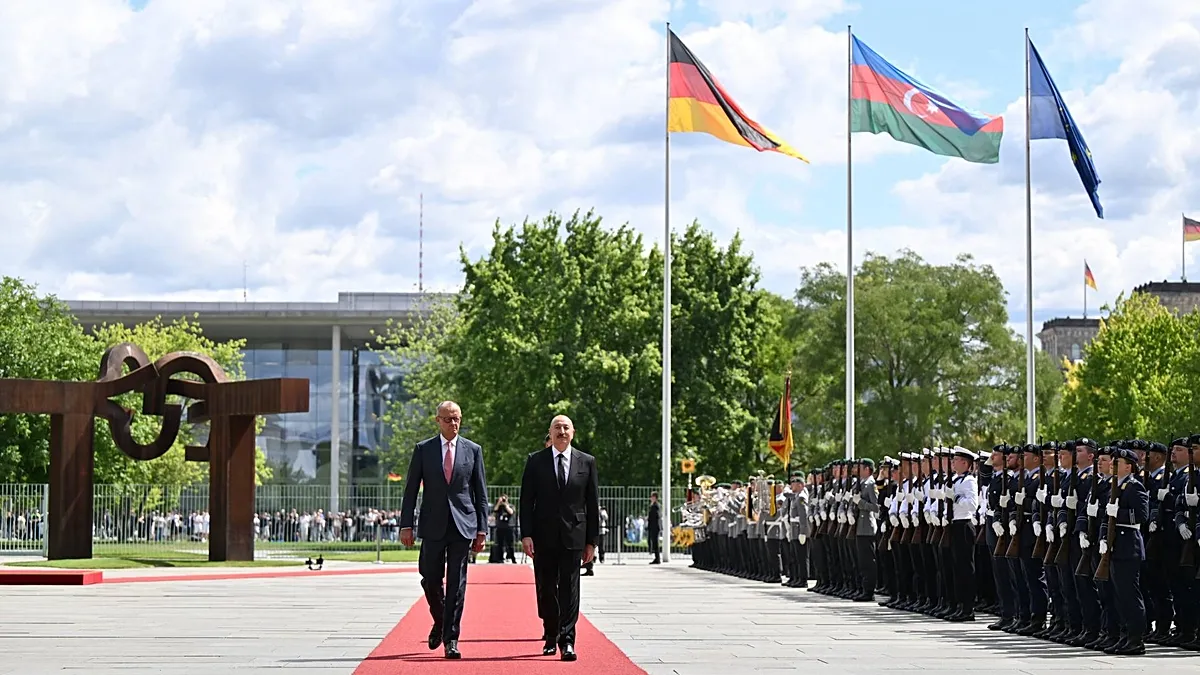
Usagevpn.com – Azerbaijani President Ilham Aliyev touched down in Berlin on Tuesday for a landmark state visit, marking his first official trip to Germany. The delegation’s priorities centered on strengthening energy security and advancing the Middle Corridor trade route, as European nations work to lessen their reliance on Russian fossil fuels. During the visit, Aliyev held bilateral discussions with Chancellor Friedrich Merz, followed by broader consultations with cabinet ministers.
Both nations formalized their commitment through a joint declaration establishing a strategic partnership. The signing ceremony also included multiple agreements spanning energy cooperation, transport development, infrastructure projects, trade facilitation, investment promotion, and scientific advancement. Notably, Germany became only the second European nation—following Italy—to conclude such an agreement with Azerbaijan.
Energy Cooperation Takes Center Stage
A joint business forum accompanied the diplomatic talks, highlighting commercial opportunities between the two countries. Chancellor Merz publicly acknowledged Azerbaijan’s contribution to Germany’s energy security:
I would like to express my gratitude to President Ilham Aliyev. You are creating an opportunity for us to receive larger volumes of gas from Azerbaijan. This issue is also reflected in the Joint Declaration that we signed today.
President Aliyev confirmed Azerbaijan’s capacity to meet Germany’s oil requirements through both domestic production and SOCAR’s trading division. Germany emerged as one of Baku’s most recent natural gas customers after Azerbaijan’s gas began flowing through the Southern Gas Corridor in 2024, utilizing onward connections to reach German markets.
Aliyev projected that annual gas deliveries to Germany would reach 2 billion cubic metres within the coming year. The Chancellor characterized the Southern Gas Corridor as a dependable supply pathway and emphasized Germany’s intention to cultivate a sustained relationship with Azerbaijan. Currently, Azerbaijan provides approximately 12 billion cubic metres of gas annually to European consumers, with Italy, Greece, Bulgaria, and Hungary representing the largest recipients.
Geopolitical Context and Regional Connectivity
Aliyev noted Azerbaijan’s readiness to expand energy exports to Germany and other EU member states as Russia’s energy infrastructure faces ongoing damage from the conflict in Ukraine. Berlin’s strategic pivot away from Russian energy following Moscow’s full-scale invasion in early 2022 has elevated the importance of the Southern Gas Corridor for European Union members.
The Middle Corridor, which connects China to Europe through Kazakhstan, Azerbaijan, Georgia, and Turkey, received substantial attention during the visit. Aliyev highlighted Azerbaijan’s significant investments in expanding port capacity at Alat on the Caspian Sea, noting that freight volumes through this corridor have increased considerably. As one of Europe’s primary industrial economies and a major importer of Asian goods, Germany maintains a direct interest in reducing reliance on trans-Russian transportation routes.
Additionally, Aliyev addressed the ongoing conflict between Iran and the United States, which has disrupted regional energy and trade flows while increasing the strategic value of overland and Caspian alternatives to the Strait of Hormuz. Azerbaijan has maintained a balanced diplomatic position throughout the conflict and expressed willingness to support international efforts aimed at restoring regional stability.
Broader Bilateral Cooperation
During separate discussions, Merz praised the Armenia-Azerbaijan peace process, voicing support for a comprehensive settlement and urging both parties to finalize their peace agreement. According to Orkhan Yolchuyev, director and co-founder of the CASPIA analytical think tank in Baku, the visit’s importance extends beyond energy to encompass a wider spectrum of sectors.
For the first time at such a high level, bilateral cooperation includes green energy, low-carbon hydrogen, digital transformation, industrial modernisation, transport connectivity and innovation. Germany increasingly sees Azerbaijan not only as an energy supplier but also as a partner for new industrial and logistics projects linking Europe, the South Caucasus and Central Asia.
Yolchuyev emphasized that the newly established Business Council could facilitate the translation of political commitments into practical cooperation, while the inclusion of education, science, and cultural exchanges provides the partnership with a more comprehensive foundation.
Shahin Ismayilov, a member of Azerbaijan’s parliament and chairman of the Youth and Sport Committee, stated that the Berlin agreements could enhance cooperation across energy, trade, transport, and investment domains.
President Ilham Aliyev’s visit to Germany marks an important step in further strengthening the strategic partnership between Azerbaijan and Germany. Azerbaijan remains a reliable partner for Europe, particularly in ensuring stable energy supplies and advancing the Middle Corridor initiative.
The comprehensive nature of these agreements reflects both nations’ commitment to deepening their relationship across multiple dimensions, positioning Azerbaijan as an increasingly vital partner in Europe’s energy transition and regional connectivity efforts.