Forty-Eight Hours in Sofia: Where Ancient Ruins Meet Brutalist Skyline
Usagevpn.com – Most travellers heading to the Balkans gravitate toward the Adriatic coast, filling up Croatia’s island chains or Montenegro’s cliffside towns. Bulgaria, however, has been quietly building its case for a longer look. With the country set to host the Eurovision Song Contest in 2026 — the final staged in Burgas along the Black Sea — and with Varna, hometown of winner Dara, already drawing renewed attention, the spotlight is shifting inland. Plovdiv, recognised as Europe’s oldest continuously inhabited city, adds another layer of appeal. Yet the most logical gateway into the country remains its capital, Sofia, a city where two millennia of layered history sit uncomfortably and fascinatingly beneath a post-war concrete skyline.
A Roman Foundation Beneath the Metro
The city’s original name was Serdica. Roman legions took control of the settlement around 29 BC, and it quickly grew into the region’s dominant urban centre. The ambition attached to that status was extraordinary: Constantine the Great reportedly weighed designating Serdica as the seat of the Byzantine Empire, a choice that would have upended the entire political geography of the eastern Mediterranean in favour of a Thracian hill town. He ultimately chose Constantinople, but the near-miss left a permanent imprint on the city’s identity.
That imprint is not confined to museum displays. Step off a train at Serdica Metro Station and you are, within seconds, walking among excavated Roman foundations. The centre of Sofia is dotted with further archaeological exposures: the remnants of the city’s eastern gate sit adjacent to the National Assembly building, while the basement of the Arena di Serdica hotel shelters the preserved seating of a Roman amphitheatre. These are not sealed-off exhibits behind glass; they are integrated into the daily flow of commuters and shoppers.
Saint George Rotunda
Among the oldest surviving structures in the city is the Saint George Rotunda, a circular church dating to the fourth century. Its interior walls carry Byzantine and Bulgarian medieval frescoes accumulated over many centuries of continuous use. During the sixteenth-century Ottoman period the building was converted into a mosque; by the nineteenth century it had been restored to its original liturgical function as a Christian church. The layered history is visible in the very fabric of the walls.
The Edict and the Square of Tolerance
Just outside Saint Sofia Church stands a replica of the Edict of Serdica, issued in 311 AD. It was the first imperial decree to grant Christianity legal standing within the Eastern Roman Empire — a fact that gives the city a peculiarly central place in the story of how the faith became institutionalised across the eastern provinces.
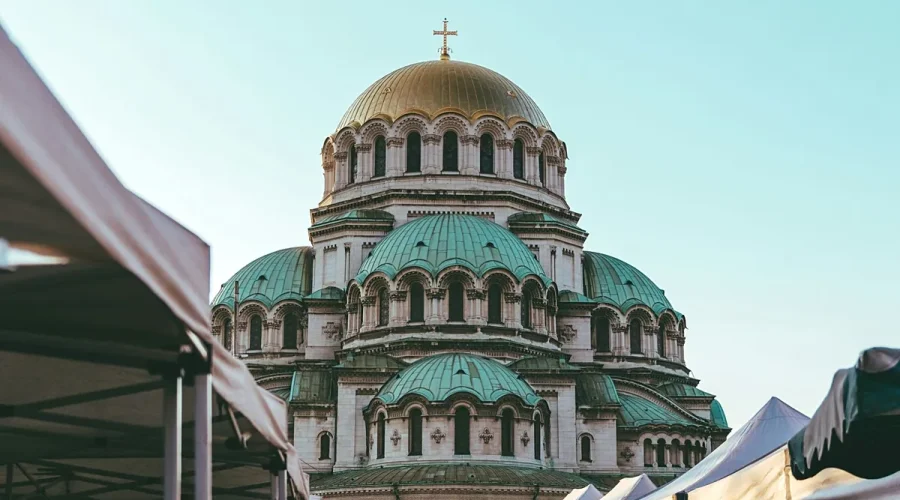
A short walk from that monument leads to what locals call the Square of Tolerance, where four houses of worship occupy the same compact block: St. Alexander Nevsky Cathedral (Bulgarian Orthodox), Banya Bashi Mosque (Sunni Islam), the Cathedral of St Joseph (Roman Catholic), and the Sofia Synagogue (Orthodox Judaism). Visitors wishing to enter any of these buildings should observe modest dress codes appropriate to each tradition. The coexistence is not merely symbolic; it reflects centuries of negotiated pluralism in a city that has served as a crossroads between empires.
Boyana Church and the Frescoes
On the city’s western fringe, Boyana Church earned a place on UNESCO’s World Heritage list in 1979. The designation recognised the complex as
“one of the most complete and perfectly preserved monuments of east European medieval art.”
The site comprises three successive churches: a tenth-century structure, a thirteenth-century successor, and a nineteenth-century addition. The thirteenth-century building houses the frescoes that drew UNESCO’s attention, described as
“one of the most important collections of medieval paintings.”
Those murals, depicting scenes from the life of Christ and the Virgin with a vividness unusual for their period, remain the primary draw for art historians and casual visitors alike.
Vitosha Mountain and Outdoor Routes
From the Boyana area, hiking trails climb into Vitosha Mountain, the volcanic peak that crowns the city’s western edge. The Visit Sofia portal lists several marked routes, including a relatively short ascent from Boyana Church to Boyana Waterfall, as well as longer loops for those with more time and stamina. In winter, the same slopes open for skiing, making Sofia one of the few European capitals with genuine alpine access within a short drive.
Murals, Brutalism, and the Communist Layer
Sofia’s streets are canvases. Murals appear in car parks, on underpasses, and across building facades; the city’s tourist information offices distribute maps pinpointing each piece. One of the most photographed is a large St. George-and-the-dragon composition near the Arte Sofia Hotel. Collectively, the street-art programme gives the city a visual energy that contrasts sharply with its more austere architectural heritage.
That heritage includes a substantial body of post-war construction. A free walking-tour map, downloadable from the Visit Sofia website, traces hotels, residential blocks, and civic buildings erected during the communist period. Brutalism reshaped the skyline decisively in those decades, and whether one admires or resents the concrete geometry, its scale is impossible to ignore. The tour deliberately routes walkers off the main boulevards to lesser-known structures where the ideological vocabulary of the era is most legible.
Zhenski Pazar: The Oldest Open-Air Market
Established in 1878, the Women’s Market — Zhenski Pazar in Bulgarian — is the city’s oldest open-air trading ground. Stalls offer fresh produce, dried spices, locally produced sweets, and clothing. A historical information board outside the market displays photographs spanning several decades of commerce. The market’s name, however, carries a more specific origin: during the Ottoman period, women were restricted to visiting either the local village bazaar or markets designated exclusively for female shoppers. The designation stuck long after the restriction lapsed, and the name persists into the twenty-first century.
Practical Notes for a Short Visit
Sofia’s public baths, fed by mineral-rich thermal springs, offer a low-key way to decompress after a day of walking between ruins and museums. The city’s compact centre means most of the sites described above are reachable on foot or by a short metro ride, making a two-day itinerary genuinely workable. The combination of Roman archaeology, medieval religious art, communist-era architecture, and active street culture gives Sofia a density of experience that few capitals of comparable size can match — and, with the Eurovision spotlight now fixed on Bulgarian shores, the window to explore it before the crowds arrive is narrowing.
Related Reading
Frequently Asked Questions
What is Sofia travel guide?
Sofia travel guide is the main topic of this guide. The article explains the context, practical details, and next steps readers should understand.
Why does Sofia travel guide matter?
Sofia travel guide matters because readers are looking for a useful answer, not just a short summary. Good content should match search intent and help them decide what to do next.