Four Wheels Along the Adriatic: A Motorhome Journey Through Croatia’s Coastal Heartland
Usagevpn.com – There is a particular freedom that comes from sleeping where the road ends and waking where the tide begins. A motorhome along Croatia’s Adriatic coastline transforms the country from a checklist of postcard destinations into a slow, unfolding conversation with its landscape. The route we traced ran from Rovinj in the upper reaches of the Istrian peninsula all the way south to Dubrovnik, threading through national parks, medieval fortresses, fishing hamlets, and island clusters with the sea never more than a few hundred metres away. Yet the experience is far from effortless. Sections of the coastal highway pinch into narrow, serpentine corridors where a 7-metre vehicle feels absurdly oversized, and parking is governed by a patchwork of licensed campsites and designated zones that frequently sit well outside the old towns and occasionally carry fees that make the wallet wince. Peak-season crowds in July and August compound every one of these frictions. For that reason, the route rewards travellers who time their departure for spring, early summer, or autumn, when the roads thin out and the campsites breathe again.
Rovinj: Where the Island Meets the Sea
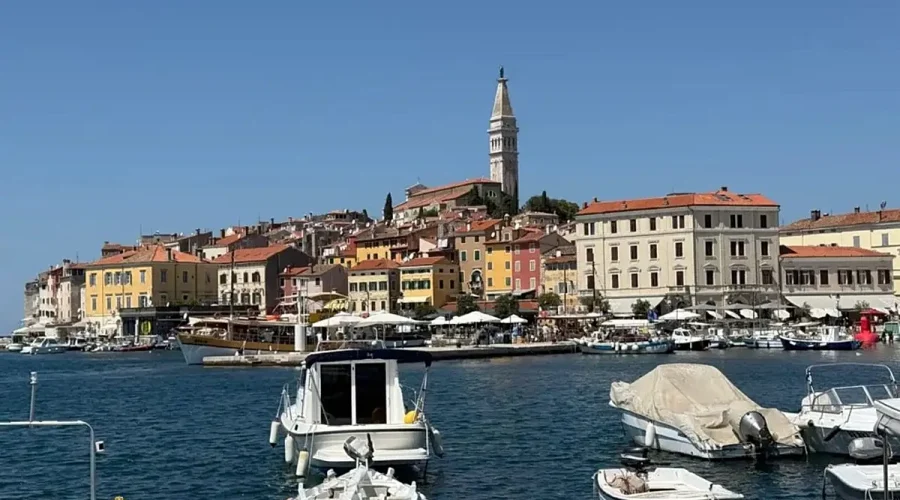
The journey’s northern anchor is Rovinj, a compact old town whose cobbled lanes were once confined to a small island now fused to the mainland. The church of St Euphemia rises above the rooftops as the visual centrepiece, while pastel-painted facades, a working harbour, and a scatter of tiny islets just offshore give the town one of the most instantly identifiable silhouettes on the entire Croatian coast. For a motorhome traveller, Rovinj doubles as a practical staging point: the surrounding campsites are well signposted, and the town’s compact scale means you can walk from your pitch to the waterfront in under ten minutes.
Pula: Roman Grandeur on a Working Harbour
Pushing further south along the Istrian coastline brings you to Pula, where the water turns a startling turquoise and the ancient past asserts itself with architectural force. The Pula Arena, raised in the first century AD, ranks among the six largest Roman amphitheatres still standing anywhere on Earth. Its tiered seating now hosts concerts, theatre festivals, and open-air performances, folding two millennia of history into a single evening’s programme. A walking circuit through the old town also surfaces the Arch of the Sergii on the principal thoroughfare, the Gate of Hercules, and the Kaštel fortress, a seventeenth-century Venetian bastion perched on a hilltop that frames panoramic views across the harbour and the terracotta rooftops below.
Istria: The Adriatic’s Tuscany
The heart-shaped peninsula that cradles Rovinj and Pula is split among three nations — Croatia, Slovenia, and Italy — and carries a pronounced Italian imprint in its dialect, cuisine, and built environment. Rolling green hills studded with vineyards, olive groves, dense forests, and medieval hill towns have earned the region the affectionate moniker “the Tuscany of the Adriatic.” Inland, settlements such as Motovun crown the ridgelines with commanding vistas. In our case, however, the absence of adequate motorhome servicing and parking infrastructure meant we had to drop Motovun from the itinerary entirely — a reminder that even the most scenic detour must survive contact with a 300-litre water tank.
Opatija: Austro-Hungarian Elegance on the Lungomare
South of Istria, the coastal character shifts abruptly. Opatija presents grand villas, century-old hotels, and manicured gardens saturated in Austro-Hungarian refinement. For decades the town served as a favoured retreat for the empire’s aristocracy, drawn by its mineral spas and a climate milder than the continental interior. The Lungomare, a seafront promenade stretching roughly ten kilometres, threads past those villas, sheltered coves, and water clear enough to see the seabed. The most rewarding way to experience it is unhurried: walk slowly, pause in the small inlets for a swim, and let the pace of the coastline set your rhythm. Extending the stroll a short distance south reaches Volosko, a modest old fishing village whose quiet lanes offer a welcome contrast to the grandeur behind you.
The Velebit Wall and the Island of Nin
Continuing south, the coastal road runs beneath the Velebit mountains in one of the most visually dramatic stretches of the entire route — sheer limestone faces dropping into deep-blue water. We opted instead for the motorway to reach Nin, a compact settlement perched on a tiny island ringed by shallow lagoons near Zadar. Nin preserves some of the oldest material traces of Croatian history, and its ninth-century Church of the Holy Cross, traditionally described as the smallest cathedral in the world, anchors the town’s identity. Sandy beaches, therapeutic mud flats, and working salt pans complete a landscape unlike anything else on the coast.
Zadar: Sound, Light, and the World’s Most Famous Sunset
Motorhome parking in Zadar is a genuine puzzle — the historic core is dense and narrow, and finding a legal pitch requires patience. The visit, however, repays the effort. Two installations dominate the seafront: the Sea Organ, a set of pipes buried beneath the stone steps that translates the push and pull of the waves into shifting tones, and the Greeting to the Sun, a ring of photovoltaic panels that ignites in a slow bloom at dusk. The sunset itself has acquired a quasi-mythical status in local tourism lore, anchored to a phrase attributed to Alfred Hitchcock, who reportedly called it the most beautiful in the world.
“The most beautiful sunset in the world.” — attributed to Alfred Hitchcock
Plitvice Lakes: Green Counterpoint to the Blue Coast
Leaving the Adriatic behind for a single day, we turned inland toward Plitvice Lakes National Park. Sixteen lakes, stacked in tiers at varying elevations and stitched together by rivers and cascading waterfalls, compose one of Croatia’s most staggering natural landscapes. Designated a UNESCO World Heritage Site, the park offers a deliberate counterpoint to the coastal itinerary: where the sea demands openness and salt air, Plitvice delivers dense forest, mineral-stained water, and a silence broken only by the rush of falling water. It is the kind of place that recalibrates your sense of scale after days of narrow coastal roads and crowded marinas.
The Adriatic motorhome route, in other words, is less a single itinerary than a negotiation — between the vehicle’s physical demands and the coastline’s narrow geometry, between the desire to linger and the practical need to find a pitch before dark, between the spectacle of the sea and the equally compelling pull of the interior. Done in the shoulder seasons, with patience for the detours and flexibility for the campsites that fill or close without notice, it remains one of the most rewarding long-distance drives available in southern Europe.
Related Reading
Frequently Asked Questions
What is Croatia on wheels?
Croatia on wheels is the main topic of this guide. The article explains the context, practical details, and next steps readers should understand.
Why does Croatia on wheels matter?
Croatia on wheels matters because readers are looking for a useful answer, not just a short summary. Good content should match search intent and help them decide what to do next.