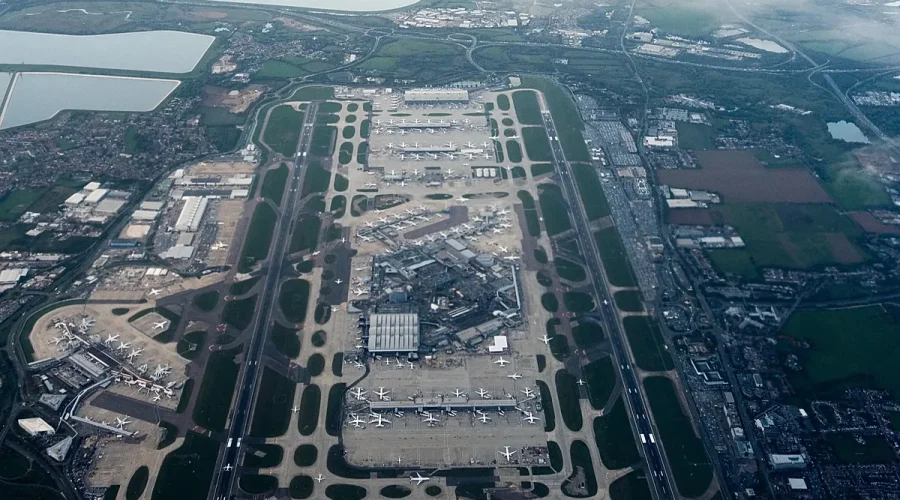
UK Airspace Grounded: Over 1,000 Flights Scrubbed After Control-System Failure
Usagevpn.com – Thousands of passengers found themselves stranded in terminals across Britain and Ireland on Tuesday morning when a sudden malfunction in the country’s air traffic management infrastructure brought scheduled departures and arrivals to a standstill. By the close of the day, flight-tracking data compiled by Flightradar24 confirmed that more than 1,000 services had been cancelled outright, making it one of the largest single-day disruptions in recent UK aviation history.
The outage struck at the heart of the system that coordinates every takeoff and landing in British airspace. For several hours, controllers could not process flight plans, meaning aircraft sat on the ground while passengers waited in increasingly anxious queues. The ripple effects extended well beyond the major London hubs, reaching secondary airports in the north, Scotland, and across the Irish Sea.
What Failed and How It Was Fixed
NATS, the organisation responsible for managing air traffic control across most of UK airspace, confirmed that a “technical issue” had developed within its flight processing system. Engineers were dispatched to the affected facility immediately, and the company stated that its teams were working through a solution while operations continued under degraded conditions.
Within hours, the company announced the problem had been corrected. In a social-media update, NATS communicated the following:
“Our system issue is now resolved, we are operating normally and working as hard as possible to clear the backlog of flights.”
The statement also carried an apology directed at passengers and airlines affected by the multi-hour freeze. Clearing the accumulated backlog of delayed departures, however, proved to be a slower process than restoring the software itself. Controllers faced a compressed window in which dozens of postponed flights needed sequencing, crew rotations had to be revalidated, and airport slots had to be redistributed before normal rhythm could return.
Airports Hit by the Cascade
The disruption was not confined to a single runway or city. London Heathrow and London Gatwick, the two busiest international gateways in the country, absorbed the heaviest volume of cancellations. Manchester and Birmingham airports in England’s industrial heartland saw their own schedules decimated. Further north, Edinburgh airport in Scotland and Liverpool airport in the northwest were similarly affected.
The problem did not stop at the British border. Dublin airport in Ireland, which handles a dense web of short-haul connections into and out of the UK, also logged cancellations and significant delays as inbound and outbound flights were pulled from the schedule. London’s two outer airports, Luton and Stansted, reported disruptions as well, meaning that virtually every major commercial airport in the region experienced some degree of operational interruption.
Airport operators cautioned that the knock-on effects would persist through the remainder of Tuesday. Manchester airport issued an evening statement confirming that it anticipated a full flight schedule to resume on Wednesday, while warning that the following day’s terminal environment could be noticeably busier than normal as airlines attempted to rebook stranded passengers into available seats.
Government Reaction and Accountability Questions
British Transport Secretary Heidi Alexander addressed the situation publicly on the social platform X, where she expressed relief that NATS had corrected the underlying fault. She directed thanks to the engineers and controllers who remained at their posts throughout the disruption:
“I am pleased NATS has remedied the problem and I thank all those working to get people moving.”
Alexander acknowledged that normalcy would not return overnight. She urged travellers to maintain patience and to verify their booking status directly with carriers:
“It will take time to fully resume flights, so continue to check with airlines.”
She also signalled that the incident would trigger a formal review of system resilience:
“I am seeking assurances that lessons will be learned and systems that support aviation are up to the job.”
That last remark points to a recurring concern in aviation infrastructure: the degree to which a single processing node can halt an entire national airspace. NATS operates the primary air traffic control services for the UK, and while its systems are designed with redundancy, a failure at the flight-processing layer effectively removes the digital backbone that links controllers, airlines, and airport operations. Industry analysts have long noted that as aviation grows more data-dependent, the blast radius of a software fault expands in proportion to the number of connected systems.
What Travellers Should Do
Airport authorities across the affected network issued a unified advisory: passengers with bookings on Tuesday or Wednesday should contact their airline directly before travelling to the terminal. Check-in desks, baggage drop points, and gate assignments may differ from the originally published schedule. Airlines were expected to offer rebooking onto later services, vouchers, or refunds in line with EU261 and UK consumer-protection regulations for cancelled flights.
For those whose itineraries extend beyond the UK, connecting flights booked through London or Manchester hubs carried particular risk of missed connections. Passengers with tight layovers were advised to allow additional buffer time or to rebook onto later departures where possible.
The episode underscores how a single technical fault, contained within one organisation’s software stack, can propagate across an entire continent’s short-haul network within minutes. As aviation authorities and NATS conduct their post-incident reviews, the central question will be whether the architecture that allowed the outage to cascade so broadly can be hardened before the next failure window arrives.
Related Reading
Frequently Asked Questions
What is Technical glitch leads to more than 1?
Technical glitch leads to more than 1 is the main topic of this guide. The article explains the context, practical details, and next steps readers should understand.
Why does Technical glitch leads to more than 1 matter?
Technical glitch leads to more than 1 matters because readers are looking for a useful answer, not just a short summary. Good content should match search intent and help them decide what to do next.