Living Beneath the Ash: The Quiet Health Toll of Europe’s Most Active Volcano
Usagevpn.com – For residents of Nicolosi, a small town clinging to the flanks of Mount Etna just outside Sicily’s second-largest city, Catania, the volcano is not a spectacle to be admired from a safe distance. It is a daily presence that settles into rooftops, crevices, and — invisibly — into human lungs. When the mountain erupts, and it can do so several times within a single year, the consequences ripple outward in ways that rarely make the evening news.
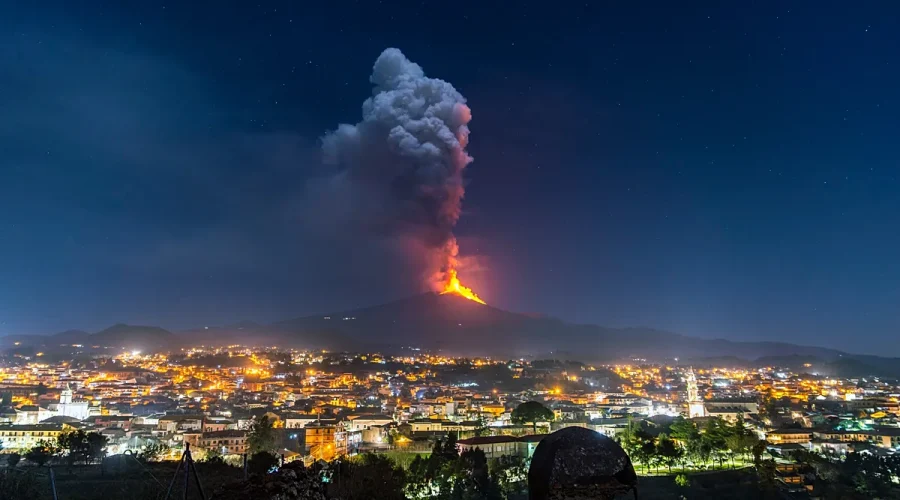
In recent weeks, a particularly violent sequence of eruptions thrust Etna back into global headlines, grounding hundreds of flights across southern Europe for roughly a week and producing the kind of fiery plume imagery that fills social media feeds. Yet beneath the spectacle of lava fountains and ash columns, a quieter story unfolds in clinics and emergency rooms across the Catania province, where residents report a familiar constellation of symptoms: persistent coughing, stinging eyes, nasal irritation, and relentless sneezing.
A Cough That Would Not Stop
Emilia Privitera first noticed something wrong in March 2021. The cough came on suddenly and refused to leave. Her initial fear was a second bout of COVID-19, but a negative test pushed that worry aside. She told herself it was seasonal allergy, nothing more.
“But the cough persisted for weeks, and my lungs would make a strange hiss sound when taking a breath between one cough and the other,” she recalls. “So I went to a specialist, and he found something I’d never expected: some almost imperceptible ash particles stuck in my lungs.”
Privitera’s experience is far from isolated. Hundreds of neighbours in the Nicolosi–Catania corridor report the same pattern: symptoms flare with each eruption, linger for weeks, and fade only partially before the next event resets the cycle. The town sits directly on Etna’s slopes, making it one of the most exposed communities in Europe to routine volcanic fallout.
What the Ash Actually Is
Volcanic ash is not simply dust. It comprises extremely fine fragments of shattered rock, crystallised minerals, and volcanic glass, often small enough to behave almost like airborne particulate matter. During periods of sustained activity, daily ashfall across the surrounding region can total thousands of tonnes. Because the particles are so lightweight and adhesive, they accumulate on rooftops, in guttering, and in hard-to-reach architectural corners where they can remain for years.
There is a paradox in this material. In agricultural terms, the ash functions as a mineral-rich amendment, improving soil drainage and water-holding capacity on surrounding farmland. For the people breathing the air above that farmland, however, the same fine fraction represents a hidden hazard, particularly once wind or vehicle traffic resuspends settled particles back into the atmosphere.
What the Research Shows
A 2013 study examining Etna’s 2002 eruptions — among the most intense in recent decades — documented a statistically significant spike in emergency-department presentations for acute respiratory illness, cardiovascular complaints, and eye irritation during the eruption window compared with the same period the prior year. Daniele Lombardo, a co-author of that work, notes that the finest ash fraction is capable of penetrating deep into pulmonary tissue, where it can provoke inflammation, oxidative stress, and sustained respiratory irritation. The risk is concentrated among children, older adults, and individuals carrying chronic respiratory conditions.
Separate investigations by the University of Palermo have examined elevated thyroid-cancer incidence in populations residing within the Etna volcanic zone, alongside evidence of heightened exposure to trace elements released during volcanic emissions. Together, these findings paint a picture of chronic, low-level biological stress that accumulates over years rather than manifesting in a single dramatic event.
Clinicians on the Front Line
Nunzio Crimi, a pulmonologist and allergist practising in Catania, shortened his summer holiday this year after a wave of emergency calls from long-standing patients with pre-existing breathing disorders.
“Patients with already fragile immune systems or pre-existing breathing medical conditions, like allergic asthma and chronic bronchopneumonia, are more prone to get sick from the ashfall and can experience quite serious worsening of their conditions,” he explains. “Especially those whose respiratory systems have been weakened by past experiences of pneumonia or COVID tend to suffer the most.”
The Sicilian Department of Civil Protection, the regional body responsible for disaster prediction, prevention, and emergency management, confirmed a measurable uptick in hospital emergency-room arrivals across the Catania province during the early-August eruption sequence. Crimi estimates his own clinic saw roughly an eight per cent rise in medical appointments relative to a normal period, with presenting complaints clustering around conjunctivitis, cough, nasal discharge, and sneezing.
A Broader European Pattern
Etna is not the only European volcano whose fallout has left a lingering health signature. In Iceland, the 2010 eruption of Eyjafjallajökull produced ashfall that affected communities far beyond the immediate crater zone. Researcher Gunnar Guðmundsson tracked residents most heavily exposed to ash particles and found that respiratory symptoms and psychological distress persisted for several years after the event, particularly among those subjected to repeated wind-driven resuspension of settled ash in the months and years that followed.
Animals Pay a Price Too
The biological impact extends well beyond human patients. In Iceland’s Westfjords, farmer Berglind Hilmarsdottir, based in Dyrafjörður, describes the practical danger to livestock when ash is not cleared promptly from grazing land.
“If ashes are not quickly removed from the fields, the cattle can risk dying of fluoride poisoning if they breathe or eat too much contaminated grass,” she warns.
Fluoride carried in volcanic ash can convert to acids within an animal’s digestive tract, eroding the intestinal lining and, in severe cases, causing systemic toxicity. For pastoral communities in ash-affected zones, the imperative to clear fields after every event is not merely cosmetic — it is a matter of animal survival.
The Unseen Infrastructure Problem
For towns like Nicolosi, the cumulative burden is logistical as much as medical. Years of accumulated ash on rooftops and in structural joints add weight, accelerate corrosion, and create slip hazards on walkways. Municipal cleaning crews face a recurring task that never truly ends, because each new eruption resets the clock. Meanwhile, residents with chronic conditions must maintain a low threshold for seeking medical attention, knowing that what appears to be a mild seasonal flare-up may in fact be another layer of microscopic glass lodged in their airways.
The spectacle of Etna’s eruptions will continue to draw tourists, photographers, and aviation disruptions. But for the people who call its slopes home, the volcano’s most consequential output is invisible, inhaled, and measured not in headlines but in clinic appointment books, pulmonary-function tests, and the quiet hiss of a breath between one cough and the next.
Related Reading
Frequently Asked Questions
What is It s a nightmare?
It s a nightmare is the main topic of this guide. The article explains the context, practical details, and next steps readers should understand.
Why does It s a nightmare matter?
It s a nightmare matters because readers are looking for a useful answer, not just a short summary. Good content should match search intent and help them decide what to do next.