The North Sea’s New Inhabitants: How Warming Waters Are Rewriting the Region’s Marine Ecology
Usagevpn.com – For generations, the North Sea’s identity as a fishing ground was defined by prawns, plaice, and cod. That identity is dissolving. A wave of cephalopod species — squid and octopus alike — has moved from being transient visitors to establishing permanent, self-sustaining populations in waters that were once too cold for them. The shift is not a seasonal blip; it reflects a structural transformation in the sea’s thermal regime, one that is reshaping food webs, commercial fisheries, and the regulatory frameworks meant to govern them.
A Permanent Population, Not a Passing Frenzy
The Thünen Institute, a German federal research body whose mandate spans agriculture, forestry, fisheries, and marine science, has documented how multiple cephalopod species have broadened their geographic range over recent decades. What once appeared as isolated strays now constitutes breeding populations. The short-finned squid Illex coindetii, a species that would have been a curiosity roughly a century ago, now spawns within the North Sea itself, maintaining its own stock independent of southern waters. This transition from vagrant to resident marks a qualitative break in the region’s marine biology.
The biological mechanism behind the speed of this colonisation lies in cephalopod life history. Compared with long-lived fish, squid and octopus complete their life cycles in a fraction of the time, enabling rapid generational turnover and swift adaptation to altered temperature, salinity, and prey availability. A species that could not survive a cold decade two generations ago may thrive within a handful of generations once the thermal envelope shifts.
The Numbers Behind the Warmth
The Federal Maritime and Hydrographic Agency (BSH) has maintained continuous surface-temperature measurements since 1969. By that record, 2025 stands as the warmest calendar year ever logged for the North Sea. Mean surface temperature reached 11.6 °C, approximately 0.9 °C above the long-term baseline. The summer of 2025 compounded the annual signal: with a mean of 15.7 °C, it registered as the hottest North Sea summer in the entire observational record. In stretches of the western and south-western basin, readings temporarily exceeded the long-term average by more than two degrees. Although complete official datasets for that summer were still being finalised at the time of reporting, sustained high readings were anticipated to persist into subsequent months.
The ecological consequences cut in both directions. Cold-adapted species such as cod face mounting thermal stress and are progressively retreating toward deeper, cooler waters. Simultaneously, the expanding squid population exerts top-down pressure on the very fish that form the backbone of traditional North Sea fisheries. Squid are voracious generalist predators; their diet encompasses herring, sprat, whiting, and cod alike. Researchers are now quantifying how much of the decline in commercially important stocks can be attributed to predation by these growing cephalopod populations versus other factors such as habitat loss or overfishing.
Octopus Join the Migration
The warming benefits are not exclusive to squid. Octopus sightings and landings have climbed noticeably, with 2026 reports highlighting a marked increase in the southern North Sea, particularly along the Belgian coast. Fishermen in that area describe occasional hauls of substantial size. Closer to home, the German Wadden Sea offers a microcosm of the broader trend. The curled octopus Eledone cirrhosa was a genuine rarity there in 2017. By the mid-2020s it remains uncommon but is no longer an anomaly: BeachExplorer, a peer-reviewed online database cataloguing coastal finds across the North Sea and Baltic, now classifies the species as “widespread in the North Sea,” with discrete records logged along the Wadden Sea shoreline.
Telling the Difference: Squid Versus Octopus
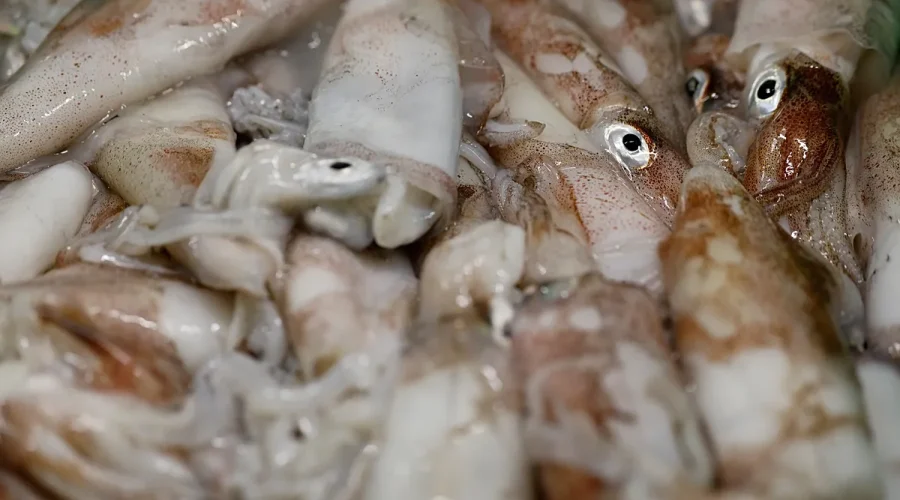
For readers encountering both groups in market or on shore, the morphological distinction is straightforward. Squid possess ten arms and an elongated mantle bearing lateral fins; internally they carry a gladius — a rigid, calcareous or chitinous rod that provides structural support and helps the animal maintain its hydrodynamic shape. Octopus, by contrast, have eight arms, a globular body devoid of fins, and no internal gladius whatsoever. The presence or absence of that internal scaffold is the single most reliable field character separating the two groups.
A Fishery Without a Rulebook
The economic dimension is accelerating faster than the regulatory one. Squid fishing has grown into one of the more significant cephalopod fisheries across the North-East Atlantic. As traditional demersal stocks fluctuate and access to other species tightens under quota regimes, coastal communities are turning to squid as an alternative income stream. Landings in the North Sea have roughly tripled over approximately four decades, reaching up to 3,000 tonnes annually.
Yet no dedicated catch quota currently governs North Sea squid. The scientific underpinning for such a regulation — stock assessments, spawning-biology data, ecosystem-impact modelling — is still in development. Cephalopod fisheries have historically escaped the structured management applied to cod, herring, or mackerel, leaving a governance gap that widens with every additional tonne landed.
What Comes Next
Scientists are exploring a menu of management instruments: catch limits calibrated to observed stock trajectories, seasonal closures timed to spawning peaks, and spatial protections around key reproductive habitats. Each option demands data that does not yet exist in sufficient resolution. Spawning grounds, for instance, remain poorly mapped. On one recent research cruise, scientists recovered squid egg masses, confirming active reproduction in situ, but the precise locations, timing, and extent of regular spawning across the basin are still unknown.
The North Sea is entering a period in which its biological identity is being rewritten faster than its governance architecture can adapt. The question for policymakers, fishers, and coastal communities is no longer whether cephalopods will remain, but how quickly the regulatory and scientific infrastructure can catch up to a sea that has already changed.
Related Reading
Frequently Asked Questions
What is Squid take over North Sea?
Squid take over North Sea is the main topic of this guide. The article explains the context, practical details, and next steps readers should understand.
Why does Squid take over North Sea matter?
Squid take over North Sea matters because readers are looking for a useful answer, not just a short summary. Good content should match search intent and help them decide what to do next.