Bishkek Becomes the Epicenter of Eurasian Power as SCO Marks Its Quarter-Century
Usagevpn.com – Twenty-one heads of state descended on Kyrgyzstan’s capital this week for what is arguably the most consequential gathering of the Shanghai Cooperation Organisation since its founding. The two-day summit, which opened on Monday, places the SCO at the center of a shifting geopolitical landscape where regional powers are recalibrating alliances, trade corridors, and security architectures in a multipolar Eurasia that no longer answers to a single Western framework.
The SCO’s ten full members — China, India, Pakistan, Russia, Belarus, Iran, Kazakhstan, Kyrgyzstan, and Tajikistan — collectively represent more than 40 percent of the global population. Around them orbit at least fifteen additional states holding “dialogue partner” status, stretching from Central Asia and the South Caucasus to the Middle East. Among those partners are Turkey, Egypt, Saudi Arabia, Qatar, Vietnam, Uzbekistan, Azerbaijan, and Armenia, giving the bloc a reach that extends well beyond its original post-Soviet security mandate.
A Quarter-Century of Institutional Evolution
Founded in the aftermath of the Soviet Union’s collapse to manage border tensions and regional instability, the organisation has transformed over twenty-five years into a multi-layered platform for trade, energy, transport, and political coordination. This year’s summit theme — “25 years of the SCO: together for sustainable peace, development and prosperity” — signals an ambition to position the bloc not merely as a security forum but as a structural alternative to the Western-led international order.
The agenda is dense. Leaders are expected to address the ongoing Russian war in Ukraine and its knock-on effects, the broader Iran conflict and its far-reaching consequences for global energy markets and supply chains, and the push by major and middle powers within the SCO to expand their influence on the world stage. Kyrgyzstan, as host, has placed particular emphasis on advancing the creation of an SCO Development Fund and a dedicated Investment Fund for large-scale infrastructure projects.
Leaders Converge: Bilateral Diplomacy and Cultural Showcases
China’s President Xi Jinping, India’s Prime Minister Narendra Modi, Turkey’s President Recep Tayyip Erdoğan, Russia’s President Vladimir Putin, Iran’s President Masoud Pezeshkian, and United Nations Secretary-General Antonio Guterres all arrived in Bishkek on Monday. Their schedules packed bilateral meetings before the leaders turned their attention to the opening of the World Nomad Games, a traditional Central Asian sporting and cultural event that doubles as a soft-power showcase for the host nation.
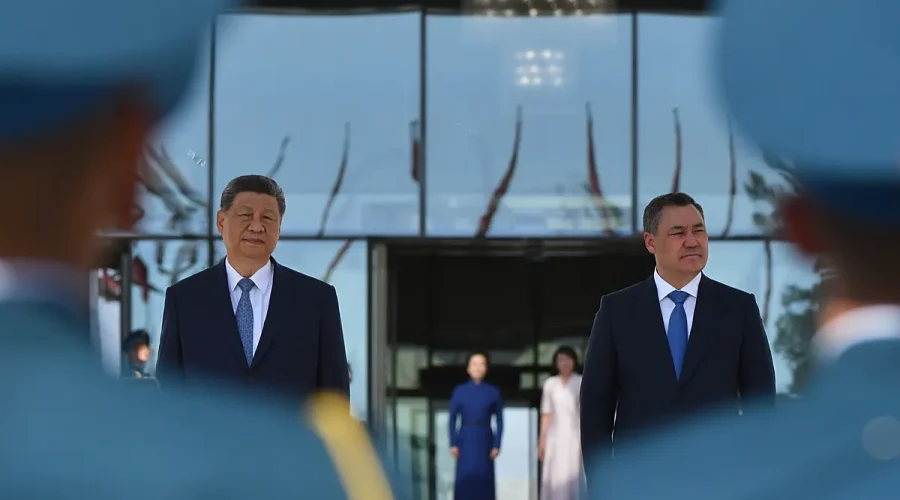
Host President Sadyr Japarov personally greeted Xi at the airport. The two leaders subsequently signed a treaty on “eternal good-neighbourliness, friendship and cooperation,” which the Kyrgyz presidency described in a formal statement as constituting a comprehensive strategic partnership for the new era. Xi characterised the bilateral relationship as entering a “golden period” of development.
“The SCO announced that Russia’s war in Ukraine, the Iran war with its far-reaching global economic consequences, as well as the push of the major and middle powers in the SCO for wider global influence, are among the main topics of this year’s gathering.”
Japarov’s Monday schedule extended well beyond the Chinese visit. He held bilateral talks with Guterres, Modi, Mongolian President Ukhnaagiin Khurelsukh, Lao President Thongloun Sisoulith, Togolese President Faure Gnassingbé, Vietnamese Vice President Vo Thi Anh Xuan, and Pezeshkian — a rapid-fire sequence underscoring Bishkek’s temporary elevation to a diplomatic crossroads.
Corridors, Railways, and the Reshaping of Transit
With the United States and the European Union actively deepening their own footprints in Central Asia, Beijing is accelerating economic engagement across the region. Major transport and infrastructure projects are under development to stitch together Chinese markets and Western destinations through the Central Asian interior. Chief among these is the China-Kyrgyzstan-Uzbekistan railway, a line expected to dramatically shorten freight routes linking Asia, the Middle East, and southern Europe.
Uzbekistan’s President Shavkat Mirziyoyev travelled to Bishkek to champion the Trans-Afghan Corridor, a project that would connect Central Asia’s rapidly expanding infrastructure network to Afghanistan and onward to Indian Ocean ports. Developing new energy and transport corridors is a stated priority of the summit, particularly as the Iran conflict disrupts established transit and supply-chain patterns.
Caucasus Peace and the Middle Corridor
In a separate track of diplomacy, Azerbaijan’s President Ilham Aliyev and Armenian Prime Minister Nikol Pashinyan convened in Bishkek on Monday for a new round of peace negotiations. The two former adversaries discussed next steps in their historic reconciliation process, alongside fresh trade and energy cooperation arrangements. Central to their talks were projects along the so-called Middle Corridor, routed through what is designated the Trump Route for International Peace and Prosperity (TRIPP) — a transit artery linking the Black Sea to the Caspian and beyond.
The convergence of these threads — security, finance, transport, and inter-state reconciliation — in a single two-day window makes this summit a barometer of how Eurasia’s centre of gravity is migrating. For the leaders assembled in Bishkek, the question is no longer whether the SCO will shape the rules of the new order, but how quickly it can translate institutional ambition into operational reality.
Related Reading
Frequently Asked Questions
What is Eurasian nations gather in Bishkek to forge?
Eurasian nations gather in Bishkek to forge is the main topic of this guide. The article explains the context, practical details, and next steps readers should understand.
Why does Eurasian nations gather in Bishkek to forge matter?
Eurasian nations gather in Bishkek to forge matters because readers are looking for a useful answer, not just a short summary. Good content should match search intent and help them decide what to do next.