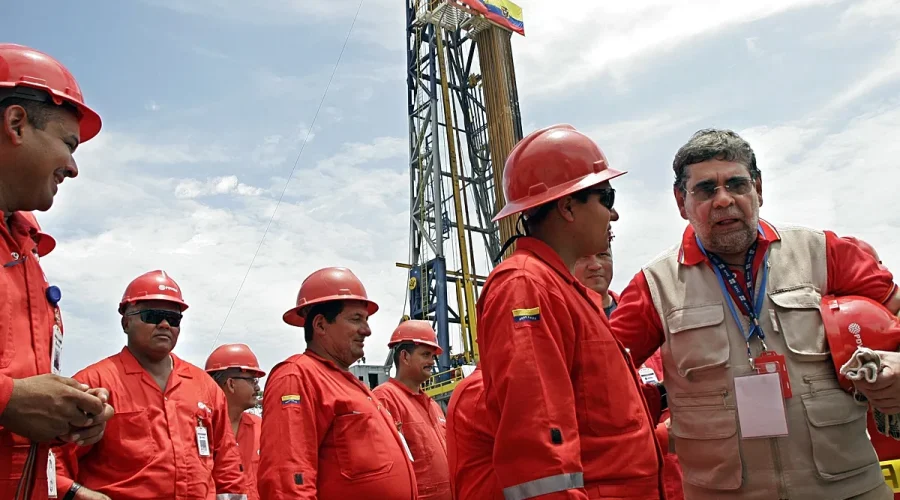
Venezuela’s Oil Sovereignty Stance Tested as US Secures Access to World’s Largest Reserves
Usagevpn.com – The question of who truly controls the world’s largest proven oil reserves has taken on new urgency after Caracas and Washington announced a sweeping energy pact that hands the United States operational authority over 65 billion barrels of Venezuelan crude. Acting President Delcy Rodríguez moved quickly on Saturday to reassure a domestic audience that ownership of those reserves remains firmly in Venezuelan hands, even as the practical mechanics of the agreement place significant decision-making power in American hands.
A Sovereignty Declaration Under Pressure
Speaking on state television, Rodríguez framed the arrangement not as a concession but as a managed partnership in which Venezuela keeps ultimate title to its subsoil wealth. The language was pointed and deliberate, aimed at silencing critics who had already begun circulating doubts about the deal’s transparency.
“One thing must be absolutely clear: Venezuela retains ownership and sovereignty over its resources.”
The emphasis on the word “sovereignty” is telling. For decades, Venezuela’s oil sector has been a flashpoint in debates over national patrimony, state control, and foreign exploitation. Rodríguez’s insistence that the new framework does not alter that foundational principle signals an attempt to contain political backlash before it crystallizes into organized opposition.
What the Agreement Actually Delivers
US President Donald Trump unveiled the pact on Friday, describing it as a landmark in hemispheric energy cooperation. Under its terms, Washington gains control over the development of 65 billion barrels of Venezuelan reserves. Rodríguez herself outlined the scale of the undertaking, noting that the deal “calls for the development of 17 strategic fields” and projects investment exceeding $100 billion, with projected tax revenues to the Venezuelan state surpassing $209 billion.
Those figures, if realized, would represent the largest single-country energy investment inflow in South American history. They also underscore how desperately the Venezuelan economy needs capital it has been unable to attract for over a decade. The country’s oil sector has languished through successive waves of mismanagement, sanctions, and macroeconomic instability, leaving infrastructure in disrepair and production capacity far below its historical peak.
Public Skepticism and the Transparency Gap
Not everyone in Venezuela is celebrating. Social media commentary has been quick to question whether the projected tax revenues will actually reach ordinary citizens or will be absorbed by existing fiscal structures. Critics of the government have pointed to a pattern of opaque negotiations and limited public disclosure surrounding major economic decisions, arguing that the absence of a detailed public text for the agreement makes independent verification impossible.
The concern is not merely academic. In a country where hyperinflation, currency controls, and institutional fragility have eroded public trust in state institutions, the gap between promised windfalls and lived economic reality can be vast. Whether the $209 billion in projected taxes translates into improved public services, infrastructure repair, or household income remains an open question that Rodríguez’s sovereignty rhetoric does not answer.
Two Decades of Decline and the Question of Capacity
Venezuela sits atop approximately 303 billion barrels of proven oil reserves, the largest verified stockpile on Earth. Yet production has collapsed from roughly three million barrels per day in the late 1990s to levels that, even after a recent recovery, remain a fraction of that peak. Between January and July of this year, output climbed 29.8 percent to reach 1.2 million barrels per day — a meaningful rebound, but one that still leaves the country producing less than half of what it managed a quarter-century ago.
The state-owned operator, Petróleos de Venezuela (PDVSA), has been stripped of much of its technical and financial muscle through years of underinvestment and capital flight. It simply does not possess the balance sheet required to develop deep-water fields, heavy-oil upgrading facilities, or the associated midstream infrastructure on the scale the reserves demand.
Analysts See a Pragmatic Necessity
Some economists and energy specialists have framed the US role not as domination but as a necessary guarantor of investor confidence. Oswaldo Felizzola, a professor at the Institute of Advanced Studies in Administration (IESA), argued that without American backing, the targeted fields would simply sit untouched for another decade or more.
“Without this, these fields would not be developed over the next 10 or 15 years.”
He added that PDVSA “does not have the financial resources to do so,” a blunt acknowledgment that state capacity alone cannot unlock the reserves without external capital and political risk guarantees.
Reforms, Sanctions Relief, and the New Operating Environment
The deal arrives alongside a broader policy shift. Rodríguez has pushed through legislative reforms in both the mining and oil sectors designed to open doors for private and foreign capital that were effectively sealed under earlier regimes. Simultaneously, Washington has eased sanctions that had long constrained Venezuelan oil exports and complicated international trade in the commodity. The combined effect is to create, for the first time in years, a regulatory environment in which large-scale foreign energy investment is legally and commercially feasible.
Washington’s Framing
US Secretary of State Marco Rubio took to the social platform X to characterize the agreement as a mutual triumph.
“It demonstrates how President Trump’s bold foreign policy is driving America First wins: securing stable reserves and low-cost oil in our Hemisphere and lowering gas prices here at home.”
The rhetoric positions the deal squarely within a transactional foreign-policy logic: Venezuelan crude becomes a strategic asset for American consumers and refiners, while Caracas receives the capital and technical partnership it needs to move barrels from the ground to the market. Whether that transactional framing survives the friction of implementation — environmental reviews, labor disputes, fiscal negotiations, and the perennial question of who captures the rents — will determine whether the agreement delivers on its stated ambitions or becomes another chapter in Venezuela’s long struggle to convert geological wealth into shared prosperity.
Related Reading
Frequently Asked Questions
What is Venezuela says it will retain sovereignty?
Venezuela says it will retain sovereignty is the main topic of this guide. The article explains the context, practical details, and next steps readers should understand.
Why does Venezuela says it will retain sovereignty matter?
Venezuela says it will retain sovereignty matters because readers are looking for a useful answer, not just a short summary. Good content should match search intent and help them decide what to do next.