Suwayda’s Druze Sheikh Declares Community Belongs to Israel, Rattling Damascus
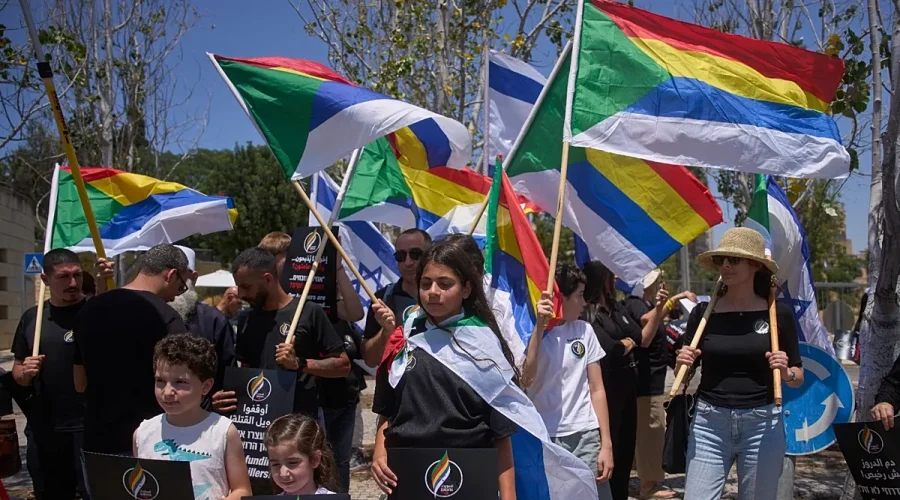
Usagevpn.com – In a province already locked in a standoff with the capital, Syria’s most prominent Druze religious authority has made a declaration that few expected: the Druze of Suwayda constitute, in his words, an inseparable element of the Israeli state. The remark, delivered at a public gathering in the southwestern province on Monday, sent shockwaves through regional capitals and intensified an already fragile confrontation between local power-holders and the new administration in Damascus.
Hikmat al-Hijri, who occupies one of the three Sheikh al-Aql seats — the highest religious offices within Syria’s Druze community — framed his comments around shared civilizational roots. He lauded what he described as Israel’s approach to nation-building and asserted that the two populations share foundational doctrinal parallels. His language went beyond mere political alignment, touching on theological commonality and a collective destiny he attributed to the region’s inhabitants.
“An integral part of the State of Israel.”
He added that the present era demands personal and communal sacrifice if lasting stability is to be achieved, without specifying what form those sacrifices would take.
A Faith with a Distinct Identity
To understand why the statement landed with such force, context on the Druze themselves is essential. The faith traces its origins to the eleventh century, emerging as a branch of Ismaili Islam before evolving into what scholars and most adherents now treat as a fully independent monotheistic religion. Approximately one million Druze live across the globe today. The overwhelming majority reside in Suwayda province and the adjacent Jabal al-Arab highlands in Syria’s southwest, while smaller but historically significant communities exist in Lebanon and within Israel’s borders.
The Israeli Druze occupy a singular position among Arab citizens of that state. Unlike their Muslim and Christian neighbors, they are conscripted into mandatory military service and have, for generations, served in the ranks of the Israeli Defence Forces. That institutional bond — combining shared ancestry with a formal civic obligation — appears to have shaped al-Hijri’s framing of communal belonging.
From Clashes to Gratitude
The declaration did not arrive in a vacuum. In July 2025, Israeli aircraft struck targets in Damascus and other locations, an operation the Israeli government characterized as a protective measure for Druze populations under threat. Syria’s government at the time denounced the strikes as a breach of national sovereignty. Yet al-Hijri publicly thanked Israel for that intervention, a gesture that underscored how far the province’s leadership had drifted from Damascus’s official position.
Since the collapse of Bashar al-Assad’s regime in December 2024, al-Hijri and allied local forces have pressed for a degree of autonomy that the new government under President Ahmad al-Sharaa has resisted. Periodic armed confrontations between provincial factions and units aligned with the central authority have punctuated the period. The province has declined to surrender its arsenals or to accept security officials appointed from Damascus, rendering it one of the most intractable governance problems facing the new administration.
Mediation, Ambiguity, and Internal Fractures
Days before al-Hijri’s Monday remarks, a Syrian-Israeli meeting convened in Jordan under American auspices. Its stated purpose was to lower tensions and explore security frameworks for southern Syria. Sources close to the Sheikh denied that direct talks with Damascus were underway, though they conceded that Washington was mediating on narrow issues — most notably the status of detainees held by each side.
Al-Hijri has earlier floated the prospect of Suwayda operating under international protection or, in a more radical formulation, acceding to another sovereign state. He has also called for special administrative arrangements that would insulate the province from central oversight. On Monday he tied his vision to the creation of a “civil state” guaranteeing every community’s rights free from discrimination, and he hinted that concrete developments in the province might be announced “within days,” offering no further detail.
Crucially, his position does not command unanimous support among Syria’s Druze. A faction of community members has openly rejected any effort to link the Druze of Jabal al-Arab or Suwayda to the Israeli state, arguing that such association instrumentalizes a distinct religious identity for geopolitical ends. Before the recent wave of violence, residents’ stated demands centered on a democratic political order that would dissolve sectarian partitions rather than entrench them.
What Comes Next
The declaration places al-Hijri at the center of a three-way equation: Damascus’s insistence on territorial integrity, Israel’s demonstrated willingness to project force into Syrian airspace, and Washington’s ongoing shuttle diplomacy. Whether the “developments within days” he alluded to will take the form of a local governance charter, a security compact, or something more consequential remains unclear. What is clear is that the language of communal belonging to a foreign state, spoken by a figure who controls both spiritual authority and de facto military leverage in a border province, has moved the question from abstract autonomy debate into the realm of hard geopolitical consequence.
Related Reading
Frequently Asked Questions
What is Syria s top Druze leader calls?
Syria s top Druze leader calls is the main topic of this guide. The article explains the context, practical details, and next steps readers should understand.
Why does Syria s top Druze leader calls matter?
Syria s top Druze leader calls matters because readers are looking for a useful answer, not just a short summary. Good content should match search intent and help them decide what to do next.