Mars Life Question Nears Resolution as New Evidence Mounts
Usagevpn.com – For decades, the Red Planet has occupied a unique position in our understanding of the solar system. While its rusty surface appears barren and unforgiving, Mars remains our closest planetary neighbor in terms of geological history and potential habitability. Recent discoveries are reshaping this narrative, suggesting that the conditions necessary for life may have existed on Mars far more recently than scientists previously believed. The conversation has reached new intensity at the COSPAR scientific assembly in Florence, where researchers are presenting compelling data that could fundamentally alter our understanding of life’s distribution across the cosmos.
Perseverance’s Groundbreaking Discoveries
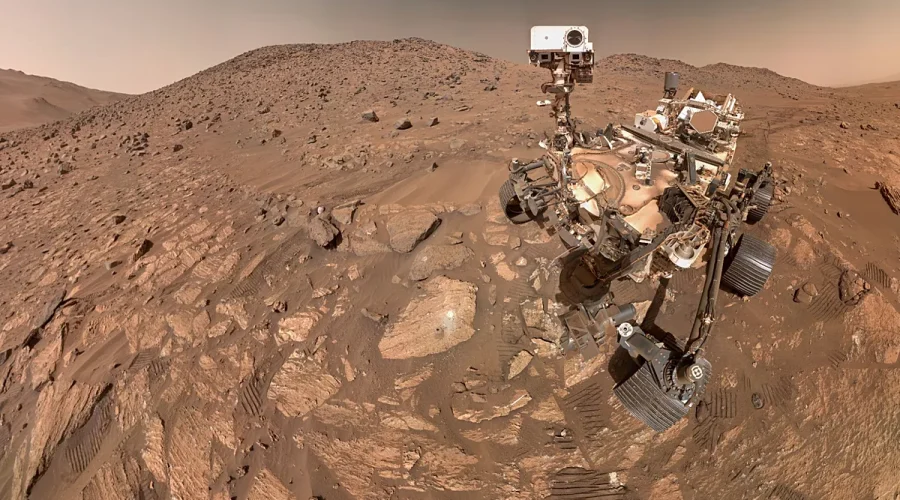
NASA’s Perseverance rover has been systematically exploring Jezero Crater since February 2021, collecting geological samples that tell a story of a wetter, warmer Mars. The rover’s sophisticated instruments have identified mineral formations that, when found on Earth, are consistently associated with biological activity. These discoveries, combined with the detection of complex organic molecules, have created a growing consensus among planetary scientists.
“The combination of several lines of evidence, such as the discovery by NASA’s Perseverance rover of minerals that on Earth are produced by micro-organisms, and of complex organic matter, is increasing the likelihood that Mars may have been inhabited, at least in the past,” explained Teresa Fornaro, researcher at the INAF Arcetri Observatory and professor of astrobiology in Florence.
The significance of these findings cannot be overstated. Organic matter detected on Mars exhibits structural characteristics that suggest biological processes, though the molecules have undergone significant alteration over billions of years. This makes tracing their exact origin challenging, but not impossible. The key to definitive answers lies in bringing these precious samples back to Earth for laboratory analysis using equipment far more powerful than anything currently capable of operating on the Martian surface.
The Underground Sanctuary Hypothesis
One of the most compelling theories emerging from recent research proposes that any Martian life would have found refuge beneath the planet’s surface. The harsh conditions on Mars today include intense ultraviolet radiation, extreme temperature fluctuations, and a thin atmosphere that offers minimal protection. Underground environments, however, would have provided shielding from these hostile surface conditions while potentially maintaining more stable temperatures and preserving water in liquid form.
“So far, we’ve only gathered indirect evidence. The organic matter we’ve found, for instance, has a structure that’s heavily altered, so it’s difficult to trace back to its origin. We’ll only have a definitive answer once we can analyse the samples here on Earth,” Fornaro noted, emphasizing the critical importance of sample return missions.
This hypothesis aligns with observations of Earth’s subsurface ecosystems, where micro-organisms thrive in complete darkness, deriving energy from chemical reactions with surrounding rocks rather than from sunlight. Such organisms, known as chemolithoautotrophs, represent a viable model for how Martian life might have survived and potentially still survives in the planet’s subsurface.
ExoMars: The Next Chapter
The European Space Agency’s ExoMars program represents humanity’s most ambitious attempt to directly investigate Mars’ biological potential. The mission architecture includes the Trace Gas Orbiter, which arrived at Mars in 2016 and has been continuously monitoring atmospheric composition, particularly methane levels that could indicate biological activity. The centerpiece of the mission, however, is the Rosalind Franklin rover, scheduled for launch in 2028 with surface operations beginning in 2030.
“Until now, rovers have only been able to explore the surface. Rosalind Franklin will be able to drill up to two metres into the ground, carrying the most advanced instruments ever sent to Mars,” Fornaro highlighted, underscoring the mission’s revolutionary capabilities.
The ability to access subsurface samples is crucial because surface conditions on Mars have been harsh for billions of years. Radiation and oxidation have degraded many surface organic molecules, while subsurface environments may have preserved biological signatures in remarkable detail. Rosalind Franklin’s drilling system will access these protected zones, collecting samples that could contain evidence of ancient life or even present-day micro-organisms.
Perseverance’s Extended Mission
While preparing for ExoMars, NASA’s Perseverance continues to deliver valuable data. Originally designed for a single Martian year—approximately 687 Earth days—the rover has exceeded expectations and remains fully operational. The mission’s longevity has allowed scientists to observe seasonal variations and collect samples from diverse geological contexts.
A particularly significant sample collected during the summer of 2024 has generated considerable excitement within the scientific community. This rock specimen, analyzed using Perseverance’s onboard instruments, contains features consistent with biological processes. While confirmation requires Earth-based laboratory analysis, the preliminary results have been described as transformative.
NASA administrator Sean Duffy characterized the discovery as “the moment when we have come closer than ever to life on Mars,” reflecting the growing confidence that the question of Martian life may soon receive a definitive answer.
The convergence of evidence from multiple missions, combined with the technological capabilities of upcoming missions, suggests that humanity stands on the threshold of one of the most significant discoveries in scientific history. Whether life existed on Mars remains one of astronomy’s most profound questions, and the answer may indeed be closer than we think.
Related Reading
Frequently Asked Questions
What is Was there ever life on Mars?
Was there ever life on Mars is the main topic of this guide. The article explains the context, practical details, and next steps readers should understand.
Why does Was there ever life on Mars matter?
Was there ever life on Mars matters because readers are looking for a useful answer, not just a short summary. Good content should match search intent and help them decide what to do next.