Forty-Nine Dead After Underground Tunnels Collapse at Central African Republic Gold Mine
Usagevpn.com – A catastrophic ground failure at an artisanal gold mine in the Central African Republic has killed at least 49 workers, according to a provisional toll issued by the country’s Mines Ministry. The disaster struck the Zamboye mine on 18 August, when the earth above a cluster of underground tunnels gave way in a matter of seconds, swallowing miners and bystanders who had been working or waiting near the surface. The site sits in Nana-Mambéré prefecture, roughly 50 kilometres from the town of Baboua, close to the border with Cameroon.
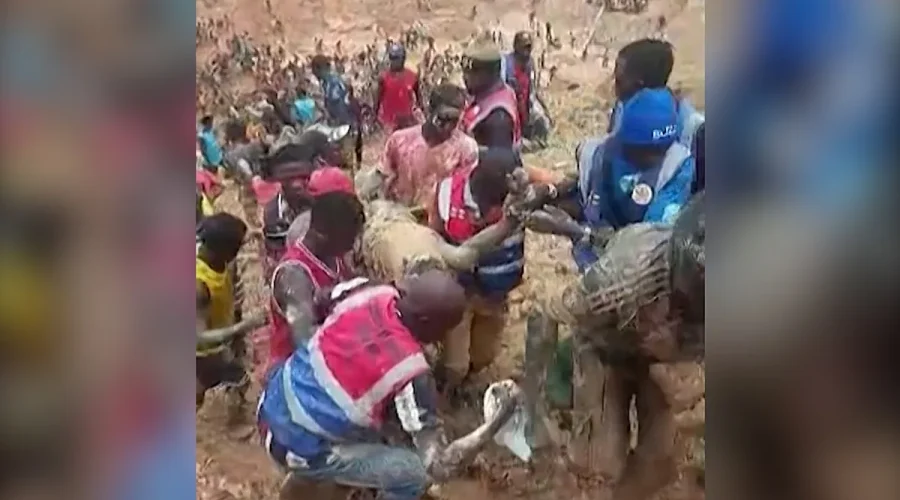
The collapse was captured on video by Freddy Metchoubatchou, who happened to be present at the mine when the ground split open. Filming from close range, he recorded the instant the terrain buckled and debris cascaded into the excavation, engulfing everyone in its path. The footage, released publicly on 21 August, offers one of the few unmediated visual accounts of the event and underscores how little warning the workers received before the earth swallowed them.
Rescue Effort Stalled by Thin Resources
As of 21 August, rescue teams were still digging through rubble and probing unstable shafts for survivors. The exact number of people who had been underground at the moment of collapse was never confirmed, a gap that complicates every subsequent search operation. Recovery work has been slowed by a shortage of heavy extraction equipment and by the limited availability of trained rescue specialists in the region. Local officials, Red Cross volunteers, and representatives from the mining sector initially spoke of more than 100 fatalities before the official figure was revised downward.
The Mines Ministry’s provisional count stands at 49 dead: 34 Central African nationals, 13 workers from Cameroon, and two from Chad. Seven injured survivors were transported to a hospital in Baboua for treatment. The disparity between early estimates and the ministry’s number reflects both the difficulty of confirming identities amid the debris and the fact that some workers may have been employed informally, without any record tying them to the site.
Investigation Opens Into Causes and Regulatory Failures
Authorities in Baboua have temporarily shut down the Zamboye mine and launched a judicial investigation into what triggered the collapse. Prosecutors indicated that several underground tunnels may have failed simultaneously, sending the overlying soil into free fall. The inquiry is also examining whether the operation violated mining regulations, with particular attention to allegations of illegal extraction and concealed employment—workers paid in cash, absent from official headcounts, and therefore invisible to safety inspections.
The closure and investigation come against a backdrop in which artisanal and small-scale mining remains a critical livelihood for thousands of households across the Central African Republic. In many of these operations, structural reinforcement of shafts and tunnels is minimal or absent, personal protective equipment is scarce, and emergency-rescue capacity is virtually nonexistent. Workers often descend into hand-dug passages with little more than a rope and a headlamp, relying on informal knowledge of the geology rather than engineered support systems.
A Pattern of Border-Region Disasters
The Zamboye tragedy is not an isolated event. Earlier in June, another deadly mine collapse occurred in the same border region near Cameroon, again claiming multiple lives among artisanal miners. The recurrence of such disasters within a single year highlights structural vulnerabilities that persist despite periodic government inspections and international development funding aimed at formalising the sector.
The proximity of the mine to the Cameroonian border also explains the multinational composition of the workforce. Workers from neighbouring countries routinely cross into the Central African Republic to seek employment in gold extraction, often without formal contracts or registration. Their inclusion in the death toll—15 of the 49 confirmed fatalities were foreign nationals—underscores how informal labour flows across porous borders complicate both rescue operations and accountability.
For the families of the dead and the communities of Nana-Mambéré prefecture, the immediate question is whether the judicial investigation will produce enforceable findings or dissolve into the administrative inertia that has characterised previous inquiries into mining accidents in the country. The temporary closure of the Zamboye mine buys time for forensic examination of the tunnel geometry, but it also suspends the income of every worker who depended on that site, deepening the economic pressure that drives miners to accept hazardous conditions in the first place.
As of the latest available information, no timeline has been announced for reopening the mine, and the final death toll may still be revised as recovery operations continue. The provisional figure of 49 stands as the official benchmark until further evidence emerges from the site.
Related Reading
Frequently Asked Questions
What is New videos show deadly landslide burying?
New videos show deadly landslide burying is the main topic of this guide. The article explains the context, practical details, and next steps readers should understand.
Why does New videos show deadly landslide burying matter?
New videos show deadly landslide burying matters because readers are looking for a useful answer, not just a short summary. Good content should match search intent and help them decide what to do next.