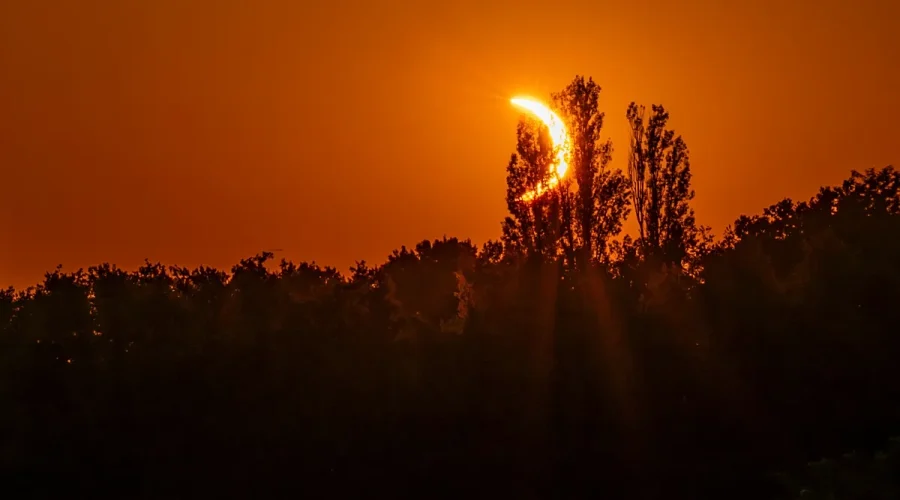
Red Sky Spectacle: Eclipse Draws Crowds to French Mountain Observatory
Usagevpn.com – Visitors to the French Pyrenees witnessed a remarkable celestial event as a solar eclipse transformed the mountain sky into a canvas of crimson hues. The gathering at Pic du Midi, one of Europe’s most renowned astronomical sites, brought together amateur enthusiasts and professional scientists eager to observe the phenomenon. Even though atmospheric conditions were less than ideal, the experience left attendees with lasting impressions of tranquility and wonder.
A Mountain Observatory Welcomes Eclipse Observers
The Pic du Midi Observatory, perched at an elevation of approximately 2,800 meters above sea level, has long served as a premier destination for both scientific research and public astronomy. Its strategic location in the Pyrenees mountain range provides relatively clear viewing conditions compared to lower-altitude sites, though weather patterns in this region can be unpredictable. On this particular day, the sky presented a mixed picture—patches of cloud drifted across the sun, yet these same clouds contributed to the dramatic reddening effect that captivated onlookers.
Hikers who had trekked to the summit found themselves rewarded with more than just panoramic views of the surrounding peaks. The eclipse offered a rare opportunity to witness the sun’s transformation as its light filtered through the atmosphere in unusual ways. Many described the atmosphere as serene, with the muted light creating an almost otherworldly ambiance that contrasted sharply with the typical brightness of a clear day.
Scientific Observations Continue Amidst Public Fascination
While visitors marveled at the visual spectacle, astronomers stationed at the observatory maintained their rigorous scientific program. Equipped with specialized telescopes designed for solar observation, researchers tracked the eclipse’s progression with precision. These instruments allowed them to capture detailed measurements of the sun’s corona and other phenomena that become visible during such celestial events. The dual purpose of the gathering—serving both public engagement and scientific inquiry—highlighted the observatory’s role as a bridge between professional astronomy and community participation.
The cloudy conditions, rather than hindering the scientific work, added an element of challenge that made the observations more noteworthy. Researchers noted that even partial cloud cover can provide valuable data about atmospheric effects on solar observation. The telescope’s tracking systems compensated for the shifting clouds, ensuring that critical measurements were not lost despite the variable weather.
The Pyrenees as a Gateway to Astronomical Discovery
The French Pyrenees have historically attracted visitors seeking both natural beauty and scientific wonder. The region’s relatively low light pollution, combined with its elevation, creates conditions favorable for stargazing and eclipse viewing. For many hikers, the eclipse represented the culmination of a journey—both literal and metaphorical. The effort required to reach the summit was amplified by the knowledge that they would be witnessing a celestial event that occurs only rarely at any given location.
The reddish appearance of the sun, caused by sunlight scattering through atmospheric particles and cloud layers, created a visual experience that many attendees found particularly memorable. This phenomenon, while not uncommon during eclipses, takes on special significance when viewed from a mountain vantage point where the sky appears closer and more intimate. The combination of altitude, cloud cover, and the eclipse itself produced a scene that defied easy description.
The experience was peaceful and unforgettable, with the sun appearing as a deep red disc through breaks in the clouds—a sight that made the effort of the climb entirely worthwhile.
Implications for Future Eclipse Viewing
Events like this one demonstrate the continued relevance of ground-based astronomical observation in an era dominated by satellite imagery and digital technology. The human element—the collective awe of spectators, the dedication of scientists working in variable conditions—remains an essential component of astronomical discovery. The Pic du Midi’s ability to host both public viewing and professional research simultaneously underscores its importance as a multifaceted scientific institution.
For the hikers and visitors who traveled to witness the eclipse, the experience offered more than a fleeting moment of beauty. It provided a connection to centuries of human fascination with the heavens, a reminder that even in our modern age, the sky still holds mysteries capable of inspiring wonder. The cloudy conditions that initially seemed like an obstacle ultimately contributed to making the event more distinctive, proving that nature’s unpredictability can enhance rather than diminish extraordinary experiences.
As the eclipse concluded and visitors began their descent from the mountain, many carried with them not only photographs but a renewed appreciation for the intersection of science, nature, and human curiosity. The red sky over the Pyrenees served as a testament to the enduring appeal of celestial events and the places where we gather to witness them together.
Related Reading
Frequently Asked Questions
What is Hikers in awe as solar eclipse?
Hikers in awe as solar eclipse is the main topic of this guide. The article explains the context, practical details, and next steps readers should understand.
Why does Hikers in awe as solar eclipse matter?
Hikers in awe as solar eclipse matters because readers are looking for a useful answer, not just a short summary. Good content should match search intent and help them decide what to do next.