Spain’s August 12 Eclipse: Who Gets the Full Show and Who Misses It
Usagevpn.com – Across the Iberian Peninsula, millions of eyes will turn upward on August 12, 2026, as the Moon passes directly between Earth and the Sun. Yet this celestial event will not deliver the same experience to every Spanish resident. Geography, weather patterns, and even workplace schedules will determine whether someone witnesses total darkness or merely a dimmed afternoon.
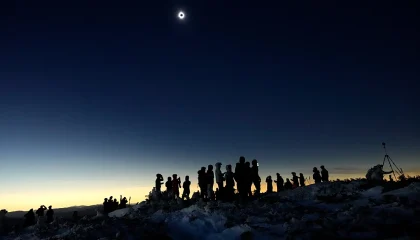
The path of totality stretches like a narrow ribbon from the Atlantic coast toward the Mediterranean, carving through the heart of the country. Within this corridor, residents will experience complete darkness for brief moments as the Moon entirely obscures the Sun. Provincial capitals positioned along this route include La Coruña, Oviedo, León, Bilbao, Zaragoza, Valencia, and Palma de Mallorca. Those living outside this zone will observe a partial eclipse, with coverage depth varying based on proximity to the central line.
Two of Spain’s largest urban centers find themselves in an unusual position. Madrid and Barcelona sit directly between the totality path, meaning their inhabitants will watch the Sun become nearly fully covered—reaching up to 99 percent in certain areas—without experiencing those precious seconds of total darkness that transform the event into something extraordinary.
Meanwhile, cities like Huesca and Zamora occupy the boundary zone of totality. Here, the jagged edge of the lunar surface creates uncertainty, making it difficult for observers to distinguish the exact moment of complete coverage without optical assistance. The southern portion of the peninsula will experience only partial coverage, with the Sun remaining partially visible throughout the event.
Weather and Timing: Nature’s Unpredictable Factor
Positioning oneself within the totality corridor offers no guarantees when meteorological conditions enter the equation. The Cantabrian coastline—encompassing Galicia, Asturias, and Cantabria—carries a reputation for cloudy skies during this season. Research indicates clear-sky probabilities in these regions sometimes fall below fifty percent, potentially obscuring even the most perfectly positioned observers.
Current atmospheric models suggest improved conditions in western Galicia, Castilla y León, and the Balearic Islands, though forecasts remain subject to revision until the final hours. For travelers who have journeyed hundreds of kilometers seeking totality, a single cloud formation on the western horizon can transform hours of anticipation into disappointment within moments.
Workplace Realities and Traffic Concerns
Unlike some nations that grant special leave for astronomical events, Spanish employment law does not recognize eclipses as force majeure situations. Drivers, hospitality employees, and construction workers scheduled for this afternoon will continue their duties while colleagues and neighbors pause to observe the sky. The totality phase lasts approximately one minute in optimal locations, fitting within the fifteen-minute break mandated by the Workers’ Statute for shifts exceeding six hours—provided employers agree in advance.
The Spanish traffic authority, DGT, has implemented special operations to manage anticipated congestion in high-traffic corridors. This means road workers and commuters alike face a more demanding afternoon than usual, navigating potential delays while others seek elevated viewing positions.
Protecting Eyes During the Event
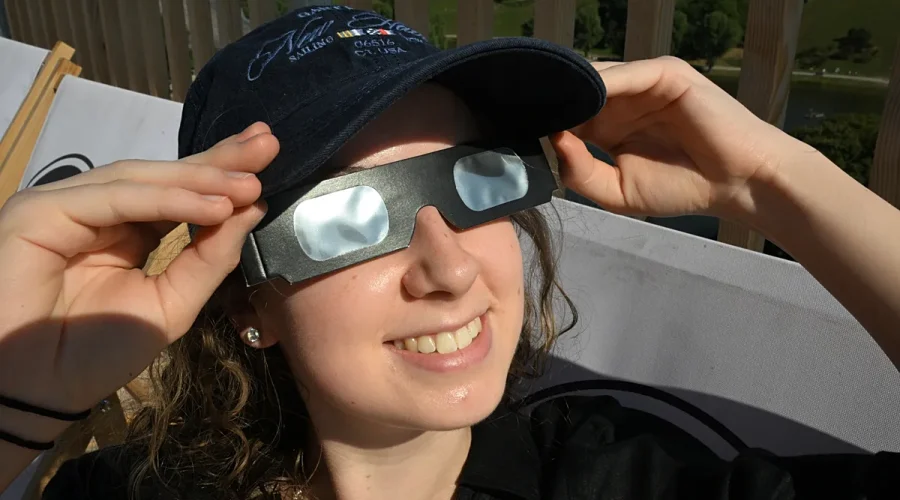
Observing the eclipse requires proper equipment. Ophthalmologists have emphasized for weeks that viewing the Sun without ISO 12312-2 certified eclipse glasses—even briefly—can trigger solar retinopathy. This condition involves retinal burns that produce no immediate pain, remain unnoticed during the event, and manifest as dark central vision patches within four to forty-eight hours afterward. Ordinary sunglasses, X-ray films, and homemade filters offer insufficient protection.
The ONCE Social Group has distributed approximately two million certified viewing glasses nationwide to prevent accidents. Medical societies particularly recommend that children observe only under direct adult supervision. Individuals lacking approved eyewear face two safe alternatives: complete avoidance of direct viewing or following the event through live broadcasts.
Watching the eclipse through binoculars is another option, provided proper filters are attached to prevent retinal damage.
Live Broadcast Options for Those Who Cannot Travel
Space agencies have prepared comprehensive coverage for viewers unable to reach the totality path. The European Space Agency will operate two simultaneous streams. The primary broadcast originates from the Javalambre Astrophysical Observatory in Teruel, featuring live interviews, educational content, and images. This English-language program will cover totality at 20:31 and remains accessible through ESA Web TV and YouTube platforms.
The secondary ESA stream presents telescope-captured imagery without commentary, offering pure visual documentation of the eclipse as it progresses. NASA will also contribute its own coverage, beginning at 19:15, displaying multiple perspectives as the shadow moves across the landscape.
Whether through direct observation or digital streams, August 12 promises to deliver a memorable celestial experience for Spaniards and viewers worldwide. The event reminds us that while geography determines our viewing angle, preparation and patience ultimately shape how we remember the moment the sky darkened.
Related Reading
Frequently Asked Questions
What is Who will miss the 12 August?
Who will miss the 12 August is the main topic of this guide. The article explains the context, practical details, and next steps readers should understand.
Why does Who will miss the 12 August matter?
Who will miss the 12 August matters because readers are looking for a useful answer, not just a short summary. Good content should match search intent and help them decide what to do next.