Uzbekistan and Azerbaijan Sign $1B Trade Pact
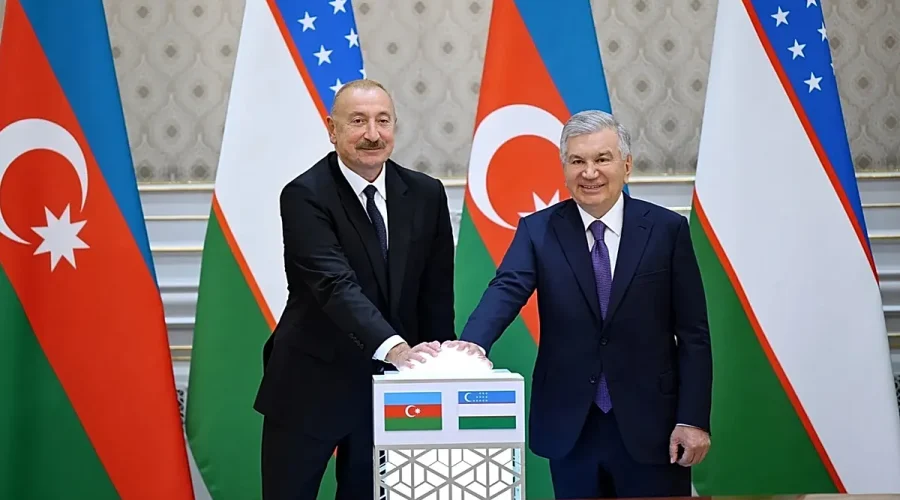
Usagevpn.com – Uzbekistan and Azerbaijan deepen alliance in a landmark move that pairs a new Treaty on Eternal Friendship with a concrete commercial goal: lifting bilateral trade to $1 billion (€856 million) by 2030. Presidents Shavkat Mirziyoyev and Ilham Aliyev formalized the instrument in Tashkent on Sunday, capping a two-day state visit and marking the sharpest escalation yet in a relationship that has accelerated since 2023.
From Allied Relations to Eternal Friendship
The treaty did not emerge overnight. In 2023 the two governments established the Supreme Interstate Council, a presidential-level body for coordinating long-term cooperation. The following year they signed a Treaty on Allied Relations, already a step beyond ordinary diplomatic friendship. Sunday’s instrument goes further, embedding the partnership in language that mirrors the permanent-alliance vocabulary reserved for close strategic partners.
Before the ceremonial signing, the two heads of state held private consultations and jointly chaired the third session of the Supreme Interstate Council, reviewing the pipeline of joint initiatives and setting priorities for the coming legislative cycle.
Trade Momentum and Investment Machinery
The commercial numbers behind the diplomacy show rapid acceleration. Bilateral trade hit $795 million (€680 million) in 2025, more than tripling the prior year’s volume. Between January and May 2026, trade reached $144 million (€123 million), a 33 percent year-on-year jump. Against that backdrop, the $1 billion target for 2030 implies roughly a 25 percent compound annual increase over the next four years.
Financing for that expansion is already in place. The Azerbaijan-Uzbekistan Investment Company, established in 2023 with $500 million (€428 million) in authorized capital, channels funds into projects on both sides of the border. During the visit, the leaders inaugurated or launched a slate of ventures spanning banking, construction, education, fuel retail, tourism, housing, mining, and agriculture. Specific facilities include a gypsum processing plant, two STEAM-focused schools, five planned SOCAR-branded filling stations, and a plant designed to extract silver from ore.
Mirziyoyev framed the portfolio as part of a wider investment architecture covering energy, geology, chemicals, construction, finance, and agriculture, signaling that the project list is expected to grow well beyond what was unveiled on Sunday.
Banking and Hydrocarbon Frontiers
One of the most consequential financial moves under negotiation involves Azerbaijan’s state-owned ABB seeking a 51 percent stake in Uzbekistan’s Davr Bank. S&P Global values the transaction above $100 million (€86 million), though it remains contingent on regulatory clearance in both jurisdictions. Completion would give the Azerbaijani lender a direct franchise in the Uzbek banking market, a first for a South Caucasus institution of that scale.
In the hydrocarbon sector, Aliyev indicated that bilateral oil and gas exploration projects are approaching their final stage. Drilling of production wells could commence as early as next year, provided exploration data confirms commercial viability. Both countries are seeking to diversify energy supply chains away from single-route dependencies, and a shared Caspian basin play would deepen that diversification.
Sea Breeze: A $5 Billion Tourism Gamble
The largest single disclosed project is Sea Breeze Uzbekistan, a year-round tourism and residential complex planned by Azerbaijan’s Agalarov Development at the Charvak reservoir in Bostanlyk district, Tashkent region. Uzbek government figures place planned investment at $5 billion (€4.28 billion) across the 577-hectare site. A public environmental impact assessment hearing was conducted in January, and authorities confirmed that wastewater would be routed outside the reservoir’s coastal zone to dedicated treatment facilities before discharge.
If realized, the development would position Tashkent region as a destination comparable to established Caspian resort towns while generating sustained employment in construction, hospitality, and ancillary services.
The Middle Corridor and Trans-Caspian Logistics
Connectivity forms the structural backbone of the partnership. Both leaders pledged to intensify freight flows along the Middle Corridor, the trans-Caspian network linking Central Asia through the South Caucasus to European markets. Transit freight between the two
Related Reading
Frequently Asked Questions
What is Uzbekistan and Azerbaijan deepen alliance with 1bn?
Uzbekistan and Azerbaijan deepen alliance with 1bn is the main topic of this guide. The article explains the context, practical details, and next steps readers should understand.
Why does Uzbekistan and Azerbaijan deepen alliance with 1bn matter?
Uzbekistan and Azerbaijan deepen alliance with 1bn matters because readers are looking for a useful answer, not just a short summary. Good content should match search intent and help them decide what to do next.