Strait of Hormuz Dispute Escalates as Trump Labels Waterway “New American Territory”
Usagevpn.com – The already volatile standoff between Washington and Tehran over the world’s most critical oil chokepoint took a sharp turn when President Donald Trump posted a map to his Truth Social account depicting the Strait of Hormuz as “new American territory.” The image, which Trump shared without any accompanying commentary, marks the second time he has published the same graphic — the first appearance having come on 18 August. The underlying concept, however, traces back to a rally in New York on 15 August, where the president outlined his vision for the waterway’s post-war status.
“After we finish defeating Iran, which is suffering a very severe defeat, I will soon announce that the Strait of Hormuz will be land belonging to the United States.”
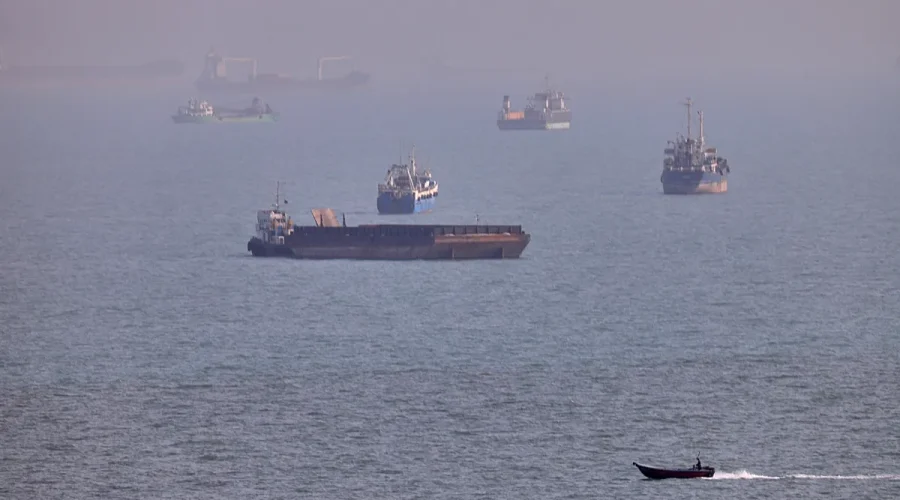
Those remarks, delivered to a New York crowd, framed the strait not merely as a transit corridor but as sovereign American ground — a claim that immediately collided with Tehran’s own assertion of authority over the passage. Iran has maintained that it exercises control of the waterway, while Trump insists the United States is the power that “fully controls” the route. Both positions sit atop a strait that, before the current war disrupted flows, carried roughly one-fifth of the world’s crude oil and liquefied natural gas exports. The closure Tehran imposed at the war’s outset has turned that statistical footnote into a daily global-market headache, and the two capitals remain locked in disagreement over the terms under which shipping might resume.
Tehran’s Counter-Narrative and Economic Threats
Iran’s response came swiftly and on multiple fronts. Mohsen Rezaei, secretary of the Supreme National Security Council, addressed Iranian state television on Saturday to declare that the strait would stay shut until Washington honoured its obligations and altered what he termed its “behaviour.”
“The Strait of Hormuz is closed, despite American claims, and it will not be opened until America corrects its behaviour… This time, America must first honour its commitments.”
Rezaei went further, issuing a direct warning to third-party nations that might align themselves with American economic pressure on Tehran. He told every country in the room, so to speak, not to participate in what he called the economic war the United States was waging. Any state that joined in imposing restrictions on Iran, he stressed, would be treated as an enemy of the Islamic Republic. He added that Tehran would seek to “harm” the commercial interests of nations that, in his phrasing, “refuse to distance themselves” from Washington.
The economic dimension of his warning carried concrete detail. Rezaei noted that Iran had so far directed its strikes exclusively at US military installations, deliberately leaving American corporate and economic assets untouched. That restraint, he made clear, was conditional.
“So far, we have targeted military bases only, but if they want to impose economic sanctions on us, the United States has oil companies and other businesses around Iran and elsewhere, and we will strike them.”
He closed his remarks by cautioning Trump that any fresh move against Iran risked triggering a major escalation — a pointed reminder that the military and economic tracks of the conflict remain tightly coupled.
Diplomatic Stalemate and the June Memorandum
The posturing on both sides comes against a backdrop of stalled diplomacy. In June, Tehran and Washington signed a memorandum of understanding intended to end the war and open a pathway toward a broader bilateral settlement. The framework, however, has not translated into implementation. Disagreements over how the MoU’s provisions should be executed, compounded by unresolved disputes about navigation arrangements in the strait itself, have frozen the process. Parallel talks between Iran and the Sultanate of Oman — aimed at establishing rules for traffic through the waterway — have continued but have yet to yield a breakthrough or any decisive agreement.
The practical stakes of that impasse are enormous. With roughly twenty percent of global hydrocarbon exports historically transiting the strait, every additional week of closure pressures energy markets, shipping insurance premiums, and the economies of Gulf states that depend on the corridor for their own export flows. The question of who controls the passage — and under what legal and operational framework — is therefore not an abstract sovereignty argument but a lever on global supply chains.
A Quip That Underscores the Rhetorical Escalation
Amid the gravity of the military and economic exchanges, one related development offered a glimpse of how far the rhetorical temperature has climbed. An official Iranian account earlier in the week described the US state of California as “new land belonging to Iran” — a mirror-image of Trump’s territorial claim, deployed with obvious satirical intent. Iranian Deputy Foreign Minister Kazem Gharibabadi, less inclined toward humour, weighed in with a sharper barb:
“His illusions about the Strait of Hormuz will be corrected soon, or we will correct the illusions of this delusional man.”
Whether the exchange remains confined to social-media maps and state-television warnings, or whether the economic threats Rezaei outlined begin to find expression in actual targeting of corporate assets, will depend on whether the June memorandum can be revived. Until then, the strait stays dark, the markets stay jittery, and two presidents continue to draw competing borders on the same stretch of water.
Related Reading
Frequently Asked Questions
What is Trump claims Hormuz on Truth Social?
Trump claims Hormuz on Truth Social is the main topic of this guide. The article explains the context, practical details, and next steps readers should understand.
Why does Trump claims Hormuz on Truth Social matter?
Trump claims Hormuz on Truth Social matters because readers are looking for a useful answer, not just a short summary. Good content should match search intent and help them decide what to do next.