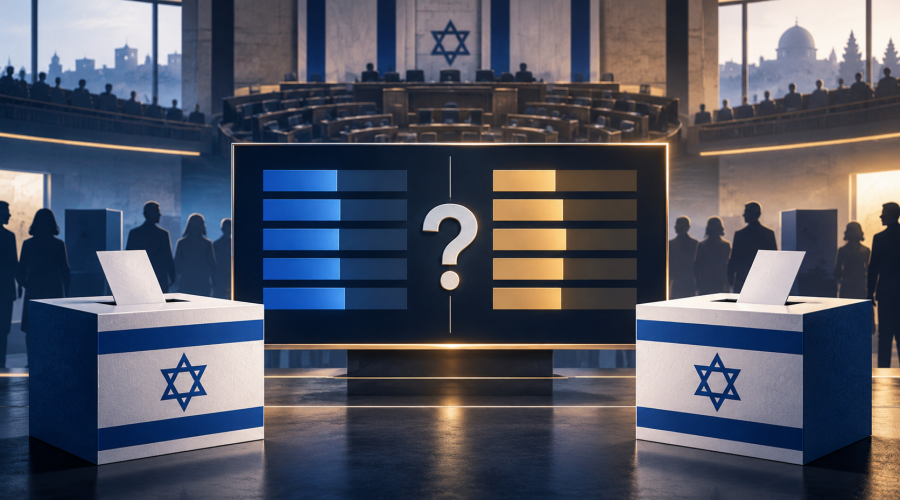
Israel’s Election Heads Toward a Fragmented Outcome
Usagevpn.com – Early projections from Israel’s legislative election pointed to a deeply divided Knesset, with neither Prime Minister Benjamin Netanyahu nor his leading challenger, Gadi Eisenkot, appearing to secure a governing majority.
The vote, held on Tuesday, was Israel’s first national election since Hamas attacked Israel on 7 October 2023. With more than 77% turnout recorded by Israel’s Central Elections Committee, the contest drew intense attention as voters weighed the country’s political direction and Netanyahu’s leadership.
Neither Major Bloc Reaches the Threshold
Initial estimates indicated that the opposition alliance led by Eisenkot may narrowly finish ahead of Netanyahu’s political camp, but neither side was projected to reach the 61 seats needed to control the 120-member Knesset.
One set of projections placed Eisenkot’s bloc on 53 seats, compared with about 50 for Netanyahu’s allies. Another estimate gave the opposition 52 seats and Netanyahu’s bloc 50. The small gap between the camps underlined the possibility of difficult coalition negotiations after the official count is completed.
Netanyahu’s Likud was still expected to emerge as Israel’s biggest individual party. Estimates gave Likud either 24 or 25 seats, leaving it ahead of every other single party even as the wider right-wing bloc remained short of a parliamentary majority.
Israeli governments are commonly formed through agreements among several parties, making the performance of smaller factions central to the final outcome. A party can lead the seat count without necessarily being able to assemble enough partners to govern.
Arab Parties Could Hold Greater Influence
Arab parties were projected to win between 17 and 18 seats, a potentially record-breaking result. Their expected strength could make them especially important in any effort to build a stable coalition or prevent one of the larger blocs from doing so.
The projections did not settle the question of who will ultimately lead the next government. Exit polls offer an early picture of voting patterns, but official results and post-election bargaining will determine whether a workable majority can be formed.
Israel’s electoral system distributes Knesset seats through proportional representation, meaning parties often depend on complex alliances. In a closely split parliament, negotiations over policy, cabinet posts and political commitments can become decisive.
Rival Leaders Claim Momentum
Eisenkot interpreted the early figures as a rejection of Netanyahu’s administration and its handling of the period since the October 2023 attacks.
“Complete lack of confidence in Netanyahu and the October 7 government.”
Yair Golan, who leads the left-wing Democrats party, also described the exit-poll picture as a clear message from voters.
“The public had spoken” and “ousted the Netanyahu government.”
Those claims were challenged by Foreign Minister Gideon Sa’ar, who cautioned that the left should not assume victory before official results and coalition talks are complete.
“One thing seems quite clear: The Likud is the largest party in Israel.”
His statement reflected the central contradiction in the early projections: Likud appeared set to retain its position as the largest party, while Netanyahu’s wider camp lacked a clear route to 61 seats.
A Vote Framed Around Leadership
Netanyahu spent much of election day urging his supporters to cast ballots, presenting the contest as a “matter of life and death.” The campaign unfolded against the continuing political and security consequences of the Hamas attacks of 7 October 2023.
For many voters, the election served as an assessment of Netanyahu’s leadership at a moment of national strain. The high turnout suggested broad engagement in a vote that could reshape the balance of power in Israeli politics without producing an immediate winner.
If the early projections are reflected in the final tally, both major camps will face a difficult challenge: finding enough parliamentary backing to govern while holding together ideologically diverse partners. The result may leave smaller parties with substantial leverage and could prolong uncertainty over Israel’s next governing coalition.
Official counting and the negotiations that follow will provide a clearer answer on whether Netanyahu can remain in office, whether Eisenkot’s camp can unite sufficient support, or whether Israel enters another period of political deadlock.
Related Reading
Frequently Asked Questions
What is Exit polls suggest no clear victor?
Exit polls suggest no clear victor is the main topic of this guide. The article explains the context, practical details, and next steps readers should understand.
Why does Exit polls suggest no clear victor matter?
Exit polls suggest no clear victor matters because readers are looking for a useful answer, not just a short summary. Good content should match search intent and help them decide what to do next.