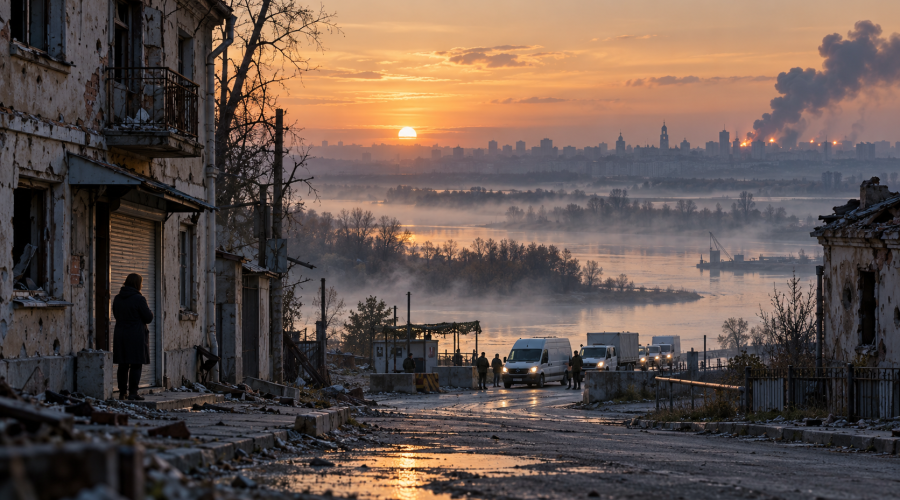
Ceasefire Opens a Narrow Window for Aid in Oleshky
Usagevpn.com – A temporary halt in fighting began at 3 a.m. Tuesday in the Russian-occupied southern Ukrainian city of Oleshky, creating a limited opportunity for an aid operation planned later this week. The arrangement, facilitated by US First Lady Melania Trump, comes as residents remain trapped amid shortages of food and medicine.
The pause is confined to Oleshky rather than representing a broader cessation of hostilities in Ukraine. Its immediate purpose is to enable humanitarian workers and civilian representatives to reach people inside the city, where the United Nations has said as many as 2,000 residents may be unable to leave.
Mines and drone activity have made evacuation especially dangerous, leaving civilians with few safe options as supplies diminish. The ceasefire therefore carries significance beyond the hours in which it is scheduled to hold: it may determine whether aid can be delivered and whether residents who want to leave can do so safely.
Civilian talks shaped the agreement
Melania Trump’s office said she led discussions involving civilian negotiators from Russia and Ukraine after meeting UN officials who outlined conditions in Oleshky. Representatives from both countries, along with their military forces, confirmed separately that the local ceasefire had started.
When she announced the deal last Friday, Trump said representatives would go door to door to assess what assistance people need and help organize departures for those seeking evacuation.
“Residents who wish to evacuate will receive coordinated support and transportation to their preferred destination. I anticipate some will want to go to Russia, and some to Ukraine,” she said.
The planned mission is expected to take place before another round of US-mediated discussions between Russia and Ukraine next month. Those negotiations are intended to explore an end to a war that has continued for more than four and a half years.
For Oleshky’s residents, however, the humanitarian operation is the more immediate test. A local agreement can provide a short opening for relief, but it does not remove the wider dangers posed by explosives, drones or the continuing conflict around the city.
Kyiv Hit as the Local Truce Takes Effect
Even as the Oleshky arrangement began, Kyiv was shaken by ballistic missile explosions shortly after 3 a.m. Air-raid alerts were activated across several parts of Ukraine, underscoring that the ceasefire did not extend beyond the designated area.
A Russian attack damaged the Southern Bridge, a major crossing over the Dnipro River in the Ukrainian capital. Mayor Vitaly Klitschko said metro infrastructure on the bridge was also affected, forcing the suspension of train services across it.
“A strike hit the Southern Bridge. Metro infrastructure on the bridge was also damaged,” Klitschko wrote on Telegram.
Damage to a river crossing can disrupt more than a single transport route. In a city divided by the Dnipro, bridges and rail links are important for daily movement, emergency response and access between different parts of Kyiv. The suspension of metro operations over the bridge added another practical consequence to the overnight attack.
The capital had already faced missile strikes late Monday. Officials said ballistic missiles damaged the grounds of a university, killing one person and injuring 10 others.
Attacks also reported in Kharkiv
Kharkiv, Ukraine’s second-largest city, was also struck late Monday. Authorities said two people were killed and four were injured in the attacks there.
Ukrainian President Volodymyr Zelenskyy condemned the continued strikes, saying they demonstrated Russia’s determination to sustain the war despite the narrowly focused humanitarian arrangement in Oleshky.
“It is important that the world sees that Russia is showing nothing but a desire to kill and continue waging war,” Zelenskyy wrote in an online post.
The contrast between the aid-focused truce and the attacks on Kyiv and Kharkiv highlights the limited nature of the Oleshky deal. It is designed as a practical measure for civilians in one endangered city, not as a nationwide security guarantee.
Its success will depend on whether access can be maintained long enough for aid workers and civilian officials to enter safely, evaluate needs and support people who choose to evacuate. With residents facing dwindling essentials and hazardous exit routes, even a short period of reduced fighting could prove critical.
At the same time, the strikes elsewhere in Ukraine illustrate the challenge awaiting negotiators before the next US-brokered talks. The humanitarian opening in Oleshky offers a rare, localized point of cooperation, while the broader war continues to inflict casualties and damage far beyond the city.
Related Reading
Frequently Asked Questions
What is US brokered ceasefire begins in Russian?
US brokered ceasefire begins in Russian is the main topic of this guide. The article explains the context, practical details, and next steps readers should understand.
Why does US brokered ceasefire begins in Russian matter?
US brokered ceasefire begins in Russian matters because readers are looking for a useful answer, not just a short summary. Good content should match search intent and help them decide what to do next.