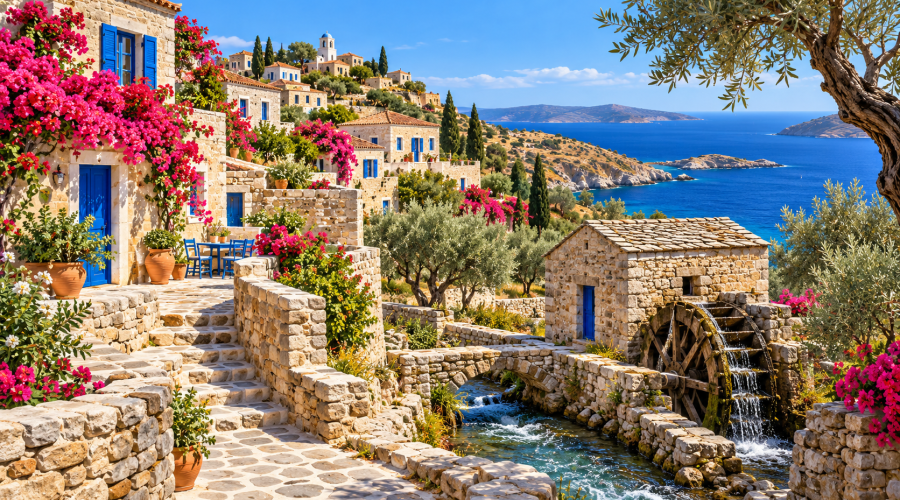
Kea’s built landscape tells the story of an island shaped by colour, stone and working rural life
Usagevpn.com – Just 16 nautical miles from Lavrio, Kea stands close to Athens yet retains an architectural character distinct from many of the better-known Cyclades islands. Also called Tzia, the western Cycladic island is often described as the gateway to the archipelago, drawing visitors not only in summer but increasingly during spring and autumn, when hiking routes, archaeological remains and traditional settlements become a central attraction.
Tourism has expanded on Kea, whose permanent population is about 2,500, but much of the island’s historic landscape remains visible. Its stone farmhouses, old mills and inland capital offer a different perspective on Cycladic architecture: one rooted in local materials, agricultural routines and generations of craftsmanship.
Ioulida: an inland capital with an urban character
Ioulida, the capital and one of Kea’s four historic towns, is unusual among the island’s settlements because it lies inland. It was formerly the commercial hub of Kea and climbs the slopes between the hills of Kastro and Mylos in an amphitheatre-like arrangement.
Rather than following only the familiar whitewashed Cycladic visual language, Ioulida combines narrow lanes, vaulted passages and stone-built homes with urban and neoclassical influences. The settlement received protected traditional status in 1978, recognising the importance of its built fabric and distinctive layout.
Colour is an essential element of that identity. Mayor Rena Velissaropoulou, who has held the post since 2019, says Kea’s older buildings reveal a past more varied than the blue-and-white palette commonly associated with Greece’s islands.
“We see the narrow streets, the arches and the stone buildings, and we also see colour on the walls. In fact, Tzia has always been a colourful place. During the Metaxas regime (1936–1940), white and blue were imposed, with white mainly for reasons of hygiene,” Rena Velissaropoulou said.
“But Tzia has colour, and we see this every time we come across an old building where we can see the plasterwork. There, we almost always find colour,” Velissaropoulou added.
The island also had access to miltos, a greyish-red stone extracted from cave-like quarries in the Otzia area. Its hue has been compared with the colour seen at Knossos, and the material was once sent to Athens.
“There was also miltos, a type of stone that was quarried in the cave-like pits of an exceptional cave in the Otzia area. This colour is a shade of greyish red, like the colour we see at Knossos, and in the past this stone was exported to Athens,” Velissaropoulou said.
Farmhouses beyond the capital
Outside Ioulida, winding roads rising through Kea’s hills lead past traditional stone structures, many of which are no longer occupied. Some have been lightly modified or adapted for visitor accommodation, while others remain reminders of an agricultural way of life that once defined the countryside.
These rural buildings were not isolated second homes in the modern sense. They served as the operational base for farmers and livestock breeders whose principal family residence was generally in the island capital. Livestock farmer Dinos Vrettos explains that ownership reflected a practical division between town and countryside.
“The farmstead is the home, the base of the island’s farmers and livestock breeders, which used to be situated in the countryside. Because their main home was in Ioulida. All farmers who owned farmhouses also had a home in the capital. Usually, the home was the wife’s dowry, and the farmhouse belonged to the husband,” Dinos Vrettos said.
Location was carefully considered. Builders avoided exposed summits because of the powerful northern winds, but they also stayed clear of the lowest ravines, where summer heat could become oppressive. The resulting pattern of construction reflects an intimate understanding of Kea’s terrain and climate.
Vrettos spent 25 years working as a stonemason and another five years with the excavation team at the ancient theatre of Karthia. His experience links the island’s archaeological inheritance with the practical stonework traditions found in its rural homes. One traditional dwelling he helped present, though no longer inhabited, still retains the features associated with a Tziotiki house.
“They used stones from ancient structures to build the houses. Over the years, the craft passed from one generation to the next, so I learnt it too. Unfortunately, the house in this condition has changed hands; it has been sold. Usually, the houses are bought by foreigners, not Greeks – mainly foreigners who, however, try to preserve them as they found them,” Dinos Vrettos said.
The preservation of such buildings matters because their value lies in more than their appearance. They record how families organised property, worked the land and adapted construction to the island’s materials. Sensitive restoration can help retain those links even when properties take on new uses.
Watermills and the memory of everyday work
Kea’s industrial heritage is also visible in Mylopotamos. Along the stream near the Flea spring, 11 watermills once operated. They are thought to date from the Ottoman period and continued working until the Second World War. By the 1980s, they had gradually fallen out of use.
Only fragments of that network remain active today. One former mill has become a home, while another is maintained for island visitors. Their survival offers a tangible view of how water once supported local production and everyday life.
For retired aviation worker Savvas Michael, keeping these places visible is a way of connecting younger generations with the island’s past.
“Technology has advanced enormously. Young people and children being born today have no idea what life was like in the past. So we’re trying to bring young people closer to tradition so that they know what we’ve inherited. Even if we don’t use them anymore, it’s important to keep at least”
Although the thought is unfinished, its message is clear: heritage does not need to remain economically indispensable to deserve care. In Kea, coloured plaster, local stone, hillside farmhouses and quiet watermills together form a living archive of the island’s changing relationship with land, labour and tourism.
Related Reading
Frequently Asked Questions
What is The architectural heritage of Greece s Kea?
The architectural heritage of Greece s Kea is the main topic of this guide. The article explains the context, practical details, and next steps readers should understand.
Why does The architectural heritage of Greece s Kea matter?
The architectural heritage of Greece s Kea matters because readers are looking for a useful answer, not just a short summary. Good content should match search intent and help them decide what to do next.