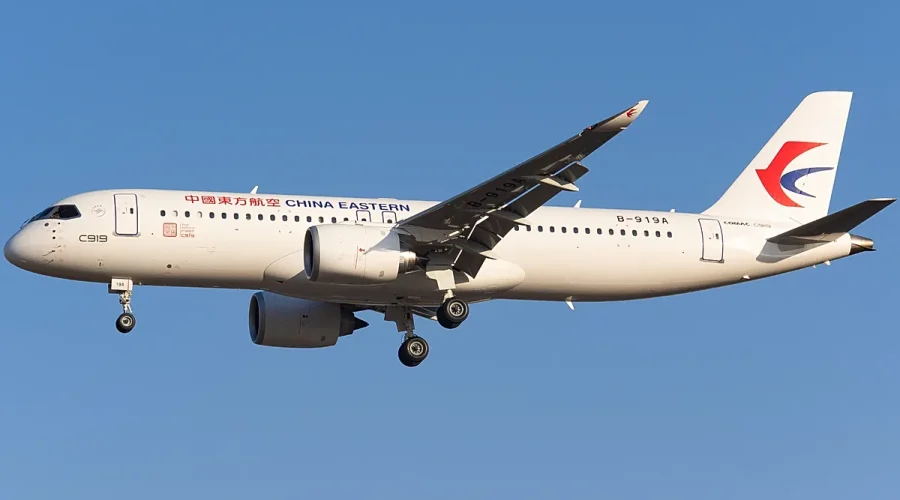
China’s C919 Embarks on Historic International Journey
Usagevpn.com – The Commercial Aircraft Corporation of China has achieved a significant milestone with the C919’s maiden international passenger service, connecting Beijing to Ulaanbaatar in Mongolia. This scheduled flight represents more than just a new route—it signals China’s growing ambition to compete directly with established aviation powerhouses Boeing and Airbus on the global stage. While the achievement is noteworthy, industry observers note that the Chinese aircraft manufacturer still faces considerable challenges before it can meaningfully disrupt the duopoly that has dominated commercial aviation for decades.
A Flight That Matters
Operating under Air China’s banner, the C919 departed from Beijing Capital International Airport and completed its journey to Mongolia’s capital in approximately two hours. Flight tracking data confirms the successful landing in Ulaanbaatar, marking the aircraft’s first departure from Chinese territory on a commercial passenger service. This route was carefully selected as an initial international destination, offering a manageable distance while demonstrating the aircraft’s capabilities beyond domestic operations.
The significance of this flight extends beyond mere geography. For COMAC, which has invested billions in developing the C919 program, this represents validation of years of engineering work and manufacturing investment. The aircraft, capable of carrying up to 174 passengers in a single-aisle configuration, mirrors the design philosophy of both Boeing’s 737 MAX and Airbus’s A320neo family—proving that Chinese engineers can produce competitive narrow-body aircraft for short to medium-haul routes.
Challenges Remain on the Road to Global Competitiveness
Despite the celebratory nature of this achievement, several obstacles continue to limit the C919’s international potential. The aircraft still incorporates foreign-sourced components in its construction, and critically, it has yet to obtain certification from major aviation regulatory bodies in Europe and the United States. Without these approvals, the C919 faces substantial barriers to entering Western markets and attracting international airline customers who require regulatory assurance for their fleet investments.
COMAC’s original ambitions were more aggressive. The company initially targeted 100 percent Chinese manufacturing by 2025 and aimed to capture 10 percent of China’s domestic aircraft market. Both objectives have slipped past their deadlines, reflecting the complexity of building an aerospace industry from the ground up. Nevertheless, the company remains optimistic, with plans to eventually operate the Beijing-Ulaanbaatar route on a daily basis.
Production Scaling and Supply Chain Concerns
Delivery figures illustrate both progress and the scale of the challenge ahead. COMAC handed over 32 C919 aircraft by the conclusion of 2025, followed by eight additional units during the first half of 2026. These numbers, while representing growth, remain modest compared to Airbus’s delivery of approximately 100 narrow-body aircraft to China in 2025 alone. The company’s target of producing 200 aircraft annually by 2029 requires substantial acceleration in manufacturing capacity.
Building the aircraft constitutes only part of the equation. COMAC must simultaneously demonstrate that it can maintain reliable production rates and ensure consistent quality across its growing fleet. Supply chain vulnerabilities pose particular risks—delays in any single component, from jet engines to minute fasteners, can cascade into significant production bottlenecks. The company has been actively working to strengthen these relationships and reduce dependency on foreign suppliers.
The Domestic Market Tells a Complex Story
China’s domestic airlines continue to demonstrate strong preference for Western aircraft, as evidenced by a substantial order placed in May for 200 Boeing planes, accompanied by spare parts and engine purchases. This order underscores that Chinese carriers recognize the value of established Western technology even as they support COMAC’s development. The coexistence of these trends—growing domestic production alongside continued Western purchases—suggests a transitional period rather than an immediate replacement of foreign aircraft.
COMAC has been actively promoting the C919 to international audiences, with notable presentations at events such as the Dubai Airshow in November. These efforts aim to build confidence among potential customers who may be hesitant to commit to an aircraft without European or American regulatory approval.
Looking Toward the Future
The C919’s first international commercial flight represents a meaningful step forward for China’s aviation ambitions. While the aircraft still has considerable ground to cover before it can seriously challenge Boeing and Airbus on a global scale, this milestone demonstrates that Chinese aerospace capabilities are maturing rapidly. The journey from domestic operator to international competitor will require sustained investment, regulatory progress, and proven reliability over time.
For the global aviation industry, the emergence of a credible Chinese manufacturer adds a new dimension to market dynamics. Whether the C919 ultimately becomes a major player or remains a regional alternative, its presence ensures that the decades-long Boeing-Airbus duopoly now faces genuine competition from an unexpected quarter. The full story of this challenge is still being written, but the first chapter has certainly been completed successfully.
Related Reading
Frequently Asked Questions
What is China s C919 makes first international?
China s C919 makes first international is the main topic of this guide. The article explains the context, practical details, and next steps readers should understand.
Why does China s C919 makes first international matter?
China s C919 makes first international matters because readers are looking for a useful answer, not just a short summary. Good content should match search intent and help them decide what to do next.