A German State Election That Could Redraw Europe’s Political Map
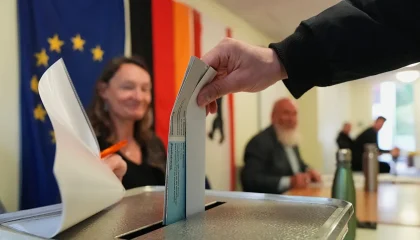
Usagevpn.com – This Sunday, the eastern German state of Saxony-Anhalt stands poised to become the epicentre of a seismic shift in continental politics. Opinion polls place the Alternative für Deutschland (AfD) at above 40 percent of the vote, placing it well ahead of Chancellor Friedrich Merz’s Christian Democratic Union (CDU) in what would be the most consequential state-level result in post-war German history. Should the far-right party convert that polling lead into a governing mandate, it would claim executive power in a German Land for the first time since the end of the Second World War — breaking a political taboo that has held firm for over eight decades.
The stakes extend well beyond one state’s parliament. A stronger AfD presence in German politics would intensify domestic battles over migration policy, climate regulation, and the scale of military and financial support for Ukraine. For the European Union, which already contends with mounting geopolitical pressure on multiple fronts, a less predictable and less cooperative Germany at a critical juncture would represent a significant strategic complication. The question hanging over the weekend is therefore not merely local: is Saxony-Anhalt simply venting accumulated frustration with the political establishment, or does the result mark a genuine inflection point for Germany and, by extension, for Europe?
The Ring: Two MEPs Clash on Blame and Remedy
To interrogate those questions head-on, this edition of The Ring — a European Parliament debate format — pits two members of the European Parliament against each other in a structured face-off. The episode is hosted by Stefan Grobe, produced by Luis Albertos Altarejos and Amaia Echevarria, and edited by Vassilis Glynos.
On one side sits Hildegard Bentele, a German MEP elected under the centre-right European People’s Party (EPP) banner. Within the Parliament she holds the Vice-chairmanship of the Committee on Development, sits on the Committee on Industry, Research and Energy, and chairs the Delegation for relations with Israel. Her argument centres on the need for the centre-right to re-engage voters through empathy and credible policy rather than dismissal.
“As Christian-Democrats, we’re convinced that the only way to counter the rise of the far-right in Saxony-Anhalt, in Germany and across Europe, is listening closely to people, offering realistic solutions and presenting – based on our values – an optimistic vision for the future.”
Bentele’s framing positions the AfD’s momentum as a symptom of institutional deafness: voters who feel ignored by established parties drift toward movements that, however extreme, at least acknowledge their grievances. The remedy she prescribes is not ideological retreat but a renewed commitment to pragmatic problem-solving delivered through a values-based narrative.
Opposing her is Jean-Marc Germain, a French MEP from the Socialists & Democrats (S&D) group. An economist by training, Germain served as adviser to former French Prime Minister Lionel Jospin and now functions as one of the principal figures within the S&D group in the European Parliament, where he leads the group’s position on budgetary matters. His diagnosis points to structural economic failure rather than mere communication breakdown.
“As long as Europe fails to build economic sovereignty, the far right will thrive in the regions devastated by globalisation and de-industrialisation.”
Germain’s argument locates the root cause in decades of industrial hollowing-out, particularly in eastern German states that bore the brunt of reunification’s economic restructuring. Without a coherent European strategy for economic self-sufficiency — in energy, manufacturing, and digital infrastructure — he contends that peripheral regions will continue to supply electoral fuel to populist and far-right movements regardless of how effectively incumbent parties communicate.
Why Saxony-Anhalt Matters Beyond Its Borders
The state’s significance is amplified by its position in eastern Germany, a region where post-reunification economic dislocation created a durable reservoir of discontent that successive governments have struggled to address. The AfD’s strength there is not an isolated anomaly; it mirrors patterns visible in other parts of eastern Germany and in comparable industrial regions across Central and Eastern Europe. A state-level victory would provide the party with administrative experience, media access, and a platform from which to project influence into federal politics.
For the EU, the implications are layered. Germany remains the bloc’s largest economy and its most consequential political actor. A government in any German state that openly questions migration quotas, climate targets, or Ukraine aid commitments would complicate consensus-building in Brussels and weaken the coherence of European foreign and security policy at precisely the moment when transatlantic and transcontinental pressures are intensifying.
The Broader European Question
The debate between Bentele and Germain ultimately crystallises a wider European dilemma: whether the far-right surge is best understood as a political-communication failure (solvable through better messaging and policy responsiveness) or as a structural-economic failure (solvable only through deep industrial and fiscal transformation). Both diagnoses carry implications for how European institutions allocate attention and resources in the months ahead. Saxony-Anhalt’s ballot boxes will offer the first concrete data point — and the answer may reshape the continent’s political architecture for a generation.
Related Reading
Frequently Asked Questions
What is The surge of the far right?
The surge of the far right is the main topic of this guide. The article explains the context, practical details, and next steps readers should understand.
Why does The surge of the far right matter?
The surge of the far right matters because readers are looking for a useful answer, not just a short summary. Good content should match search intent and help them decide what to do next.