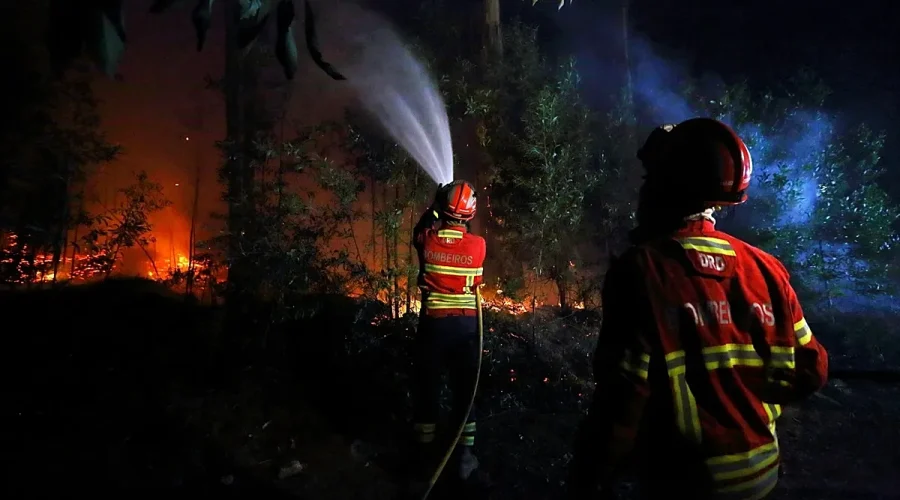
Portugal’s Wildfire Season Enters Its Most Demanding Stretch as Thousands of Crews Battle Blazing Fronts
Usagevpn.com – Portugal’s firefighting apparatus is operating at near-maximum capacity as rural blazes continue to consume forested and scrubland terrain across the country’s interior and northern reaches. By Tuesday afternoon, the national emergency tally stood above 2,000 personnel on the ground, supported by roughly twenty aircraft, all committed to suppressing fires that erupted over the preceding days. Civil Protection data confirmed that three of those incidents remained classified as significant and actively burning well into the late afternoon.
The Bragança Front: Portugal’s Most Severe Active Blaze
The most demanding operation centers on Torre de Moncorvo, a municipality in Bragança — the country’s northeasternmost district, where dense eucalyptus plantations and centuries-old oak woodland create conditions ripe for rapid fire spread. That particular blaze ignited on Saturday and had already devoured more than 2,000 hectares of vegetation by Tuesday’s count. At approximately 16:00, over 400 emergency workers were positioned in the operational zone, reinforced by more than 140 vehicles and four aerial assets.
Local broadcaster RTP reported that a single active front persisted at the onset of the afternoon. José Meneses, the mayor of Torre de Moncorvo, told the outlet that authorities were cautiously optimistic about containing the perimeter within hours.
“Declare the fire under control” and, consequently, “move into the mop-up phase,” Meneses said, expressing hope that containment would be achievable within a few hours.
The distinction between containment and mop-up matters to residents: once a fire is declared contained, crews shift from aggressive suppression to extinguishing residual hotspots, clearing debris, and monitoring for re-ignition. For a community that has watched nearly 2,000 hectares of surrounding landscape turn to ash over four days, that transition represents the first tangible sign of relief.
Two Additional Fires Strain Northern Resources
South of Bragança, in the coastal district of Aveiro, a second significant fire in Arouca — which broke out Monday night — was still generating four active fronts as of Tuesday morning. By 16:00, more than 300 firefighters, approximately one hundred vehicles, and two aircraft were deployed around its perimeter. The blaze was advancing through scrubland, and Civil Protection had implemented preventive evacuation and protective measures in several nearby communities to shield homes and lives.
A third operation, in Santo Tirso within Porto’s Metropolitan Area, consumed over 900 hectares after igniting late Monday afternoon. Around 200 personnel, backed by more than 60 vehicles and a single aircraft, remained engaged in suppression work there.
Extreme Heat and Low Humidity Compound the Threat
The fires are unfolding against a backdrop of sustained, punishing weather. The Portuguese Institute for Sea and Atmosphere (IPMA) had placed nine districts under an orange alert valid until 18:00 on Tuesday, while the remainder of mainland Portugal — excluding the Lisbon, Setúbal, and Faro districts — sat under a yellow warning. The National Authority for Emergency and Civil Protection issued a public advisory flagging maximum temperatures exceeding 40 °C across several regions, paired with low atmospheric humidity across the bulk of the territory.
Under those conditions, the northern and central inland zones — precisely where the active fires were burning — faced a very high to maximum probability of new ignitions and rapid spread. The authority urged residents to adopt preventive measures: clearing vegetation near structures, avoiding open flames, and monitoring official alerts.
Prime Minister Frames the Weeks Ahead
Speaking Tuesday after a coordination meeting at Civil Protection headquarters, Prime Minister Luís Montenegro cautioned that the country still faces “weeks of heightened complexity” before the fire season can be considered over. He emphasized that Portugal was currently “under high risk, which places a duty of care on everyone,” urging citizens to minimize ignition sources and follow local guidance.
“Another tough year,” Montenegro described 2026 in terms of forest fires, while insisting that the operational response mounted so far is “the largest ever.”
Government statistics cited at the briefing indicated a “very significant reduction” in cumulative burnt area compared with 2025 — roughly four times less. That figure, while encouraging, does not diminish the immediate danger: fewer hectares burned nationally does not mean individual communities escape devastation, and the sheer scale of Tuesday’s deployment underscores how close the margin between containment and catastrophe remains.
Montenegro also singled out Luís Neves, the minister for internal administration who has faced public controversy over his portfolio, for what he called “an absolutely extraordinary job” in coordinating resources, praising a “strong sense of responsibility” in the minister’s handling of the crisis. Neves attended the Tuesday meeting alongside senior Civil Protection commanders.
Portugal’s wildfire season typically peaks between June and September, driven by Mediterranean climate patterns, decades of monoculture forestry, and a landscape dotted with small, scattered settlements. The 2017 Pedrógado Grande disaster, which killed 66 people in a single afternoon, remains the defining trauma of modern Portuguese fire history and the benchmark against which every subsequent response is measured. Tuesday’s deployment — over two thousand personnel, twenty aircraft, and hundreds of vehicles committed simultaneously to three fronts — represents the kind of all-hands mobilization that authorities hope will prevent any repeat of that catastrophe, even as the dry air and 40-degree heat continue to press against every containment line.
Related Reading
Frequently Asked Questions
What is Over 2 000 emergency personnel tackle?
Over 2 000 emergency personnel tackle is the main topic of this guide. The article explains the context, practical details, and next steps readers should understand.
Why does Over 2 000 emergency personnel tackle matter?
Over 2 000 emergency personnel tackle matters because readers are looking for a useful answer, not just a short summary. Good content should match search intent and help them decide what to do next.