Rome Escalates Pressure on Berlin Over Mediterranean Rescue Costs
Usagevpn.com – The trans-Mediterranean migrant corridor has long strained relations between southern and northern European capitals, but a fresh round of accusations from Rome has pushed the confrontation with Berlin into sharper territory. Italy’s Interior Ministry has published a detailed accounting of arrivals carried by privately operated rescue vessels since Prime Minister Giorgia Meloni assumed office in October 2022, and the numbers now underpin a formal demand for financial compensation from Germany.
The Numbers Behind the Demand
According to the figures released by Rome, roughly 42,300 people reached Italian ports aboard private rescue ships during the period in question. Of that total, approximately 22,500 were brought by vessels linked to German-based aid organisations. An additional 4,500 arrivals came on ships run by other European charities yet registered under the German flag. Taken together, the Italian government calculates that nearly two-thirds of all private-rescue arrivals can be traced back to German-linked operations.
Interior Minister Matteo Piantedosi has framed the data as a basis for a direct financial claim. In his view, Germany should bear a proportionate share of the costs associated with processing, housing, and ultimately deciding the fate of those migrants. Piantedosi has also signalled that Rome will not entertain discussions about accepting back asylum seekers currently in Germany who first set foot in the EU on Italian soil until the compensation question is settled.
A Three-Person Test Case
The diplomatic friction has already produced a concrete flashpoint. Berlin has indicated its intention to transfer three individuals to Italy — people who entered the EU through Italian waters before subsequently filing asylum applications in Germany. Under the longstanding EU principle of first entry, such applicants are ordinarily returned to the member state where they initially arrived so that their claims can be assessed there. Rome, however, has hinted it may refuse to admit the three and instead bounce them straight back to Germany, effectively turning a routine administrative transfer into a political statement.
The new EU migration framework, which entered into force in June, preserves the first-entry responsibility rule while introducing limited exceptions and a solidarity mechanism designed to redistribute pressure among member states. Neither side appears willing to invoke those flexibility clauses in the current standoff, preferring instead to press their respective positions bilaterally.
Behind the scenes, Piantedosi and his German counterpart Alexander Dobrindt of the CSU party are reportedly continuing negotiations aimed at a joint arrangement. Whether those talks will yield a workable formula before the next parliamentary session remains uncertain.
Salvini Widens the Target
Deputy Prime Minister Matteo Salvini, who commands a large domestic audience on immigration issues, has broadened the scope of Rome’s complaint beyond Germany. He has publicly urged both the German and Spanish governments to “rein in” their respective aid organisations, contending that such groups should no longer be permitted to ferry what he calls “illegal immigrants” to the Italian coastline. Salvini’s remarks implicitly cast Spain’s Mediterranean rescue operations into the same frame of responsibility, even though the current financial demand is directed squarely at Berlin.
The Human Cost of the Crossing
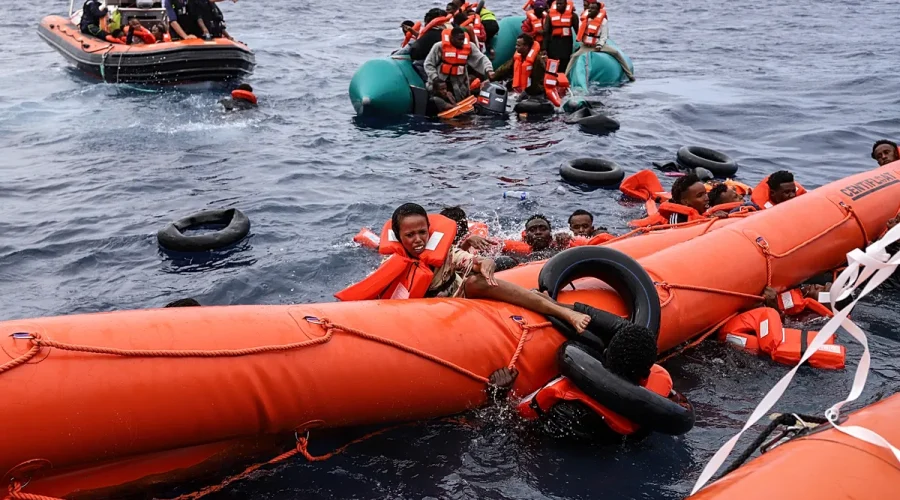
While ministers and diplomats debate cost-sharing formulas, the central Mediterranean continues to claim lives at a rate that dwarfs most other migration routes on the planet. In recent weeks, the Italian charity Emergency documented seven fatalities aboard an overcrowded vessel near the Libyan coast; 57 survivors were pulled from the water, two of them in critical condition. Separately, the German organisations Sea-Watch and Resqship each reported recovering three bodies from the sea.
The International Organization for Migration (IOM) has tallied at least 872 deaths and disappearances along the central Mediterranean route so far this year. That count covers only incidents that have been formally documented; the agency itself cautions that the actual toll is almost certainly higher, given that many small-boat crossings go unrecorded when they end in silence.
Why the Dispute Matters Beyond Two Capitals
The Rome-Berlin confrontation is not merely a bilateral billing argument. It exposes a structural gap in European migration governance: the absence of a clear, enforceable mechanism for allocating the financial and administrative burden of rescue operations conducted by non-state actors in international waters. Private charities fill a vacuum left by member states that have scaled back their own naval and coast-guard search-and-rescue missions. Yet the legal and fiscal consequences of those rescues — who pays for processing, who hosts applicants during adjudication, who ultimately bears integration costs — remain contested.
Until the solidarity provisions embedded in the new EU framework are operationalised in practice, individual member states will continue to shoulder disproportionate shares of arrivals, and disputes of the kind now unfolding between Italy and Germany are likely to recur. The question of who shoulders the cost of saving lives at sea, and then managing the aftermath on land, remains the defining unresolved issue of European migration policy.
Related Reading
Frequently Asked Questions
What is Italy demands compensation from Germany over?
Italy demands compensation from Germany over is the main topic of this guide. The article explains the context, practical details, and next steps readers should understand.
Why does Italy demands compensation from Germany over matter?
Italy demands compensation from Germany over matters because readers are looking for a useful answer, not just a short summary. Good content should match search intent and help them decide what to do next.