Europe’s Sky Put on a Spectacular Show as Moon Blocks the Sun
Usagevpn.com – Residents across the European continent witnessed a breathtaking celestial phenomenon yesterday evening as the moon slid directly between Earth and the sun, casting a dramatic shadow across the landscape. This marked the first total solar eclipse visible from mainland Europe in twenty years, drawing crowds to beaches, parks, and mountain peaks to observe the rare astronomical event.
For many Europeans, this was more than just a pretty sight—it was a once-in-a-lifetime opportunity. The continent faces a long wait before another total eclipse graces its skies. France will not see another until 2081, while the United Kingdom must wait until 2090. Germany’s next total eclipse won’t arrive until the following century. Spain, however, has a shorter wait, with another total eclipse coming next year.
Viewers Across the Continent Captured the Moment
From the fjords of Denmark to the beaches of Spain, photographers and skywatchers documented the eclipse from countless vantage points. In Denmark, the Mariager Fjord provided a stunning backdrop as the moon gradually obscured the sun’s brilliant disk. Meanwhile, in central Spain, the town of Berlanga de Duero offered clear views of the total eclipse, with residents and visitors alike craning their necks toward the darkening sky.
Italy’s northern regions also proved popular viewing locations. In Vidigulfo, near Pavia, the silhouette of the moon against the sun created an ethereal image framed by the architecture of a Virgin Maria church. The juxtaposition of ancient religious structures with cosmic events added a layer of cultural significance to the astronomical display.
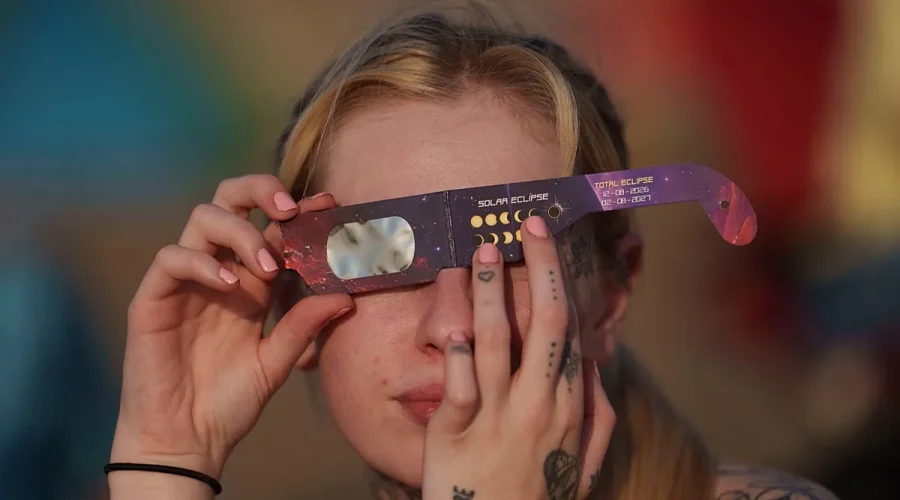
Spain’s coastal areas attracted beachgoers eager to experience the eclipse. At Puerto de Sagunto beach near Valencia, visitors donned special protective glasses to safely observe the beginning phases of the celestial event. The combination of sea, sand, and sky created memorable scenes as people gathered to witness history in the making.
Urban Centers Become Observation Points
Major cities across Europe transformed into impromptu observatories. In London, Northala Fields and Primrose Hill became gathering spots for eclipse enthusiasts. The Houses of Parliament provided a historic backdrop as the moon began its slow journey across the sun’s face. Meanwhile, in Liverpool, Crosby beach hosted crowds watching as the moon covered more than ninety percent of the sun, creating a twilight-like atmosphere during the afternoon hours.
Germany’s capital also played host to eclipse viewers. Near the iconic Molecule Man sculpture, people watched as the moon partially covered the sun. At the former Tempelhof airport, now a public park, a couple shared a kiss during the partial eclipse, capturing a romantic moment against the cosmic backdrop. The vast open spaces of Tempelhof offered unobstructed views for thousands of visitors.
Further east, St. Petersburg’s shores along the Gulf of Finland became a popular destination. Residents and tourists alike gathered to watch the eclipse, with some capturing images of the moon and sun setting together over the water. The northern latitude provided unique viewing conditions, with longer daylight hours allowing for extended observation.
Mountain Top Experiences
For those seeking elevation, Switzerland’s Bernese Oberland region offered spectacular views. From the summit of Niesen mountain, observers watched as the moon obscured the sun above the Gantrisch peak. The mountain setting provided clear, unobstructed views and a sense of being closer to the heavens.
In Spain’s Palencia region, another total eclipse unfolded, with the moon completely covering the sun at certain moments. These total phases, lasting only a few minutes, created an eerie darkness as birds ceased their songs and temperatures dropped noticeably.
The Science Behind the Spectacle
Solar eclipses occur when the moon passes between Earth and the sun, blocking all or part of the sun’s light. This alignment happens during new moon phases, but not every new moon produces an eclipse due to the moon’s tilted orbit. The rarity of total eclipses for any given location explains why yesterday’s event generated such widespread excitement.
Viewers were advised to use proper eye protection during all phases except totality, when the moon completely covers the sun. Special eclipse glasses, welder’s glass, or pinhole viewers allowed safe observation without risking eye damage from direct sunlight exposure.
As the moon moved out of position during the total eclipse in Berlanga de Duero, the sun’s corona became visible—a faint, pearly white halo surrounding the darkened disk. This ethereal glow, visible only during totality, provided a stunning visual reminder of the sun’s outer atmosphere.
Yesterday’s eclipse will be remembered not just for its beauty, but for bringing Europeans together to witness one of nature’s most spectacular displays. With the next total eclipse for mainland Europe still decades away, many hope to return to their viewing spots when the celestial dance repeats itself.
Related Reading
Frequently Asked Questions
What is Solar eclipse 2026 in pictures?
Solar eclipse 2026 in pictures is the main topic of this guide. The article explains the context, practical details, and next steps readers should understand.
Why does Solar eclipse 2026 in pictures matter?
Solar eclipse 2026 in pictures matters because readers are looking for a useful answer, not just a short summary. Good content should match search intent and help them decide what to do next.