Isabel Coixet Leaves an Analogue Message for 2076
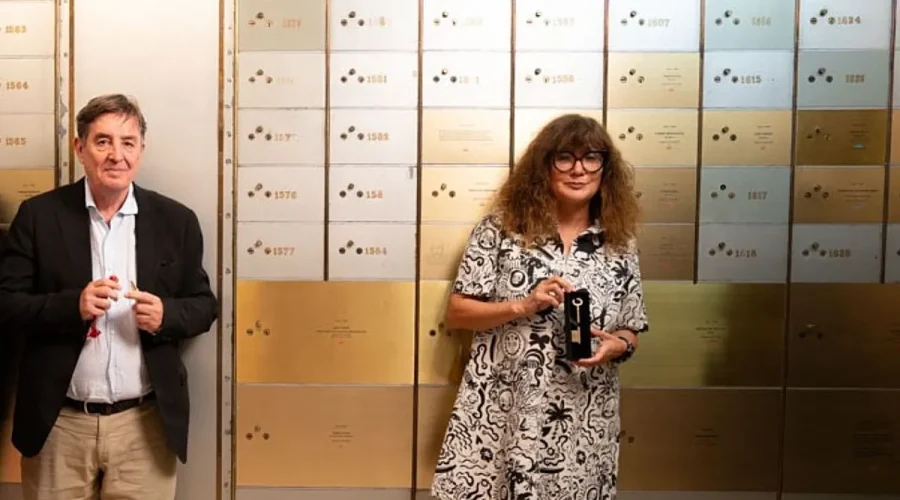
Usagevpn.com – Film director Isabel Coixet bequeaths a defence of the analogue world in a time capsule at Madrid’s Instituto Cervantes. Her contribution to the Caja de las Letras includes a cassette, a handwritten letter and a collage created on the cover of a discarded 1913 book. The items are sealed in box 1586 and will not be opened until 2076.
The Spanish filmmaker, born in Sant Adrià del Besòs in 1960, chose objects and memories that celebrate tactile, everyday life. Her archive reflects an attachment to handwritten notes, recorded music, familiar food and ordinary rituals that may feel very different to the person who eventually opens the box.
A cassette for a future listener
The cassette contains 18 songs, including music by Camarón, Lucho Gatica, and “La lista de la compra” by La Cabra Mecánica and María Jiménez. Coixet described the selection as a personal collage with a Lynch-like feeling, deliberately leaving room for the future listener’s own interpretation.
Film director Isabel Coixet bequeaths this collection without trying to explain every image or object. She referred to Florence Green, the bookseller in her film The Bookshop, and the character’s belief that too much explanation can narrow the imagination.
“Understanding makes the mind lazy.”
For Coixet, the archive is designed to preserve sensations rather than deliver a fixed lesson. It invites its future recipient to find meaning in the sounds, images and handwritten words left behind.
A handwritten defence of ordinary objects
Coixet wrote her letter with a blue Bic biro, an everyday pen that became a symbol of the deposit. She wondered whether the future reader would still recognise it and urged them not to underestimate its value.
“I am writing this with a Bic biro, my favourite. I wonder if they still exist. You, whoever you are, do not be taken in by treatises on the wonders of the world. The Bic biro is one of humanity’s great inventions.”
The letter captures the spirit of her gesture: a defence of objects that can be held, used, stored and rediscovered. In a world increasingly shaped by digital communication, the cassette and handwritten note give physical form to memory.
Her reflections also included clay water jugs, torrijas, outdoor summer film screenings and a dislike of speciality coffee chains. These details turn the box into a record of domestic life as much as artistic life.
Literature, cinema and cultural resistance
Film director Isabel Coixet bequeaths her archive during a period in which literature remains central to her work. In The Bookshop, the main character opens a bookshop in rural England as an act of independence and resistance. Coixet is also set to receive the 2026 Antonio de Sancha Award from the Madrid Publishers’ Association for bringing literature closer to wider audiences and defending bookshops as cultural spaces.
The ceremony included a conversation with Cristina Andreu, former president of the Association of Women Filmmakers and Audiovisual Media. Luis García Montero, director of the Instituto Cervantes, praised Coixet’s international career and her ability to connect travel and freedom with a search for what matters most.
“Her films have travelled far and wide, but it would be a mistake to confuse that international trajectory with simple geography, because she has turned freedom and travel into a way of working her way towards the heart of things.”
Coixet has received four Golden Bear nominations at the Berlin Film Festival and a Cannes Palme d’Or nomination for Map of the Sounds of Tokyo. Her work as a director, screenwriter and documentary maker has also earned eight Goya Awards.
FAQ: Isabel Coixet’s Caja de las Letras deposit
When will Isabel Coixet’s box be opened?
The contents of box 1586 at the Instituto Cervantes will remain sealed until 2076.
What did Isabel Coixet place in the time capsule?
She deposited a cassette with 18 songs, a handwritten letter written with a Bic biro, and a collage on the cover of a discarded 1913 book.
Why is the deposit important?
Film director Isabel Coixet bequeaths a personal record of analogue culture, using music, handwriting and everyday objects to reflect on memory, imagination and the value of physical experience.