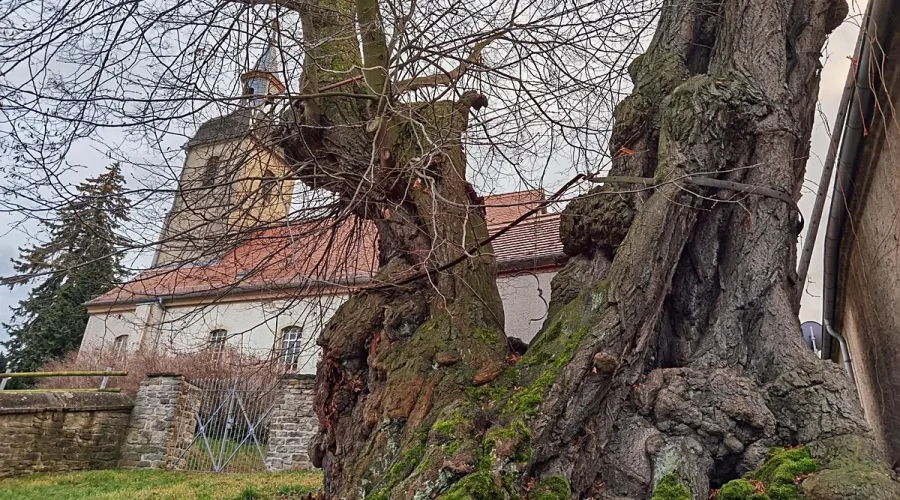
A Rusty Ring on a Nine-Century Trunk: The Pillory Lime of Großpörthen
Usagevpn.com – Five kilometres south-east of the small Saxon town of Zeitz, tucked into the rolling landscape of Saxony-Anhalt, stands a winter lime whose bark still bears the scar of medieval justice. Beside the village church in Großpörthen, this ancient tree has watched generations pass for roughly nine centuries — and its trunk carries a corroded iron collar that once locked around the necks of convicted offenders. Few landmarks in Germany fuse natural history and penal history so viscerally as this single specimen.
Physical Dimensions and Botanical Significance
The tree measures approximately 9.85 metres around its trunk and rises to roughly twelve metres in height. Those figures place it, by most estimates, at the top of the list for the thickest surviving winter lime (Tilia cordata) in Germany. Its girth dwarfs what one might expect from a specimen of comparable age, owing partly to an unusual siting on a slope that has forced pronounced thickening and bulging across both the trunk and the root collar over many centuries.
The German Dendrological Society, which assesses such specimens using ring-counting where possible and morphological inference where it is not, places the tree’s age somewhere between 700 and 900 years. Pinpointing a more precise figure is effectively impossible: trunks of this magnitude deform, split, and regenerate over centuries, erasing the very growth rings that would yield an exact date.
The Neck Iron and the Grammar of Public Shame
A rusted metal ring remains fixed to the trunk — a neck iron, the kind used in what German legal tradition called Schand- or Ehrstrafen: shame punishments designed to strip a person of social standing before their neighbours. The convicted individual was fitted with the collar, locked in place, and left exposed for a set period. Depending on the locality and the severity of the verdict, this humiliation could be compounded by corporal punishment administered while the ring was still on.
In certain cases, offenders were additionally required to wear placards spelling out their offence, turning the punished body into a walking public notice. The practice is documented across German-speaking regions from at least the fourteenth century and persisted through the late Middle Ages and early modern era, appearing in legal codes well into the eighteenth century.
The catalogue of offences that drew this penalty was broad. Petty theft, verbal insults, slander, disturbance of the peace, breaches of prevailing moral norms, and fraud involving tampered measures or weights all appear in surviving records as grounds for pillory exposure. The punishment’s logic was reputational rather than purely physical: by making the transgression visible to the entire community, authorities aimed to annihilate the offender’s social credit.
Court Tree, Pillory Tree
The Großpörthen lime served a dual judicial function. As a court tree (Gerichtslinde), it marked the spot where local disputes were heard and verdicts pronounced — a role that anchored communal authority in a living landmark rather than a building. Its secondary role as a pillory tree, evidenced by the surviving iron collar, made it simultaneously the stage for sentencing and the instrument of punishment. That combination is rare enough to give the specimen its distinctive name.
Survival After Catastrophic Damage
The tree’s longevity has not been uninterrupted. Around the middle of the twentieth century a substantial portion of the trunk broke away, an event that would have killed most specimens of lesser vigour. The winter lime, however, regenerated from its remaining structure and is now assessed as being in sound health — a testament to the species’ capacity for compartmentalising injury and redirecting growth.
Context Among Germany’s Oldest Trees
In the national ranking of ancient trees, the Großpörthen lime currently holds second place. The title of oldest tree in Germany was recently ceded to a yew (Taxus baccata) estimated at roughly 1,100 years, growing on an Alpine pasture in the Allgäu region. The former holder of that distinction — now third — is another lime, this time a summer lime (Tilia platyphyllos), standing in the village square of Upstedt in Lower Saxony.
The Upstedt square itself dates its use as a communal gathering place to the early second millennium. By the thirteenth century the tree had been formally designated as the local court tree. Yet unlike its Großpörthen counterpart, no documentary or physical evidence links the Upstedt specimen to pillory practice; it served judicial authority without carrying the additional burden of public humiliation.
The distinction matters for understanding how medieval and early-modern communities embedded legal ritual into their built — and grown — environment. A tree that merely witnessed verdicts occupied a different symbolic space from one that physically held the condemned. Großpörthen’s lime, with its corroded collar still visible against nine centuries of bark, remains one of very few places in Germany where that darker function can be read directly off the landscape.
Related Reading
Frequently Asked Questions
What is Pillory linden of Großpörthen?
Pillory linden of Großpörthen is the main topic of this guide. The article explains the context, practical details, and next steps readers should understand.
Why does Pillory linden of Großpörthen matter?
Pillory linden of Großpörthen matters because readers are looking for a useful answer, not just a short summary. Good content should match search intent and help them decide what to do next.