Athens’ Marble Colosseum Undergoes Its First Full Restoration in Over 100 Years
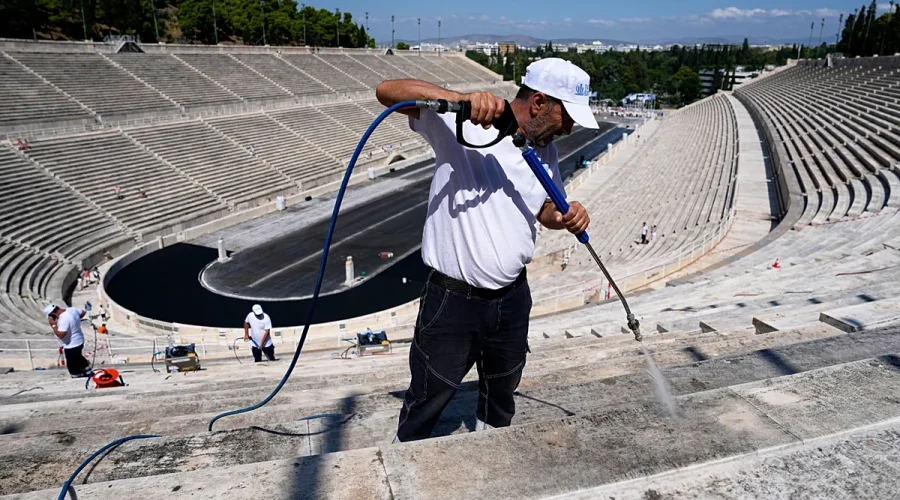
Usagevpn.com – Nestled in the shadow of the Acropolis, the Panathenaic Stadium — known to Greeks as the Kallimarmaro, or “beautiful marble” — is currently receiving a meticulous, century-overdue deep clean. The structure, carved entirely from the same luminous Pentelic marble that crowns the Parthenon, has hosted marathon finishers, concert audiences, and the athletes who competed at the very first modern Olympic Games in 1896. Now, conservation crews are working tier by tier to strip away a century of accumulated grime, biological growth, and human residue, restoring the arena to the gleaming white that gave it its famous nickname.
A Monument at the Heart of Olympic History
The stadium’s place in sporting history is singular. When the modern Olympic movement was resurrected in Athens in 1896, the ancient track was rebuilt in marble specifically to host those inaugural Games. Since then, it has served as the ceremonial site where the Olympic Flame is handed from the Hellenic Olympic Committee to the host nation’s delegation — a ritual that will recur ahead of the 2028 Los Angeles Games. No other venue in the world carries that particular weight of origin.
Isidoros Kouvelos, president of the Hellenic Olympic Committee, framed the restoration as both a practical necessity and a symbolic act of stewardship:
“The Kallimarmaro is a unique monument for the global Olympic movement, as this is where the modern Olympic Games were revived in 1896. It was essential to remove everything that has built up over the years. In this way, the Panathenaic Stadium will once again reveal all its splendour.”
A Delicate Operation on Ancient Stone
Because the marble is identical in composition to that of the Acropolis monuments, the cleaning cannot proceed with brute force. Crews navigate the stadium’s 47 tiers of seating with spray apparatus calibrated to deliver clean water at carefully controlled, low pressure. Simultaneously, purpose-built suction units capture the runoff, ensuring that no excess moisture penetrates the stone or that chemical residues linger in the grain. The entire protocol is designed to minimise mechanical and hydraulic stress on a surface that has endured two millennia of weathering.
Antiquities conservator Dimitris Selemis, who oversees the project, was explicit about what the operation is — and is not — trying to achieve:
“The aim of the cleaning is not to make everything dazzling white. The goal is to remove pollutants and the first layers of organic matter that build up on the surface. Weeds and vegetation in general are a serious problem for monuments, as they grow and spread. In some cases, they even leave residues that stain the marble surface.”
Gum, Heels, and a Century of Wear
Beyond atmospheric pollution and biological intrusion, the marble bears the unmistakable scars of millions of visitors. Stadium officials identified chewing gum, high-heel indentations, and carbonated-beverage stains as among the principal agents of surface degradation. Gum that has oxidised to a near-black tar is lifted with targeted steam application, a technique chosen for its ability to soften the adhesive without abrading the stone beneath.
The cumulative effect of decades of foot traffic, seasonal rainfall, and urban particulate had dulled the marble’s characteristic radiance. As the cleaning advances across each tier, the original crystalline sheen is gradually re-emerging — a transformation visible to spectators watching from the upper rows.
Why the Name Matters
The Greek designation Kallimarmaro is not merely poetic. It encodes the material reality of the structure: a bowl of seating and track fashioned from one of the finest architectural marbles ever quarried, chosen in antiquity for its fine grain and brilliant white colour. That same quality makes the stone exceptionally vulnerable to acid deposition, biological colonisation, and mechanical abrasion — which is precisely why the restoration demands the level of care now being applied.
When the work is complete, the arena will once again present the unblemised white surface that has defined its identity since antiquity. For the athletes who will cross its finish line at future Olympic marathons, and for the delegations that will receive the Flame beneath its arches, the restored marble will stand as a reminder that the oldest continuous sporting tradition in the world is anchored to a single, irreplaceable piece of Greek stone.
Related Reading
Frequently Asked Questions
What is Panathenaic Stadium s marble regains its shine?
Panathenaic Stadium s marble regains its shine is the main topic of this guide. The article explains the context, practical details, and next steps readers should understand.
Why does Panathenaic Stadium s marble regains its shine matter?
Panathenaic Stadium s marble regains its shine matters because readers are looking for a useful answer, not just a short summary. Good content should match search intent and help them decide what to do next.