Historic Nazi-Era Warships Resurface as Danube Waters Recede
Uncovering a River’s Hidden Military Heritage
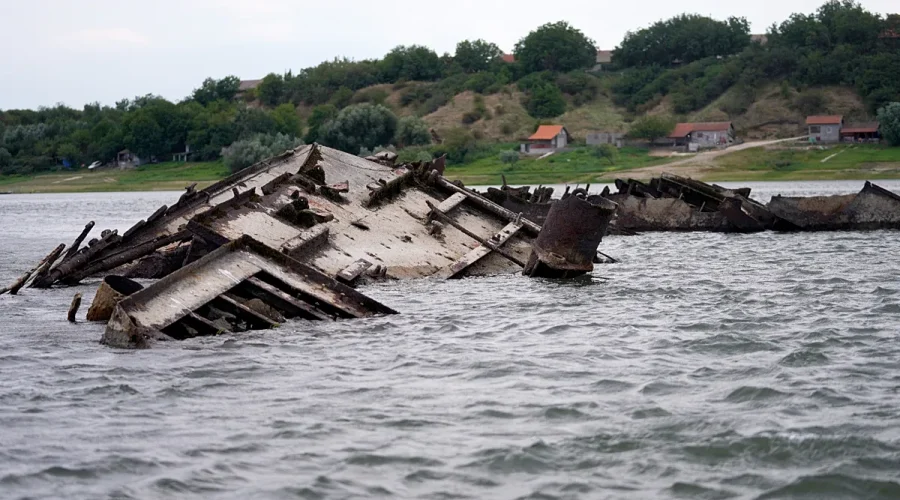
Usagevpn.com – Extended periods of intense heat have triggered a significant decline in water levels across various sections of the Danube River, revealing remarkable artifacts from a bygone era. The area surrounding Prahovo in Serbia has become particularly notable for this phenomenon, where German military vessels that sank decades ago now emerge from the riverbed with increasing regularity. Some of these maritime relics are scheduled for extraction over the next several years, while others have already been successfully removed from the water and brought to shore.
Earlier this week, the publication “Fokus” provided the first comprehensive report on this ongoing archaeological and engineering endeavor. The narrative of these sunken vessels stretches back more than eight decades to the concluding phase of the Second World War. During the autumn of 1944, German forces executed a strategic withdrawal as the Soviet Red Army advanced on multiple fronts, both terrestrial and aquatic.
A Strategic Blockade That Endures
Orders issued by Adolf Hitler’s command were unequivocal: no functional military apparatus was to be surrendered to advancing enemy forces. This directive encompassed the naval formations of the Kriegsmarine operating along Europe’s second-longest waterway. Consequently, German crews deliberately sank their vessels within the Danube’s waters. The strategic objective was twofold—these submerged ships would serve as an underwater barrier while simultaneously preventing Soviet forces from navigating upstream along the river corridor.
This wartime blockade continues to influence modern navigation patterns. During previous summers marked by extreme temperatures, declining water levels have already revealed portions of these sunken vessels, with notable exposure occurring in August 2022. The response to this recurring challenge came through an EU-supported initiative operating under the Western Balkans Investment Framework, commonly abbreviated as WBIF. This comprehensive project has focused on extracting twenty-one of the most problematic wrecks from the riverbed.
Technical and Economic Challenges
The European Investment Bank serves as the strategic partner for this investment framework, providing crucial financial and technical support. According to official EIB documentation, several of the submerged remains located within a five-kilometer constriction of the Danube were successfully recovered during 2024. These vessels were carefully extracted from the river using heavy-duty ropes and subsequently cleaned of accumulated sediment and mud.
An article published on the EIB’s official website during the same year featured statements from Serbia’s then-deputy minister for construction, transport and infrastructure. The minister emphasized the importance of maintaining navigational efficiency while preserving historical artifacts. Based on EIB projections at that time, the comprehensive salvage operation is scheduled for completion by 2028.
Before these recovery efforts commenced, approximately two hundred vessels were estimated to rest on the Danube’s floor, encompassing a diverse collection of destroyed cargo ships, tugboats, and barges. Extracting armed military vessels presents considerably greater difficulties than recovering civilian craft. The EIB has noted that certain ships may still contain unexploded ammunition, creating potential explosion hazards during the recovery process.
Looking Toward the Future
The extraction of the initial twenty-one wrecks also addressed important economic considerations, according to the bank’s analysis. The accumulated debris had created substantial bottlenecks for commercial freight transport. Consequently, Serbia was estimated to experience annual losses of approximately five million euros due to these navigational impediments.
According to Banjac, professional divers will be deployed alongside powerful pumps designed to remove sand and silt from around the vessels. However, he acknowledged that certain wrecks exceed the practical limits of such recovery methods. These oversized vessels have been strategically positioned within the riverbed and partially buried to minimize obstruction to commercial shipping traffic.
In July 2024, the EIB awarded a subsidy of sixteen million euros to support this ambitious project. The overarching objective is to enhance the competitiveness of inland navigation throughout Serbia and the broader region. This initiative represents a component of the Economic and Investment Plan for the Western Balkans, a comprehensive program valued at thirty billion euros. According to the EIB, this substantial investment is also designed to facilitate the transition of freight traffic from road networks to waterways, promoting more sustainable and efficient transportation across Southeastern Europe.
Related Reading
Frequently Asked Questions
What is Low water levels?
Low water levels is the main topic of this guide. The article explains the context, practical details, and next steps readers should understand.
Why does Low water levels matter?
Low water levels matters because readers are looking for a useful answer, not just a short summary. Good content should match search intent and help them decide what to do next.