Eighty-Four Watches, One Night in Geneva: Inside the 2026 GPHG Shortlist
Usagevpn.com – The annual Grand Prix d’Horlogerie de Genève has just unveiled its 2026 shortlist, and the field reads like a collision course between tradition and outright invention. Eighty-four timepieces have been slotted into fourteen competitive categories, each vying for one of nineteen trophies that crown the year’s boldest achievements in contemporary watchmaking. The ultimate prize — the Aiguille d’Or Grand Prix — will be handed out at a ceremony in Geneva on Saturday, 7 November, with the event streamed live for audiences worldwide.
What makes this year’s slate particularly electric is the sheer range of ambition on display. A Moscow-based independent workshop has challenged the Swiss establishment on its own turf. A Dutch maison has built a functioning solar system onto a wrist. A ten-kilogram mechanical sculpture will wind a watch while its owner sleeps. These are not incremental refinements; they are paradigm shifts compressed into precious metal and sapphire.
The Moscow Anomaly: ThinKing Mystery
Stack two credit cards and you get roughly 1.65 millimetres of thickness. That is the full depth of the ThinKing Mystery, a mechanical timepiece produced in a small Moscow workshop that has landed what can only be described as a knockout blow against the industry’s thinnest-watch arms race. While the major Swiss houses were locked in a public contest over the world’s-thinnest record, this independent maker quietly undercut them all.
The trick — and it is genuinely a trick — is that there is no conventional watch inside the case. The case itself functions as the movement’s mainplate. Two transparent sapphire discs display the hours and minutes, and the mechanism driving them remains entirely invisible to the wearer. The result is a piece that looks less like a watch and more like a sliver of glass with a faint, enigmatic smile. Only twelve examples will ever be made, each priced at €426,000.
A Dutch Solar System on the Wrist
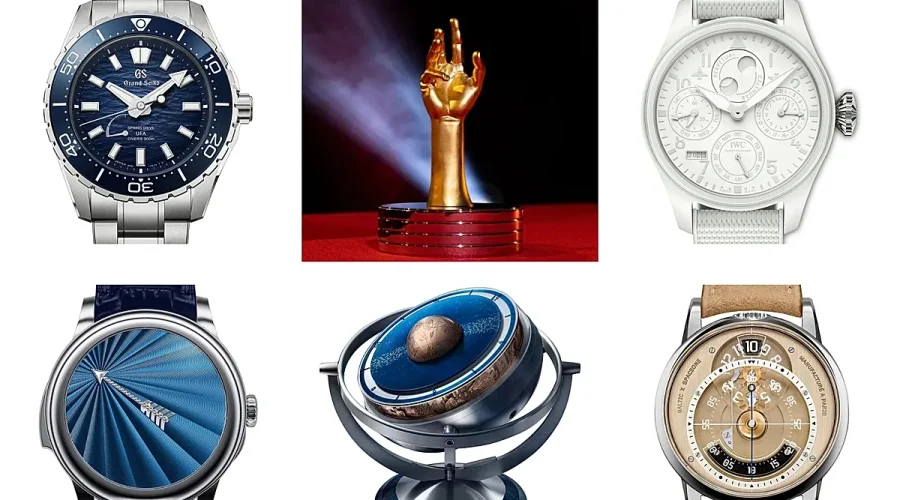
The same Dutch house that took the Calendar and Astronomy category in 2021 returns with a piece that turns a starry evening into a personal astronomical instrument. Eight hand-painted planets orbit across a dial of iridescent oxidised silicon, each positioned exactly where it would sit in the actual night sky at any given moment. The orbits run in real time at true celestial speed: Mercury completes a circuit in three months, while Neptune’s full revolution stretches across 165 years — a span no living owner will witness from start to finish.
Just six pieces are being produced at €157,000 each. The implication is clear: this is not a complication bolted onto a conventional movement. It is a self-contained cosmological engine, and the house has already proven it can win the category it inhabits.
Two Radical Grammars: The Freak Collaboration
When two of the most combative names in independent watchmaking decide to share a dial, the result defies easy categorisation. The Freak collection, first launched in 2001 and already an Iconic-category winner in 2023, dismantled the assumption that a watch requires hands or a winding crown. Its entire movement rotates on its own axis, serving simultaneously as the hour indicator. Into that framework, Urwerk injects its signature satellite-hours architecture: small cubes mounted on rotating arms, the active numeral gliding along a minute scale. The movement pivots every three hours around a silicon balance wheel.
The outcome is a single object speaking two incompatible mechanical languages at once. One hundred pieces are planned at €115,000 apiece — a comparatively accessible entry point into what is arguably the most conceptually dense watch on this year’s list.
The Voice of Time: L.Leroy’s Chiming Heritage
French haute horlogerie traces a long lineage through L.Leroy, the maison whose timepieces were reportedly read by Napoleon, Marie-Antoinette, and Marcel Proust. The 2026 entry continues that tradition while pushing it into auditory territory. A single hand remains fixed while the dial rotates beneath it to indicate the hour. Minutes, however, are not read — they are heard. A minute repeater sounds each interval aloud, earning the piece its evocative name: “the voice of time.”
Below the case, a flying tourbillon stabilises the escapement for improved accuracy. Above it, the rotating dial carries a flinqué soleil decoration sealed under a translucent dark-blue varnish, with a hand-engraved hand sweeping across the scene. The price is €341,000, and the effect is less a complication than a small theatre of sound and motion.
Ten Kilograms of Meteorite and Rose Gold
One GPHG category is reserved not for wristwatches but for objects that serve them. Among this year’s competitors, one entry deserves particular attention: a mechanical sculpture roughly 30 centimetres tall and weighing ten kilograms, mounted on a titanium base inlaid with meteorite. Three rose-gold rings rotate slowly around the structure, each hand-engraved after drawings by Belgian illustrator François Schuiten — a steam train crossing a viaduct, hot-air balloons drifting over the African savannah, sherpas scaling a mountain face.
The function is deceptively simple. You unclip the bracelet, set the watch into its cradle, and overnight the clock winds the movement and resets it to the correct time. No electronics are involved; the entire operation is gear-train and mainspring. Behind the project sits an alliance between Louis Vuitton, whose watchmaking division operates just outside Geneva, and De Bethune, one of the most decorated houses in horology and a previous Aiguille d’Or recipient. Only two complete sets — clock and watch together — will be produced, at €4,717,000 each.
Grand Seiko’s Diver Enters the Arena
At the other end of the precision spectrum, Grand Seiko has entered its first diver’s watch equipped with a U.F.A. (Ultra Fine Adjustment) movement. The Japanese brand characterises the calibre as the most accurate mainspring-powered movement it has ever produced, with a stated annual rate of merely ±20 seconds — whether the wearer is at a desk, on a run, or underwater. In an industry where chronometer certification typically tolerates several seconds per day, a twenty-second annual drift represents a different order of mechanical discipline entirely.
What the Shortlist Signals
Taken together, the 2026 nominees sketch a watchmaking landscape in which the boundaries between disciplines are dissolving. A Moscow workshop out-thins Geneva. A Dutch atelier out-orbits the sky. Two independent houses merge incompatible mechanical philosophies into one object. A French heritage maison turns time into sound. A luxury conglomerate and a micro-manufacturer collaborate on a ten-kilogram sculpture that replaces the charger. And a Japanese precision factory pushes mainspring accuracy into territory previously reserved for quartz.
The fourteen categories and nineteen trophies will be resolved on 7 November in Geneva. Whatever the final verdicts, the shortlist itself makes the case that contemporary watchmaking has moved well beyond the question of which brand can stack the most jewels into a conventional case. The question now is what a watch can be — and, increasingly, what it can do while you sleep.
Related Reading
Frequently Asked Questions
What is GPHG 2026?
GPHG 2026 is the main topic of this guide. The article explains the context, practical details, and next steps readers should understand.
Why does GPHG 2026 matter?
GPHG 2026 matters because readers are looking for a useful answer, not just a short summary. Good content should match search intent and help them decide what to do next.