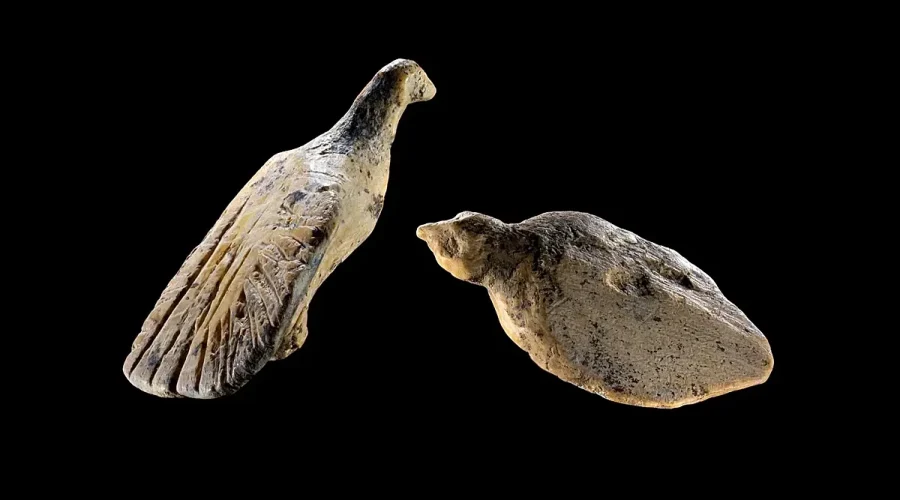
Remarkable Discovery: Ancient Mammoth Ivory Bird Sculptures Unearthed in German Cave
Usagevpn.com – Archaeologists have unveiled a fascinating find from the depths of a German cave—two exquisitely carved bird figurines crafted from mammoth ivory that date back approximately 40,000 years. The remarkable artifacts were recovered by researchers affiliated with the University of Tübingen from the lower strata of the Hohle Fels cave, situated within the Swabian Jura region of southwestern Germany.
A Window into Aurignacian Artistry
Scholars believe these miniature masterpieces were fashioned by members of the Aurignacian culture, a group of early humans who inhabited this territory during the Upper Palaeolithic era. The two sculptures were discovered in close proximity to one another, separated by merely a meter and a half of cave sediment. The more intact of the pair portrays a bird in a resting position, potentially brooding over eggs or settling onto a nest. Its companion depicts a bird with wings fully extended, though the left wing has suffered damage over millennia. Both pieces are astonishingly diminutive—each would comfortably rest upon a human fingernail. Weighing just 1.3 grams and 0.7 grams respectively, one of them stands as the smallest Ice Age artwork ever documented in this region, measuring only two centimeters in length.
Expert Interpretation of the Findings
Nicholas Conard, an archaeologist at the University of Tübingen who directs the excavation efforts, provided insight into the significance of these carvings:
“Mammoth ivory was not simply used here to create a simplified form of a bird’s body,” Conard explained in an official statement. “Detailed observations of nature were translated into figurines whose richness of detail even allows us to investigate which bird species is depicted and what it is doing.”
The resting figurine, rendered with the bird stretched out and lying flat, may represent a creature brooding or perched upon its nest. Meanwhile, the second sculpture—with wings spread wide and neck elongated—could capture a bird engaged in courtship display, preparing for flight, or alighting upon water.
Identifying the Ancient Avians
Researchers have yet to reach complete consensus regarding the precise bird species or behaviors illustrated in these carvings. One compelling theory suggests the figurines portray ptarmigan, a cold-adapted species whose skeletal remains are commonly recovered from prehistoric sites throughout the region. Alternatively, the sculptures might represent larger, pheasant-like birds such as the capercaillie, a woodland dweller celebrated for its vivid plumage and elaborate mating rituals. While the intricate carvings enable comparisons of body morphology, posture, and feather representation, the minute scale and stylized execution complicate definitive identification. Nevertheless, scientists are confident that both potential species existed in Europe during the Ice Age.
The Significance of Hohle Fels Cave
Hohle Fels cave—sometimes referred to as Hohler Fels—was occupied during the Aurignacian period, spanning roughly 43,000 to 28,000 years ago, by early Homo sapiens. This era coincided with the disappearance of Neanderthals from the European continent. During this transformative period, humans experienced an extraordinary cultural and artistic renaissance, producing some of the oldest known musical instruments, ornamental jewelry, and figurative artworks. Among the cave’s most celebrated discoveries is the “Venus of Hohle Fels,” a 41,000-year-old ivory sculpture depicting a woman with pronounced breasts and hips. This artifact is considered one of Europe’s earliest examples of figurative art. Hohle Fels ranks among six caves in the Swabian Jura that receive special protection as part of a UNESCO World Heritage designation. The region stands as one of the most crucial archaeological landscapes for understanding the origins of human artistic expression in Europe. Since excavations commenced in the 1860s, researchers have uncovered numerous artifacts dating between 33,000 and 43,000 years ago, including some of the earliest musical instruments ever discovered.
Public Exhibition
Visitors will have the opportunity to view these extraordinary figurines at the Museum of Prehistory and Ice Age Art in Blaubeuren. The exhibition will run until April 4, 2027, offering the public a rare chance to witness these ancient masterpieces up close.
Related Reading
Frequently Asked Questions
What is Find in German cave?
Find in German cave is the main topic of this guide. The article explains the context, practical details, and next steps readers should understand.
Why does Find in German cave matter?
Find in German cave matters because readers are looking for a useful answer, not just a short summary. Good content should match search intent and help them decide what to do next.