Punk Duo’s Anti-Chega Message Ignites Political Firestorm at Portugal’s Longest-Running Music Festival
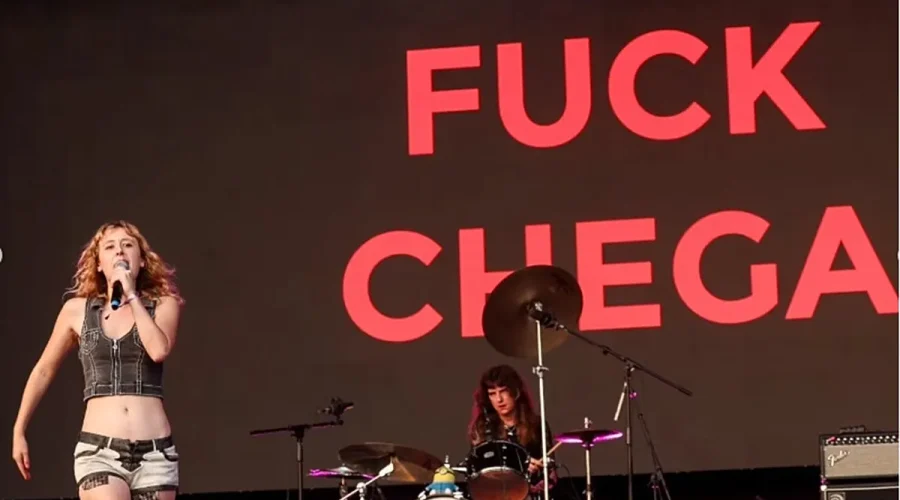
Usagevpn.com – A two-person English punk outfit that took the stage during the opening night of one of Portugal’s most storied music gatherings found itself at the centre of a heated national debate within hours of its set. The Brighton-based duo, pairing vocalist Phoebe Lunny with bassist Selin Macieira-Boşgelmez, projected a bluntly worded message onto the festival’s main screen — a direct address to Chega, the right-wing party that has surged in Portuguese politics in recent years. The words displayed read “F**k Chega,” rendered in Portuguese as “Que se f**a o Chega.” Lunny then turned to the crowd and encouraged them to chant the phrase back at the screen, turning what had been a musical performance into a charged political moment in front of thousands of festivalgoers.
A Festival with Six Decades of History
The venue for the incident was the CA Vilar de Mouros Festival, held in the small town of Vilar de Mouros within the municipality of Caminha, in Portugal’s northern Minho region. The event is widely recognised as the oldest continuously running music festival on the Iberian Peninsula, having operated for more than sixty years. Its programming spans rock, folk, electronic, and world music, and it draws audiences from across Portugal and beyond. Because of its municipal sponsorship and deep cultural roots in the community, the festival occupies a particular place in local identity — a fact that would become central to the backlash that followed the duo’s performance.
More Than One Message
The Chega-directed remark was not the only politically explicit statement the pair projected during their set. Presenting their debut album, titled “Who Let the We Dogs Out,” the duo also displayed the phrases “To hell with the far right” and “Free Palestine, free Congo, free Sudan.” A Palestinian flag was shown alongside these messages, broadening the scope of their on-stage commentary beyond domestic Portuguese politics into wider geopolitical territory. For a festival that prides itself on musical eclecticism and community celebration, the density of partisan messaging in a single set proved difficult for many attendees and local officials to overlook.
Chega Leader Demands Answers
André Ventura, the charismatic leader of Chega, moved quickly to respond. Posting on the social platform X, he framed the episode as a question of public accountability, asking why taxpayer-funded events should be used to deliver what he called insults directed at his party and its supporters.
“‘F**k Chega’ was heard on the stage of the Vilar de Mouros Festival, where thousands of euros of taxpayers’ money are being spent (so Chega members and supporters also paid for this nonsense). Is anything allowed when it comes to insulting us? Can drugs and a ‘burnt-out’ head be a justification for offending millions of Portuguese people, on top of that using public funds?”
Ventura’s framing — linking public funding, personal conduct, and political insult into a single grievance — amplified the story well beyond the festival grounds and into national media cycles within a day.
The Mayor Steps In
Liliana Silva, the PSD-elected mayor of Caminha, issued her own condemnation through a Facebook post. She labelled the duo’s conduct “regrettable” while simultaneously pushing back against what she saw as opportunistic political exploitation of the incident.
“I condemn this artist’s behaviour in the same way that I reject political opportunism around it. The Vilar de Mouros Festival has no party and no colours. It belongs to the municipality of Caminha.”
Silva went further, expressing anger at what she described as artists using the festival platform “to insult whatever it may be.” In her view, such behaviour constituted “an affront to the freedom, respect and healthy coexistence that we want to prevail at this festival” — language that positioned the event as a shared civic space rather than a stage for partisan expression.
The Band’s Own Account
In a subsequent interview, Lunny defended the pair’s choices by arguing that musicians need not align themselves with any political party, yet that the global rise of fascist movements imposes a kind of moral obligation on artists to voice the concerns of their communities.
“Given the general rise of fascism at a global level, I think all artists have a responsibility at least to reflect the opinions of the people around them and the situations and environment in which they find themselves.”
Macieira-Boşgelmez, who carries Portuguese heritage, offered a complementary perspective rooted in the band’s musical identity. She described how increasingly extreme political climates are seeping into the sonic landscape of punk and related genres, and how the duo’s creative identity is, in her words, “very much built around” that intersection of politics and sound.
“I think political climates are becoming far more extreme, and I think that is also being reflected in music. I think that we in particular, as a band and as an identity, are, in a way, very much built around that.”
Why the Episode Resonated
The controversy sits at the intersection of several tensions that have come to define Portuguese public life in recent years. Chega’s rapid ascent from a marginal party to a governing coalition partner has made every public mention of its name — favourable or hostile — a potential flashpoint. Simultaneously, questions about how municipal budgets fund cultural events, and whether artists performing under that umbrella owe the public a degree of neutrality, have resurfaced with unusual frequency. The festival’s sixty-year legacy as a nonpartisan cultural institution made the incident feel, to many locals, like a breach of an unwritten social contract: that the stage belongs to the music, not to the manifesto.
Whether the episode will alter the festival’s future programming policies, or simply fade into the archive of minor cultural controversies, remains to be seen. What is clear is that a two-minute projection on a festival screen managed, within a single evening, to summon the mayor, a national party leader, and a national conversation about the boundaries between artistic expression, public money, and political speech.
Related Reading
Frequently Asked Questions
What is F k Chega?
F k Chega is the main topic of this guide. The article explains the context, practical details, and next steps readers should understand.
Why does F k Chega matter?
F k Chega matters because readers are looking for a useful answer, not just a short summary. Good content should match search intent and help them decide what to do next.