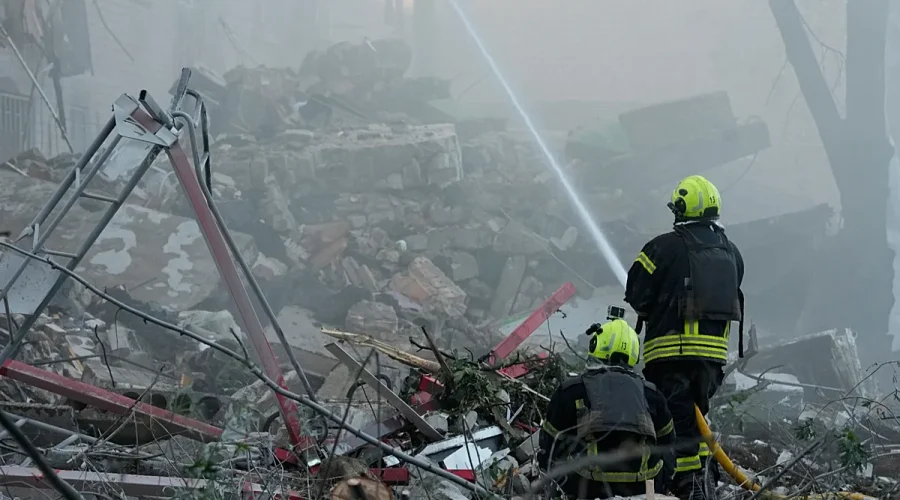
Drone Warfare in Ukraine Now Targets the People Sent to Save Lives, UN Chief Warns
Usagevpn.com – The skies over southern Ukraine have become a killing zone for more than civilians. Humanitarian convoys, marked with international insignia, are being struck by surveillance and explosive drones launched from occupied territory, and the UN’s top aid official has called the situation a “dangerous obstacle” to delivering relief where it is most needed. Tom Fletcher, head of the UN’s humanitarian operations, made the assessment on Wednesday following a trip to Kherson, a city bisected by the Dnipro River that now functions as an active front line between Russian forces on the eastern bank and Ukrainian troops holding the western shore.
Fletcher’s remarks came after he attended a memorial service honoring two aid workers killed while carrying out their duties. The deaths underscore a grim reality: the very people dispatched to shield vulnerable populations are themselves within the crosshairs of aerial weaponry.
“Drones are a real threat to not just civilians but the humanitarians who are here to protect them,” Fletcher said.
A City Divided by Water and Fire
Kherson offers a stark illustration of how drone warfare reshapes daily existence. From the occupied eastern bank, surveillance drones track movement while explosive variants strike vehicles, public transit, and pedestrians with regularity. Fletcher described the experience of walking through the western sector as “quite chilling,” noting that the constant overhead menace strips residents of any sense of routine or safety.
“It really gives us an insight into the dangers ahead of us,” he said.
The practical consequence for aid agencies is severe. Routes that were once viable for delivering food, medicine, and shelter supplies now require constant vigilance, and marked humanitarian vehicles have nonetheless been hit. Fletcher acknowledged that international humanitarian law grants protection to aid workers, yet the law offers no physical shield against a drone’s warhead.
“So that does restrict what we can do,” he said.
Local Groups Bear the Heaviest Burden
Ukraine’s humanitarian architecture leans heavily on domestic organisations. According to Fletcher, more than two-thirds of operations financed through Ukraine’s dedicated humanitarian fund are executed by local groups operating close to the front. These organisations, often with fewer resources and less diplomatic cover than international NGOs, feel the exposure most acutely.
“They’re the ones who are saying most loudly to us, we’re not protected,” Fletcher said.
Their vulnerability is compounded by the fact that drone strikes do not distinguish between a school bus and a supply truck, between a market square and a warehouse. For local staff who know the terrain and the community, the risk of being in the wrong place at the wrong moment is a daily calculation.
Funding Gaps and a Narrowing Global Mandate
The UN’s humanitarian apparatus is operating under severe fiscal pressure worldwide. Fletcher disclosed that the organisation initially identified 87 million people facing the most acute humanitarian needs; that figure has since climbed to roughly 92 million, driven by the Ebola outbreak sweeping parts of Africa, a major earthquake in Venezuela, and ongoing conflicts elsewhere. The global appeal now stands at $23 billion (€19 billion) to deliver life-saving assistance, yet approximately $11 billion (€9.4 billion) has been secured so far.
Ukraine, by comparison, is relatively well funded. Fletcher indicated that roughly 70 to 75 percent of the country’s hyper-prioritised funding requirement has been met. The total need for Ukraine’s prioritised humanitarian response this year exceeds $2 billion (€1.7 billion). Still, even full financing would cover only a fraction of the population’s requirements, particularly as winter approaches.
Winter is among Fletcher’s gravest concerns. Sustained damage to electricity grids, water networks, and gas pipelines could leave millions exposed to freezing conditions, echoing the severe hardship of last winter. The prospect of another prolonged cold season without reliable utilities amplifies the urgency of both infrastructure repair and continued aid delivery.
Fletcher also conceded that the political environment for humanitarian fundraising has grown more hostile. Governments increasingly channel public spending toward defence budgets and domestic programmes, leaving less discretionary room for international relief. He characterised the shift bluntly:
“We’re in a more transactional world, I would say a more selfish world,” he said.
The practical effect is that the UN must now justify every allocation with granular efficiency metrics. Fletcher framed the obligation as one of stewardship over taxpayer money:
“We have to show governments that we are spending their taxpayers’ money sensibly, wisely, in a prioritised way,” he said.
An Accountability Vacuum
A new UN assessment released on Wednesday painted a sobering picture of the toll exacted on aid personnel. In the previous year alone, 907 humanitarian workers were victims of violence; over a three-year span, more than 1,000 have been killed. Fletcher stated that, given the international community’s tepid response to these killings, he could not offer colleagues the assurance that perpetrators would face meaningful consequences.
He argued that accountability must reach beyond the individual who physically pulled a trigger or piloted a drone. The chain of command, the decision to deploy aerial weaponry over a populated area, and the institutional choices that enable such strikes all warrant scrutiny.
“I want to see investigations into the people who fired the weapon or flew the drone,” he said.
For the communities of Kherson and the wider regions under sustained aerial bombardment, the question of accountability is not abstract. It is the difference between a drone strike treated as an unavoidable cost of war and one treated as a prosecutable act that can, over time, alter the calculus of those who order such attacks. Until that shift occurs, the people Fletcher was sent to protect will continue to look up at the sky and wonder what is coming next.
Related Reading
Frequently Asked Questions
What is Russian drones threaten civilians and aid work?
Russian drones threaten civilians and aid work is the main topic of this guide. The article explains the context, practical details, and next steps readers should understand.
Why does Russian drones threaten civilians and aid work matter?
Russian drones threaten civilians and aid work matters because readers are looking for a useful answer, not just a short summary. Good content should match search intent and help them decide what to do next.