Europe Faces a Tighter Gas Winter as Prices Surge
Usagevpn.com – European households could face significantly higher heating costs this winter as wholesale natural gas prices climb and the region enters the cold season with unusually low reserves. The pressure is being driven by constrained supplies of liquefied natural gas, uncertainty in the Middle East and the prospect of stronger competition with Asian buyers for available cargoes.
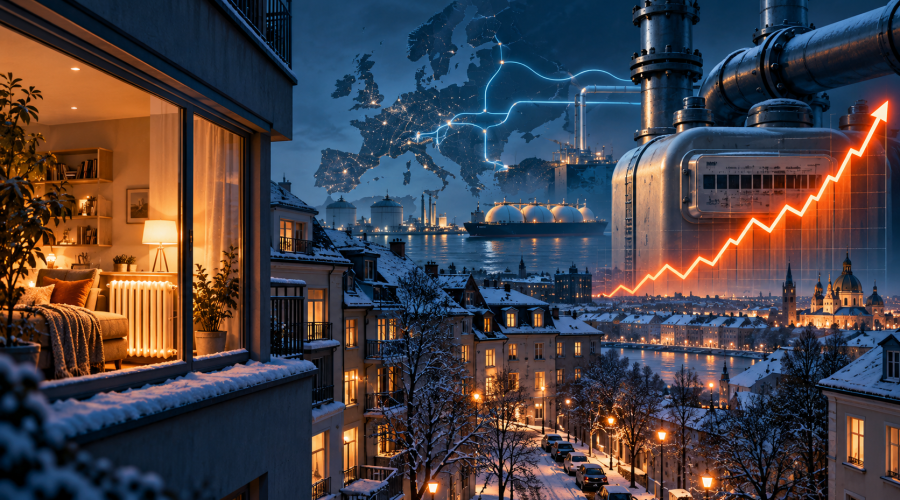
At the beginning of January, the Dutch TTF contract, Europe’s principal gas benchmark, was trading near €28 per megawatt hour. By Monday it was close to €96 per megawatt hour, after briefly reaching €97.64, its highest point since December 2022. The increase of roughly 234% this year remains well below the extraordinary highs seen in August 2022, when prices exceeded €340, but the speed and direction of the rise have raised fresh concern.
The immediate issue is not simply the current price level. Europe’s ability to make it through the heating season and refill storage for next winter may depend heavily on weather conditions, wind-power output and the availability of replacement LNG supplies.
“Wind output and temperatures will determine how tight Europe’s gas supply becomes this winter and how high prices go,” Ana Maria Jaller-Makarewicz, lead energy analyst for Europe at the Institute for Energy Economics and Financial Analysis, said. “Demand reduction remains the biggest lever within Europe’s control.”
Storage levels have stalled
Europe entered the current season with gas inventories lower than in recent years. EU storage sites were 74.6% full on 24 October, compared with 82.9% at the same point a year earlier. In 2023, inventories were close to full at 98.5%. The Institute for Energy Economics and Financial Analysis says the October level was the weakest for that time of year since records began in 2011.
More worrying for the market, reserves have barely increased in recent weeks. Daily changes in the week ending 24 October were close to zero, while some countries began withdrawing gas before November. Austria’s storage level dropped from 69.3% in mid-October to 67.2%; a year earlier it stood at 84%.
Storage acts as a buffer when heating demand rises. If stocks fall sharply during the coldest months, Europe must compete more aggressively for LNG deliveries. That can feed directly into wholesale prices and make the task of rebuilding inventories during the following summer more expensive.
Qatari supplies are missing from the market
The conflict involving Iran and the closure of the Strait of Hormuz have removed Qatar from Europe’s available supply options. Middle Eastern LNG represented roughly 8% of EU LNG imports last year. While that may appear limited, the loss matters in a global market where spare cargoes are scarce and Asian buyers are pursuing many of the same shipments.
Europe is also preparing for another reduction in supply flexibility. Russian LNG accounted for around one fifth of EU LNG imports in the second quarter. The bloc is set to ban Russian LNG entirely from January 2027.
“In the report, the Russian LNG ban starting in January 2027 is included in the calculation showing that the EU may need to use about 7% less gas than it did last winter,” Jaller-Makarewicz said.
The loss of Qatari volumes means Europe could struggle to replenish reserves over the summer. Lower storage at the end of this winter would make that challenge more acute, particularly if demand remains high or supply disruptions continue.
Weather remains the decisive unknown
Wood Mackenzie expects European gas storage to finish March at approximately 17% to 20%, slightly below its earlier outlook. That forecast assumes a normal winter and a conflict that ends this year, allowing Qatar and the United Arab Emirates to resume usual LNG production early in 2027.
A colder-than-normal season would create a more difficult outcome. El Niño has reduced expectations of a harsh European winter, but low temperatures remain a major risk because household heating demand can rise quickly during sustained cold spells. Weak wind generation would add further strain by increasing the need for gas-fired electricity production.
“If it’s a cold winter – which is not the consensus because of El Niño – storage levels could be even lower,” Tom Marzec-Manser, director for Europe Gas & LNG at Wood Mackenzie, said.
In that situation, Europe would likely need to offer higher prices to secure cargoes that might otherwise head to Asia. The effect would not necessarily be limited to one winter: depleted reserves in March would require a larger refill effort over the summer, sustaining pressure on gas markets into the next heating season.
“Even assuming the conflict ends by the end of the year and the Middle Eastern producers do begin returning their LNG operations at the start of next year, we still hold the view it will take to the autumn of 2028 to bring the global LNG market back to balance,” Marzec-Manser said. “This does mean wholesale gas prices will remain high in Europe during much of this time.”
What the wholesale market could mean for bills
TTF contracts for the coming winter months are trading near €95 per megawatt hour, almost three times the roughly €36 average recorded last winter. The difference is equivalent to about six euro cents per kilowatt hour of gas.
For a household using gas heating and consuming around 10,000 kilowatt hours from November through March, that change alone would add about €600 to the energy cost. Applying an average VAT rate of 20% raises the figure to roughly €715.
Actual household bills will vary by country, tariff, contract type, taxes and the timing of supplier price adjustments. Consumers on fixed-price deals may not see an immediate change, while households on variable contracts could feel wholesale increases sooner. Still, the underlying market trend points to a winter in which energy costs remain highly sensitive to temperature, supply disruptions and Europe’s ability to reduce gas use.
Related Reading
Frequently Asked Questions
What is European natural gas prices soar?
European natural gas prices soar is the main topic of this guide. The article explains the context, practical details, and next steps readers should understand.
Why does European natural gas prices soar matter?
European natural gas prices soar matters because readers are looking for a useful answer, not just a short summary. Good content should match search intent and help them decide what to do next.