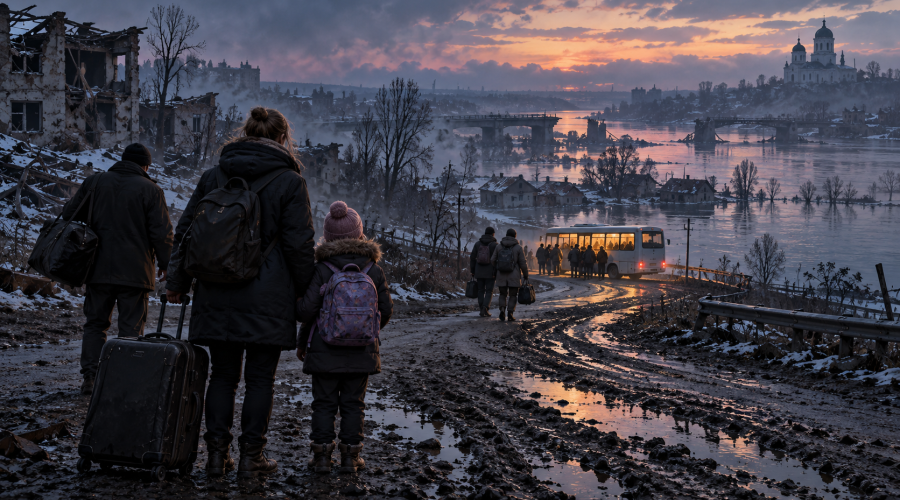
Oleshky Evacuation Plan Raises Questions Over Freedom of Movement
Usagevpn.com – A humanitarian operation planned for the Russian-occupied town of Oleshky has offered a rare opening for civilians trapped by war, while also prompting serious concern about where evacuees may be taken and whether they will be able to travel freely afterwards.
The proposed mission in southern Ukraine’s Kherson region involves a temporary ceasefire, the delivery of essential relief supplies and preparations for civilians who decide to leave. Its arrangement included the involvement of US First Lady Melania Trump. Yet uncertainty over the transport route has become central to the operation, as people departing Oleshky could reportedly be bused first through Russian-controlled territory.
Possible initial destinations include occupied Crimea or Russia itself. That prospect has revived fears that an evacuation intended to protect civilians could expose them to the risk of forced displacement, particularly if residents have little practical ability to refuse the route or choose where they ultimately go.
A fragile pause in fighting
The ceasefire began on Tuesday and is scheduled to remain in place until 1 November. On Wednesday, Ukrainian Human Rights Ombudsman Dmytro Lubinets said the first 30 hours had passed without incident.
“Without a single incident”
For the estimated 2,000 civilians still in Oleshky, the pause offers relief after prolonged deprivation. Food, medicine and other basic necessities have been in critically short supply, leaving residents dependent on a narrow and uncertain humanitarian lifeline.
The truce has also created opportunities for some Ukrainians displaced from the Kherson region to return briefly to homes and relatives in liberated areas. Such visits had become exceptionally dangerous because of continuing Russian drone strikes. Civilians have been deliberately targeted in attacks described as a “human safari,” making even short journeys across the region potentially deadly.
Why the route matters
Travel through Russia or occupied Crimea would not automatically mean that a person had been forcibly deported. The defining issue is consent: whether civilians can make a real, informed decision to leave, retain control over their destination and continue their journey without coercion or obstruction.
That distinction is especially important in a town under military occupation, where residents may have few safe alternatives and limited access to independent information. An evacuation is genuinely humanitarian only if those leaving are not compelled to go somewhere they do not wish to be and are free to move onwards.
Ukrainian officials have not publicly detailed the arrangements, pointing to the operation’s sensitivity and the precarious nature of the ceasefire. The lack of public clarity has added to concern among those watching whether evacuation transport will be accompanied by meaningful safeguards for residents.
Memories of earlier transfers
The debate is inseparable from events in 2022, when civilians fleeing Mariupol and other Russian-occupied locations on the Sea of Azov coast were moved into territory controlled by Russia. Many people then faced compulsory security procedures known as filtration, including questioning, searches and the collection of biometric information.
Human Rights Watch documented situations in which civilians did not have a meaningful alternative to travelling into Russia or Russian-held areas. Amnesty International recorded testimonies describing beatings, electric shocks and threats of execution during detention connected to filtration.
Both organisations concluded that Russia’s forced transfers of civilians were war crimes and could also amount to crimes against humanity. Those findings have made the planned Oleshky operation more than a logistical question: its credibility will rest on whether residents can leave voluntarily and retain personal agency throughout the process.
Competing claims over Oleshky
Russia has rejected allegations that Oleshky residents could be removed against their will, maintaining that any evacuation would occur with consent. Russia’s Human Rights Commissioner Yana Lantratova said residents should be able to decide both whether to depart and where they want to go.
Lantratova said the mission would bring food, medicines and hygiene products, while assisting residents who choose to leave. She also asserted that relatively few people in the town wanted evacuation.
At the same time, she described Oleshky as Russian territory and said Russian law alone applies there. Internationally, however, the town remains part of Ukraine. Moscow’s assertion of sovereignty does not alter Oleshky’s legal status under international law.
The town sits across the Dnipro River from the Ukrainian-controlled city of Kherson and has been occupied since the first phase of Russia’s full-scale invasion in February 2022.
A crisis shaped by isolation
The Institute for the Study of War has said Russian occupation authorities halted deliveries of food and other essentials in late December 2025. It stated that no food or medicine had reached Oleshky since May 2026.
The US-based think tank said Moscow had turned down Ukrainian proposals for local humanitarian pauses in May, July and September. Ukrainian forces subsequently used drones to deliver food. It has placed responsibility for the humanitarian emergency on Russian occupation authorities, citing repeated obstruction of aid deliveries and evacuation routes.
For the people who remain, the immediate concern is survival: access to food, medical care, hygiene supplies and safe passage out of a town isolated by occupation and conflict. But the longer-term test of the operation will be equally significant.
A successful mission would require the ceasefire to endure, aid to arrive and civilians to be able to make their own choices. Residents who wish to stay must not be pressured to leave, while those seeking safety must be able to reach the destination they choose without being detained, redirected or prevented from continuing their journey.
Related Reading
Frequently Asked Questions
What is Evacuation or forced deportation?
Evacuation or forced deportation is the main topic of this guide. The article explains the context, practical details, and next steps readers should understand.
Why does Evacuation or forced deportation matter?
Evacuation or forced deportation matters because readers are looking for a useful answer, not just a short summary. Good content should match search intent and help them decide what to do next.